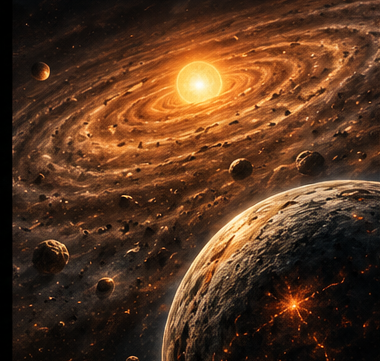
About 4.6 billion years ago, our Solar System began as a vast cloud of gas and dust left behind by earlier generations of stars. Under the influence of gravity, this cloud gradually collapsed, giving birth to the Sun and the planets that orbit it.
In the region that would become Earth, countless particles of rock and metal collided and merged over millions of years. These collisions produced larger and larger bodies, eventually forming a young planet unlike the world we know today.
Early Earth was a violent and hostile place. Its surface was covered by molten rock, while frequent impacts from asteroids and comets bombarded the young planet. Volcanoes erupted continuously, releasing gases that would eventually contribute to the formation of the atmosphere.
As the Earth slowly cooled, water vapor condensed to form oceans, creating the conditions that would later allow life to emerge. During this time, the Moon was also formed, probably as the result of a colossal collision between the young Earth and a Mars-sized object known as Theia.
Over hundreds of millions of years, continents began to form, oceans deepened, and the planet gradually became more stable. The Earth transformed from a fiery world into the remarkable blue planet that we call home.
Everything we know—mountains, oceans, forests, animals, and human beings—owes its existence to this long and extraordinary history.
In many ways, the story of Earth is also the story of the cosmos itself.
The atoms that make up our planet were forged in ancient stars, and the processes that shaped the Earth are part of the same natural laws that govern the universe.
Our world is not separate from the cosmos.
It is one of its creations.