It is comforting to have some answers, but what has always fascinated me are the questions yet to be asked—questions I will never live to hear, let alone answer.
Every generation stands on the shores of the unknown believing it has travelled far, while the greatest mysteries still lie beyond the horizon. That thought has never discouraged me. Quite the opposite. It reminds me that our journey of discovery will always remain unfinished, and perhaps that is exactly as it should be.
Throughout history, countless men and women have devoted their lives to understanding the world around them. Some became famous. Many remained unknown. Each inherited knowledge from those who came before and added something of their own before passing it on to the next generation.
None of us begins at the beginning.
Every idea has a history.
Every discovery has a foundation.
Every generation sees a little farther because someone before them asked a difficult question.
Science has taught us many remarkable things, but perhaps its greatest lesson is humility. It encourages us to question, to test our ideas and, when the evidence demands it, to change our minds. Admitting that we were wrong is not a defeat. It is often the first step towards a deeper understanding.
The reflections collected here are not offered as final answers. They are simply thoughts that have accompanied me throughout my life. Some begin with a childhood memory. Others with an encounter, a telescope, a book or an idea. Occasionally they bring into the conversation some of the remarkable people who have helped humanity understand the Universe a little better.
I do not expect everyone to agree with every reflection.
That is not their purpose.
If they encourage someone to pause, to ask another question or to see an old idea from a different perspective, then they have already served their purpose.
After all, science is not a monument to certainty.
It is a celebration of curiosity.
Stay Curious. Never Stop Exploring.
The Questions Yet to Be Asked
People sometimes ask whether it frustrates me not to know the answer to a question.
The truth is quite the opposite.
I have never been afraid of not knowing.
What has always fascinated me are the questions that have not yet been asked.
Throughout history, every generation has believed it was approaching a complete understanding of the world. Yet each discovery has revealed new mysteries waiting beyond the horizon. The more we learn, the more we realise how much remains unknown.
There is something wonderfully humbling about that thought.
Somewhere, perhaps hundreds or even thousands of years from now, a child will ask a question that has never before entered the human mind. That question may open an entirely new way of understanding the Universe, just as Newton, Einstein or Vera Rubin once changed the way their generations understood reality.
I will never hear that question.
I will never know its answer.
And strangely enough, that does not make me sad.
It fills me with hope.
It means that humanity’s greatest discoveries are not behind us. They are still waiting.
Science is sometimes described as a search for answers.
I see it differently.
Science is a search for better questions.
Every answer becomes the foundation upon which another question is built. In that sense, knowledge is never complete. It is simply passed from one generation to the next, each leaving behind a slightly clearer picture of the Universe than the one it inherited.
Perhaps that is our greatest responsibility.
Not to know everything.
But to leave those who come after us with better questions than the ones we inherited.
When I think about the future, I do not wonder whether humanity will find all the answers.
I wonder what beautiful questions are still waiting to be asked.
The Table Around Me
One of my earliest memories is not of the stars, but of a world map.
As a child, I could spend hours sitting beside it, letting my imagination wander far beyond the walls of our home. I travelled across mountains I had never seen, crossed oceans I had never sailed and visited countries I knew only by their names. Long before I travelled the world, I had already explored it in my imagination.
That simple map taught me something I did not fully understand at the time.
The world was far larger than my own small corner of it.
Years passed, and my curiosity continued to grow.
Gradually, the world itself no longer seemed large enough.
Without ever planning it, I replaced that familiar table in my imagination with another one.
This time it was not rectangular.
It was perfectly circular.
There was a large opening in its centre, and that was where I sat, able to turn slowly in every direction.
Around me lay the Universe.
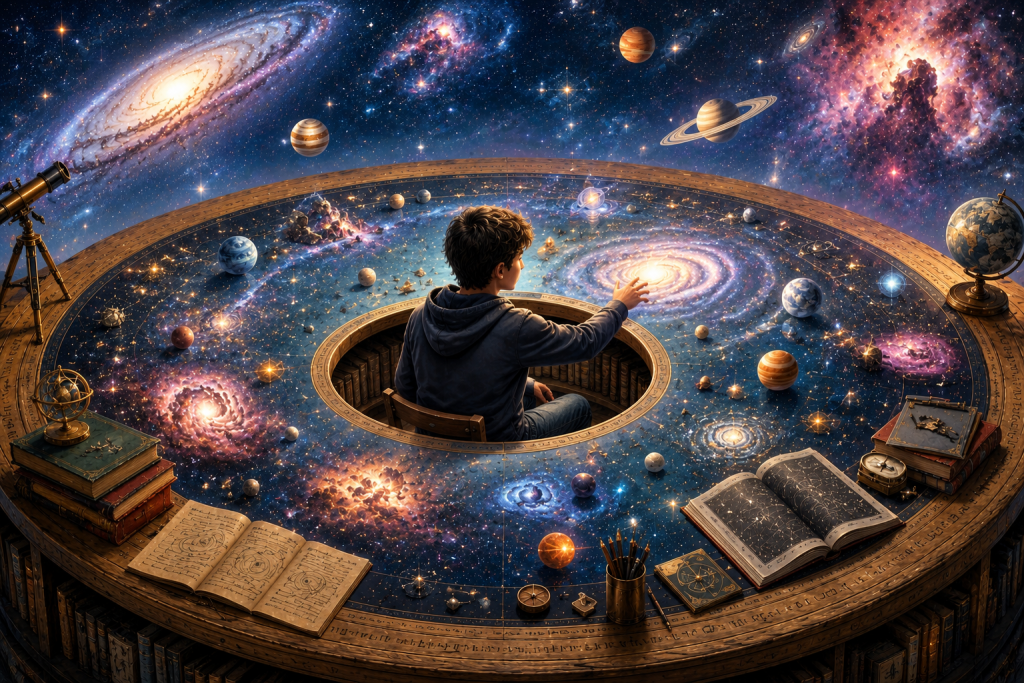
At that table I could travel wherever my imagination wished.
I moved galaxies from one place to another, gathered stars into new constellations and shifted black holes across the cosmos without worrying whether such things were possible. In that small universe, nothing was fixed except one thing—my curiosity.
I did not know the names of most of the objects surrounding me. I understood very little about gravity, galaxies or the lives of stars. None of that mattered.
What mattered was the freedom to wonder.
Looking back, I realise that this imaginary table became my first observatory.
Not because it contained scientific instruments, but because it encouraged me to ask questions.
Many years later I would learn that the Universe does not bend to our imagination. Galaxies follow the laws of physics, stars are born and die according to nature’s own rules, and black holes cannot simply be moved from one place to another.
Yet I have never regretted those imaginary journeys.
They taught me something that no textbook could have taught.
Before we understand the Universe, we must first allow ourselves to imagine it.
Even today, whenever I read about a newly discovered galaxy, a distant exoplanet or an unexpected idea in cosmology, I sometimes find myself returning to that circular table.
The Universe has become far larger than I ever imagined as a child.
But the feeling has never changed.
Somewhere inside me, that curious boy is still quietly turning his chair, looking in every direction and wondering what might be discovered next.
Conversations With Myself
For as long as I can remember, I have never thought alone.
Whenever I am faced with an important question, I imagine another version of myself sitting across the table.
Then the discussion begins.
Sometimes it is calm.
Sometimes it becomes surprisingly heated.
We disagree.
We interrupt one another.
We challenge assumptions.
Neither of us is easily convinced.
One of us argues with conviction, while the other quietly asks,
“How do you know?”
That simple question has accompanied me throughout my life.
It has saved me from accepting easy answers and reminded me that confidence is not the same as certainty.
Eventually, one argument becomes stronger than the other.
Not because one voice wins, but because the evidence is better.
At that moment, the discussion ends.
Not with victory.
With understanding.
Those conversations have taught me something that I value deeply.
Our opinions are not part of our identity.
They are simply our best understanding at a particular moment in time.
When new evidence appears, we should not be afraid to let our ideas evolve with it.
Science has progressed for centuries because countless men and women have been willing to abandon old beliefs in favour of better explanations.
I have always tried to do the same.
Changing one’s mind is not a weakness.
It is often a sign that we have learned something new.
Perhaps the most honest conversation we will ever have is not with another person.
It is with ourselves.
Why We Share Knowledge
People sometimes ask me why I continue to give lectures, write books and spend so much time talking about astronomy.
The answer has always seemed obvious to me.
Knowledge becomes truly valuable only when it is shared.
Over the years, I have often encouraged students to learn together. I suggest that a small group of friends each choose a different subject to study. They spend a few days reading, thinking and trying to understand their chosen topic. Then they meet again, and each person explains what they have learned to the others.
Something remarkable happens during that process.
Before we explain an idea, it still belongs largely to the books we have read or the teachers we have listened to.
But the moment we understand it well enough to explain it in our own words, something changes.
It becomes part of us.
We are no longer repeating someone else’s knowledge.
We have made it our own.
I believe that is one of the most powerful ways to learn. By teaching others, we deepen our own understanding. We discover what we know, what we do not yet understand and which questions still need answers.
Knowledge shared in this way is rarely forgotten.
It stays with us for the rest of our lives.
Perhaps that is why the greatest teachers have never been those who simply gave answers.
They inspired questions.
They encouraged curiosity.
They helped others discover ideas for themselves.
Throughout history, knowledge has travelled from one generation to the next because people chose to share it freely. Teachers passed it to their students. Scientists published their discoveries. Writers filled books with ideas they knew they would never live to see fully explored.
Each generation inherited a little more than the one before it.
I have always believed that we have a responsibility to do the same.
Not because we expect recognition.
Not because we believe we possess all the answers.
But because somewhere, someone may discover a new passion simply because another person took the time to share what they knew.
Some of the happiest moments of my life have not come from explaining astronomy.
They have come from watching curiosity awaken in someone else.
A child seeing the craters of the Moon for the first time.
A student suddenly understanding why the stars shine.
A visitor leaving a lecture with more questions than they had when they arrived.
Those moments remind me that knowledge is unlike almost anything else we possess.
When we share it, we do not lose it.
It grows.
Perhaps that is why humanity has come so far.
Every generation has inherited a library it did not write and a Universe it did not discover.
Our responsibility is not simply to admire that inheritance.
It is to understand it, enrich it where we can, and pass it on to those who follow us.
If, somewhere along the way, we inspire another curious mind to ask a new question, then we have added our own small page to the never-ending story of human knowledge.
Standing on the Shoulders of Giants
Every time we learn something new, we are building upon the work of countless people who came before us.
Whether we realise it or not, every book we read, every lecture we attend and every scientific discovery we admire rests upon foundations laid by earlier generations.
None of us begins with an empty page.
We inherit languages, ideas, mathematics, science and centuries of accumulated knowledge. Every generation receives this remarkable inheritance, adds something of its own and quietly passes it on.
The history of science is often told through the lives of great individuals. We remember the names of Newton, Faraday, Maxwell, Einstein and many others because they changed our understanding of the Universe.
Yet none of them truly worked alone.
Some, like Michael Faraday, spent their lives in laboratories. Others, like Albert Einstein, worked largely through thought experiments rather than scientific instruments. Yet even Einstein did not begin with an empty page. Before questioning the accepted view of space and time, he immersed himself in the knowledge that generations of scientists had built before him. He studied it carefully, questioned its assumptions and then dared to think beyond it.
That is how science advances.
Every great discovery begins by understanding what is already known before asking whether there is another way to see the world.
Newton himself famously wrote that if he had seen farther, it was because he stood on the shoulders of giants.
He was reminding us that every discovery has a history.
Every new idea grows from older ideas.
Knowledge is not built by isolated individuals.
It is built by humanity, one generation at a time.
That thought has always filled me with humility.
Whatever we know today will one day become the starting point for someone else.
Perhaps a child reading a book today will solve a mystery that has puzzled scientists for centuries.
Perhaps one of the questions we cannot answer today will seem obvious to future generations.
That is how knowledge grows.
It is a journey rather than a destination.
Looking back across history, I do not see a collection of isolated discoveries.
I see an unbroken chain of curious minds reaching across thousands of years.
Each generation receives a small flame from those who came before.
Each protects it, adds a little more light, and passes it on to the next.
That, perhaps, is one of humanity’s greatest achievements.
Not that we know so much.
But that we have learned how to learn together.
Every one of us has inherited that flame.
What we do with it is our contribution to those who will one day follow us.
The Courage to Change Our Minds
One of the greatest lessons science has taught me is that there is no shame in saying,
“I don’t know.”
There is even greater courage in saying,
“I was wrong.”
Throughout history, many of the men and women who transformed our understanding of the Universe did so because they were willing to question accepted ideas. More importantly, they were willing to question their own.
Isaac Newton gave us a mathematical description of gravity that changed science forever. Yet he openly admitted that he did not know what gravity actually was. Rather than invent an explanation without evidence, he left that question to future generations.
Albert Einstein spent years believing, as almost everyone else did, that the Universe was static. To make his equations fit that picture, he introduced the cosmological constant. But when observations and the work of astronomers such as Edwin Hubble and Georges Lemaître showed that the Universe was expanding, Einstein accepted that the evidence pointed in another direction. His reputation did not prevent him from changing his mind.
Georges Lemaître offers another remarkable example. Although he was a Catholic priest, he insisted that science and religion should not be confused. When Pope Pius XII suggested that the expanding Universe supported Christian doctrine, Lemaître respectfully urged him not to use science to defend religion. Scientific ideas, he believed, must stand or fall on scientific evidence alone.
Vera Rubin trusted her observations even when they challenged accepted ideas about galaxies. Subrahmanyan Chandrasekhar followed mathematics where it led, despite strong opposition from some of the most respected astronomers of his time.
These people did not become great because they were always right.
They became great because they were honest enough to follow the evidence wherever it led.
That, perhaps, is one of the noblest qualities of science.
The Universe has no obligation to agree with our opinions, our beliefs or our expectations.
It simply is.
Our task is not to persuade the Universe that we are right.
Our task is to understand it.
Perhaps that is why I have spent so many evenings arguing with myself across the kitchen table. If I cannot convince my own most stubborn critic, I have no reason to expect anyone else to be convinced. The evidence must always have the final word.
There should be no prestige in being right.
There should be no embarrassment in being wrong.
There is only the responsibility to follow the evidence with honesty, humility and an open mind.
Every time we are willing to change our minds in the light of new understanding, we take one small step closer to the truth.
And perhaps that is one of the greatest adventures of all.
The Ones We Never Knew
When we tell the history of science, we celebrate remarkable people.
We remember Galileo, Newton, Einstein, Curie, Rubin, Hawking and countless others whose discoveries changed our understanding of the Universe.
Their names fill our books.
Their portraits hang in museums.
Their ideas continue to inspire new generations.
And rightly so.
But sometimes my thoughts wander elsewhere.
I find myself thinking about the people whose names we will never know.
The child who looked up at the stars but never had a telescope.
The girl who loved mathematics but was never given the opportunity to study.
The young boy whose questions slowly disappeared because no one had the time to listen.
The curious mind that spent a lifetime earning a living while quietly wondering how the Universe worked.
History remembers the discoveries.
It rarely remembers the opportunities that never came.
Curiosity is born everywhere.
Opportunity is not.
That thought has stayed with me throughout my life.
Perhaps that is why I have always believed that knowledge should be shared freely, that encouragement matters, and that taking the time to listen may change the direction of someone’s life.
Richard Feynman once suggested that when a child drops a cup of coffee, our first reaction should not be anger. Instead of asking, “Who made this mess?”, perhaps we should ask, “What just happened?” In that single moment lie gravity, motion, the behaviour of liquids, broken ceramics and a child’s natural curiosity. What appears to be an accident can become the beginning of understanding.
How many questions disappear because our first response is criticism instead of curiosity?
Every child is born asking questions.
Our responsibility is to make sure they never become afraid of asking the next one.
Sometimes the person who asks an unusual question is dismissed as unrealistic, unconventional or even foolish. History reminds us to be careful before doing so. Not every unusual idea is correct, but every worthwhile idea deserves the chance to be heard, examined honestly and tested against the evidence.
We will never know how many remarkable minds the world has lost through poverty, circumstance, prejudice or simply because no one stopped long enough to listen.
Those are the names history never had the chance to record.
The ones we never knew.
Whenever I meet a curious child, I remind myself that I am not looking at a future astronomer or physicist.
I am looking at a human being whose curiosity deserves encouragement.
Whether that child one day becomes a scientist, a teacher, an artist, a carpenter or something entirely different is not the most important thing.
The important thing is that their curiosity survives.
Perhaps the greatest gift we can offer another human being is not an answer.
It is encouragement.
A listening ear.
A few words that simply say,
“Tell me what you are thinking.”
We may never know where that conversation will lead.
But I have a feeling that humanity has lost far too many discoveries because someone, somewhere, was discouraged from asking one more question.
The Universe Belongs to All of Us
The more I have learned about the Universe, the less I have become interested in having all the answers.
Instead, I have become more interested in asking better questions.
Knowledge has given humanity extraordinary power.
We have learned to understand the lives of stars, to measure the age of the Universe, to walk on the Moon and to look billions of years into the past. Every generation has added another chapter to humanity’s story.
Yet every new discovery quietly asks another question.
How will we use what we have learned?
Knowledge, by itself, is neither good nor bad.
Its value depends entirely on how we choose to use it.
Will it help us understand one another?
Will it improve human life?
Will it protect the fragile planet that has given us life?
Will it leave a better world for those who come after us?
Those questions matter just as much as the discoveries themselves.
Throughout history, curiosity has appeared in every corner of the world.
It has never belonged to one nation, one culture, one religion or one gender.
The night sky does not recognise borders.
Gravity does not care about nationality.
Light does not ask what language we speak.
The Universe welcomes every curious mind in exactly the same way.
Curiosity is one of humanity’s greatest gifts.
It deserves to be encouraged wherever it appears.
In every child.
In every young woman whose dreams are too often overlooked.
In every young man searching for his place in the world.
In every person who dares to ask a question that others have not yet considered.
Humanity cannot afford to leave curiosity in the shadows.
Every curious mind we discourage is a possibility we may lose forever.
The greatest discoveries of tomorrow may never come from the places we expect.
They may begin with a child who is listened to instead of dismissed.
With a teacher who chooses encouragement instead of criticism.
With a parent who answers another question with,
“Let’s find out together.”
Perhaps that is the greatest lesson science has taught me.
Not that we know so much.
But that there is still so much to learn.
And that every human being deserves the opportunity to take part in that journey.
If these reflections leave the reader with anything, I hope it is not a collection of answers.
I hope they leave with a little more curiosity.
A little more humility.
A little more kindness.
And a greater willingness to listen.
The Universe does indeed belong to all of us.
Our responsibility is to make sure that the opportunity to explore it does as well.