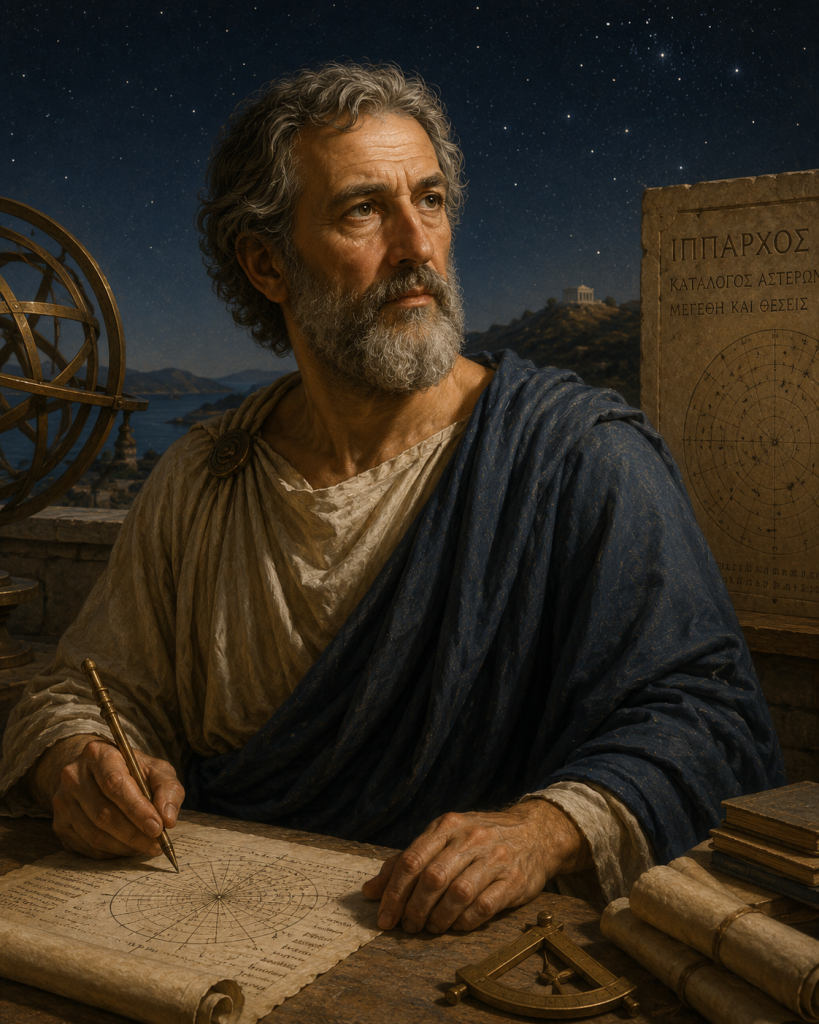
No reliable contemporary portrait of Aristarchus of Samos has survived. This illustration is a modern artist’s interpretation based on the appearance and clothing of Greek scholars of the Hellenistic period.
Few astronomers have transformed careful observation into scientific discovery as profoundly as Hipparchus. While others imagined the structure of the Universe, Hipparchus devoted his life to measuring it with remarkable precision. His work laid the foundations of scientific astronomy and established observation as one of the most important tools of scientific inquiry.
Hipparchus was born around 190 BC, probably in the Greek city of Nicaea in Asia Minor, and later carried out much of his work on the island of Rhodes. Living during the Hellenistic period, he inherited centuries of Greek mathematical knowledge while adding discoveries that would influence astronomy for nearly two thousand years.
Unlike many philosophers of his age, Hipparchus believed that understanding the heavens required more than ideas—it required accurate measurements. Night after night, he carefully observed the stars, the Sun and the Moon, recording their positions with extraordinary precision. His dedication marked a turning point in astronomy, transforming it from philosophical speculation into a science based upon observation.
One of his greatest achievements was the creation of the first comprehensive star catalogue. Hipparchus measured the positions of approximately 850 stars and classified them according to their brightness. His system of stellar magnitudes became the foundation of the brightness scale that astronomers, with later refinements, still use today.
His most remarkable discovery came almost by accident. By comparing his own observations with records made by earlier astronomers, Hipparchus realized that the positions of the stars slowly changed over time. He had discovered the precession of the equinoxes—the slow wobble of Earth’s rotational axis that causes the celestial poles and equinoxes to shift gradually over thousands of years. It remains one of the greatest astronomical discoveries of antiquity.
Hipparchus also made important advances in mathematics. He developed early forms of trigonometry that enabled astronomers to calculate distances and angles with increasing accuracy. These methods became indispensable for later astronomers and eventually formed part of the mathematical foundations of astronomy, navigation and engineering.
He devoted considerable effort to understanding the motions of the Sun and Moon and developed improved methods for predicting eclipses. His careful observations made astronomical calculations more reliable than ever before and demonstrated the power of combining mathematics with precise measurement.
Although many of Hipparchus’ original writings have been lost, his discoveries survived through later scholars, especially Claudius Ptolemy, who relied extensively upon Hipparchus’ observations in compiling the Almagest. In this way, his work continued to shape astronomy long after his own lifetime.
Hipparchus reminds us that science advances not only through bold new ideas but also through patient observation and meticulous measurement. Great discoveries often depend upon the willingness to collect accurate data, compare results and allow evidence to guide conclusions.
Today, every astronomical catalogue, every modern observatory and every spacecraft that maps the stars follows a tradition that Hipparchus helped establish more than two thousand years ago.
His legacy is a reminder that before we can understand the Universe, we must first learn to measure it.
Legacy
Hipparchus transformed astronomy into a science of careful observation and precise measurement. His star catalogue, stellar magnitude system, discovery of the precession of the equinoxes and contributions to trigonometry established standards that influenced astronomy for nearly two thousand years.
What We Can Learn
- Careful observation is the foundation of scientific discovery.
- Accurate measurements often reveal truths that cannot be seen otherwise.
- Patience and precision are as important as imagination.
- Mathematics gives meaning to observation.
- Lasting progress is built upon reliable evidence.