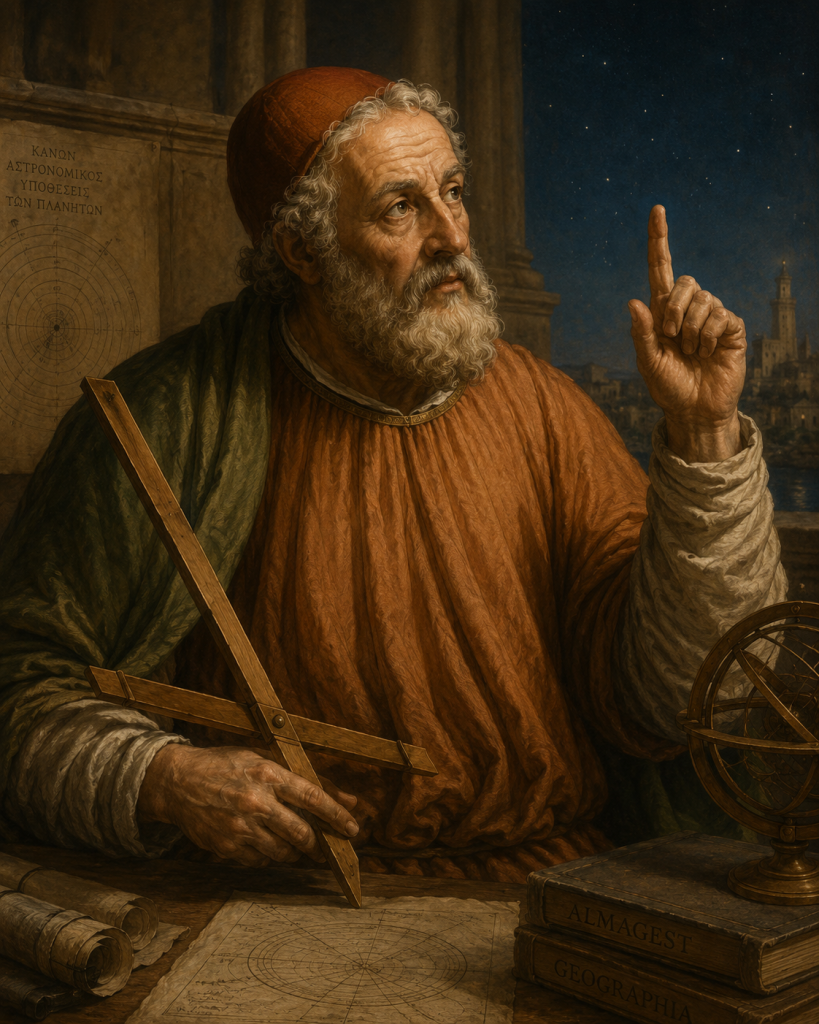
No reliable contemporary portrait of Claudius Ptolemy has survived. This illustration is a modern artist’s interpretation based on the appearance and clothing of scholars in Roman Alexandria.
Few scholars have influenced humanity’s understanding of the Universe for as long as Claudius Ptolemy. Although many of his conclusions were later replaced by new discoveries, his remarkable ability to gather, organize and explain centuries of astronomical knowledge shaped scientific thought for nearly fifteen hundred years. His work became one of the greatest intellectual achievements of the ancient world.
Claudius Ptolemy lived in Alexandria, Egypt, during the second century AD, when the city remained one of the world’s greatest centres of learning. Building upon the observations of earlier astronomers, particularly Hipparchus, he devoted himself to creating a complete mathematical description of the heavens.
Ptolemy understood that science advances by building upon the work of those who came before. Rather than beginning from nothing, he carefully examined existing observations, compared different ideas and combined them into a comprehensive model of the Universe. His greatest strength was not simply making new discoveries but bringing together the accumulated knowledge of generations into a coherent system.
His most famous work, the Almagest, became the standard reference for astronomy for more than a thousand years. In this remarkable book, Ptolemy described the movements of the Sun, Moon, planets and stars with extraordinary mathematical detail. Drawing heavily upon the precise observations of Hipparchus, he created tables that allowed astronomers to predict celestial motions with impressive accuracy.
At the heart of his model lay the belief that the Earth stood motionless at the centre of the Universe while the Sun, Moon, planets and stars revolved around it. To explain the complex motions of the planets, he introduced an intricate system of circles upon circles, known as epicycles. Although this geocentric model was ultimately incorrect, it represented the most sophisticated explanation available in its time and successfully predicted planetary positions for centuries.
Ptolemy’s interests extended far beyond astronomy. He wrote important works on geography, mathematics and optics. His book Geographia provided one of the first systematic attempts to map the known world using latitude and longitude, laying foundations that influenced cartography for generations.
For more than fifteen centuries, scholars across Europe, the Middle East and North Africa studied the Almagest. Medieval Islamic astronomers translated, preserved and carefully examined his work, often improving its accuracy while recognising its limitations. Later, European scholars inherited this rich tradition, eventually leading to the revolutionary work of Nicolaus Copernicus.
History sometimes remembers Ptolemy because his model of the Universe was eventually replaced. Yet this should never diminish his achievement. Science does not progress by leaping directly to perfect answers. It advances step by step, with each generation building upon the work of those before it. Ptolemy created the most complete astronomical system of antiquity, and without his careful work, later astronomers would have had a far weaker foundation from which to begin.
His life reminds us that even ideas that are later revised can play an essential role in human progress. Every scientific model is part of an ongoing journey toward a deeper understanding of nature.
The story of Ptolemy is therefore not one of failure but of remarkable intellectual achievement. He demonstrated that knowledge grows through observation, mathematics and the willingness of each generation to improve upon what it has inherited.
Legacy
Claudius Ptolemy created the most influential astronomical system of the ancient world. His Almagest guided astronomers for nearly fifteen centuries and preserved the observational work of earlier scholars, especially Hipparchus. His contributions to geography, optics and mathematics also left a lasting mark on the history of science.
What We Can Learn
- Great science builds upon the work of earlier generations.
- Even imperfect models can move knowledge forward.
- Careful organisation of existing knowledge is itself a major scientific achievement.
- Every scientific theory should remain open to improvement.
- Progress is made by continually questioning, testing and refining our understanding of nature.