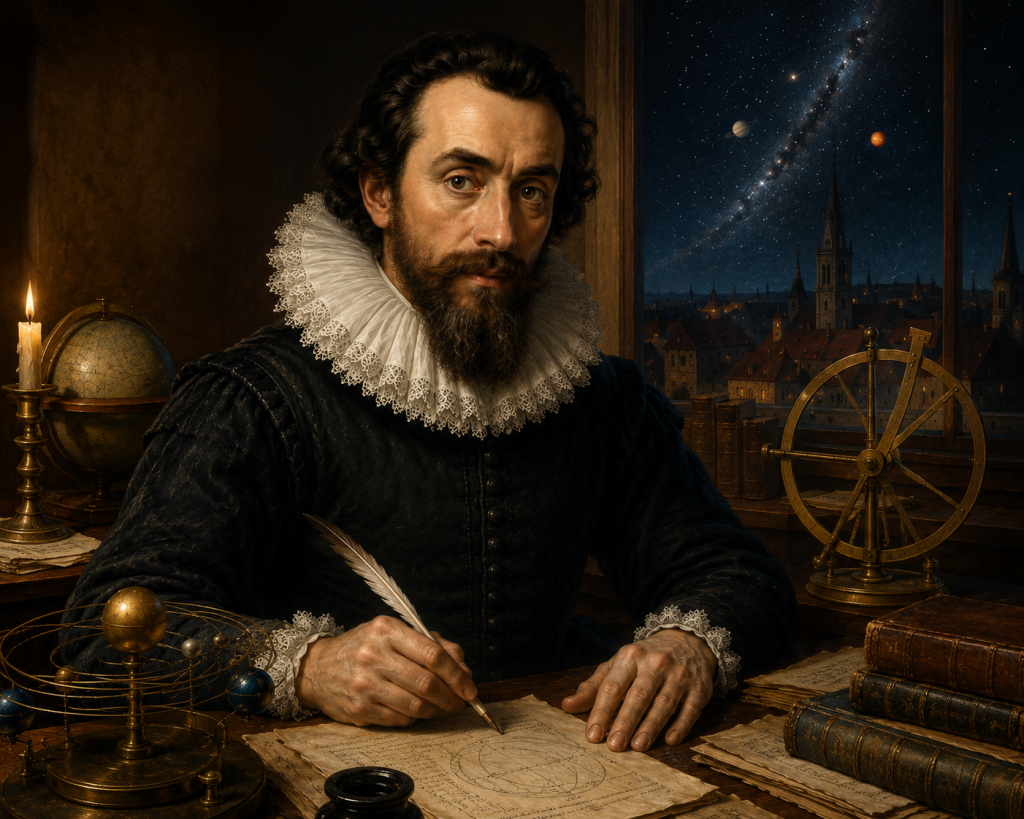
The planets do not move in perfect circles. Today that seems like a simple scientific fact, but discovering it required years of patient work, extraordinary mathematical insight and the courage to question one of the oldest assumptions in astronomy. The man who made that discovery was Johannes Kepler.
Johannes Kepler was born in 1571 in the German town of Weil der Stadt. From an early age, he showed an exceptional talent for mathematics and a deep fascination with the heavens. He believed that the Universe was governed by harmony and that mathematics was the language through which God had written the laws of nature.
Kepler’s life, however, was far from easy. His father abandoned the family while he was still a child, and throughout his life he struggled with poverty, religious conflict and personal tragedy. Several of his children died at a young age, and his first wife passed away after a long illness. Perhaps the greatest challenge came when his mother, Katharina, was accused of witchcraft. At a time when such accusations often led to execution, Kepler devoted years to preparing her legal defence and ultimately succeeded in saving her life.
Despite these hardships, he never abandoned his search for the mathematical order of the Universe.
In 1600, Kepler travelled to Prague to work with the great Danish astronomer Tycho Brahe. Tycho had spent decades making the most accurate observations of the heavens ever achieved before the invention of the telescope. Although initially reluctant to share his life’s work, Tycho recognised Kepler’s extraordinary mathematical ability and entrusted him with the difficult problem of analysing the orbit of Mars.
After Tycho’s death, Kepler gained access to the complete observational record. For years he struggled to make Mars fit the accepted belief that planets moved in perfect circles. The observations refused to agree.
Instead of questioning the measurements, Kepler questioned the theory.
That decision changed astronomy forever.
He discovered that planets travel in elliptical orbits, with the Sun located at one focus of the ellipse. From this breakthrough he developed his three laws of planetary motion, describing how planets move around the Sun with remarkable mathematical precision.
Kepler’s discoveries provided the first accurate description of the Solar System. More importantly, they demonstrated that nature follows simple mathematical laws that can be discovered through careful observation and logical reasoning.
His work transformed Copernicus’ heliocentric idea into a scientific model that accurately described reality. A generation later, Isaac Newton would build upon Kepler’s laws to develop the universal law of gravitation, explaining why the planets move as they do.
Kepler also made important contributions to optics, improving the design of telescopes and helping to establish modern observational astronomy. His curiosity extended beyond astronomy into mathematics, geometry and the study of light, reflecting the broad intellectual spirit of the Scientific Revolution.
Johannes Kepler reminds us that scientific progress often requires the courage to abandon even our most cherished assumptions when the evidence points elsewhere. He did not force nature to fit his expectations. Instead, he allowed nature to reveal its own truth.
His life is a powerful reminder that even in the face of hardship, loss and uncertainty, curiosity and perseverance can illuminate the deepest mysteries of the Universe.
Legacy
Johannes Kepler discovered the three laws of planetary motion, revealing that planets move in elliptical orbits according to precise mathematical relationships. His work transformed Copernicus’ revolutionary idea into a predictive scientific theory and provided the essential foundation upon which Isaac Newton built the law of universal gravitation.
What We Can Learn
- Evidence is more important than long-held assumptions.
- Great discoveries often require patience and perseverance.
- Mathematics is one of humanity’s most powerful tools for understanding nature.
- Personal hardship does not prevent extraordinary achievement.
- Science advances when we are willing to let evidence change our minds.