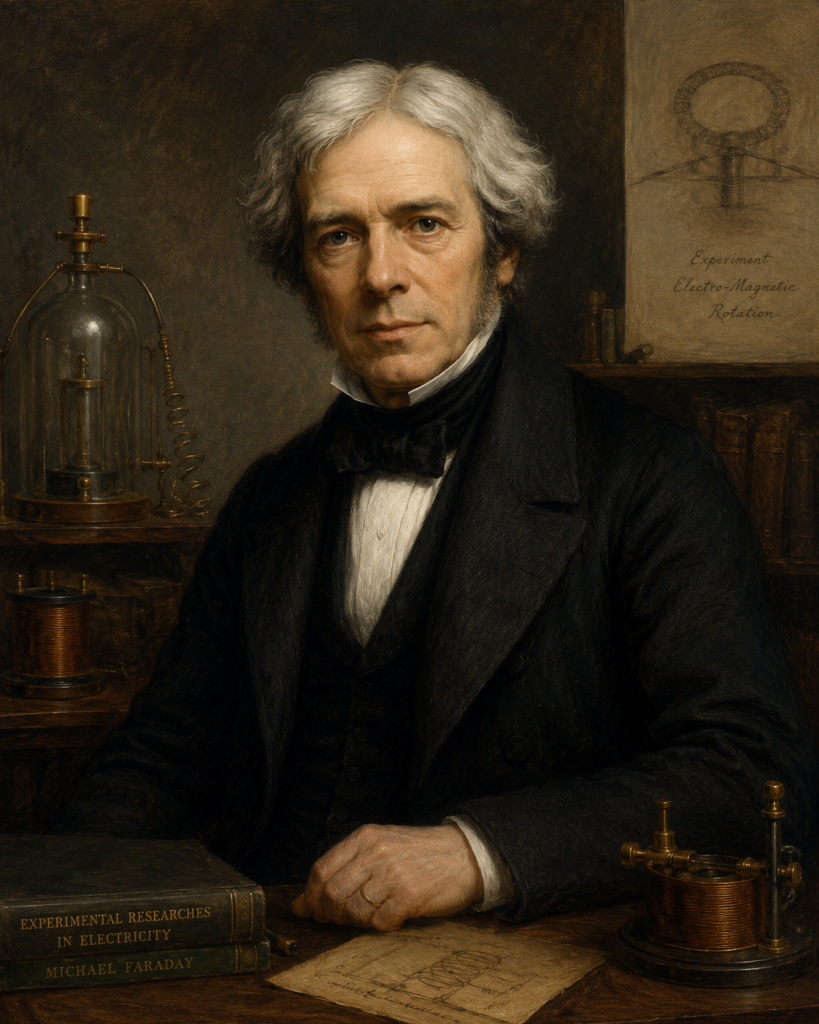
A young bookbinder’s apprentice spent his days binding books written by great scientists. In the evenings he read them. That apprentice would grow up to change the world forever. His name was Michael Faraday.
Michael Faraday was born in 1791 in London to a poor family. His father was a blacksmith, and opportunities for education were limited. At the age of fourteen he began working as an apprentice to a bookbinder. Surrounded by books every day, Faraday developed an insatiable curiosity. He carefully read the scientific works that passed through his hands and taught himself chemistry, physics and electricity.
His life changed when he attended a series of public lectures given by the famous chemist Sir Humphry Davy at the Royal Institution. Faraday took detailed notes, carefully bound them into a beautiful volume and sent them to Davy together with a letter asking for employment. Impressed by both his enthusiasm and his determination, Davy hired the young apprentice as his laboratory assistant.
It was the beginning of one of the greatest scientific careers in history.
Faraday possessed an extraordinary gift for experimental science. While many scientists relied primarily on mathematics, Faraday relied on careful observation, imagination and ingenious experiments. His laboratory became the place where invisible forces revealed their secrets.
In 1831 he discovered electromagnetic induction, demonstrating that a changing magnetic field can produce an electric current. This single discovery made it possible to generate electricity on a large scale and became the foundation of modern power stations, electric motors and electrical engineering. Every time we switch on a light, charge a phone or use electricity in our homes, we are benefiting from Faraday’s work.
Faraday also introduced the concept of fields—the idea that invisible electric and magnetic forces fill the space around us. At first many scientists found this difficult to understand. Later, James Clerk Maxwell transformed Faraday’s intuitive ideas into mathematical equations, revealing that electricity, magnetism and light are all aspects of the same physical phenomenon.
Faraday’s discoveries changed not only science but also everyday life. His work laid the foundations for the electrical age that powers the modern world.
Despite becoming one of the most respected scientists of his century, Faraday remained remarkably humble. He declined the offer of a knighthood and preferred to be remembered simply as Michael Faraday. His kindness, modesty and generosity earned him the admiration of colleagues and students alike.
When asked about the practical value of electricity, Faraday is said to have replied:
“One day, sir, you may tax it.”
Whether the story is entirely accurate or not, it captures his remarkable ability to see the future long before others did.
Michael Faraday reminds us that curiosity, determination and a love of learning can overcome almost any obstacle. Without a university education, armed only with patience, imagination and relentless experimentation, he helped create the electrical world in which we live today.
Legacy
Michael Faraday transformed our understanding of electricity and magnetism. His discovery of electromagnetic induction made electric generators and motors possible, laying the foundation for the modern electrical age. His concept of fields also inspired James Clerk Maxwell to develop one of the greatest theories in the history of physics.
What We Can Learn
Curiosity and determination matter more than privilege.
Great discoveries often begin with a simple question.
Careful experiments can reveal the hidden laws of nature.
Humility and greatness can exist together.
Never stop learning, regardless of where you begin in life.