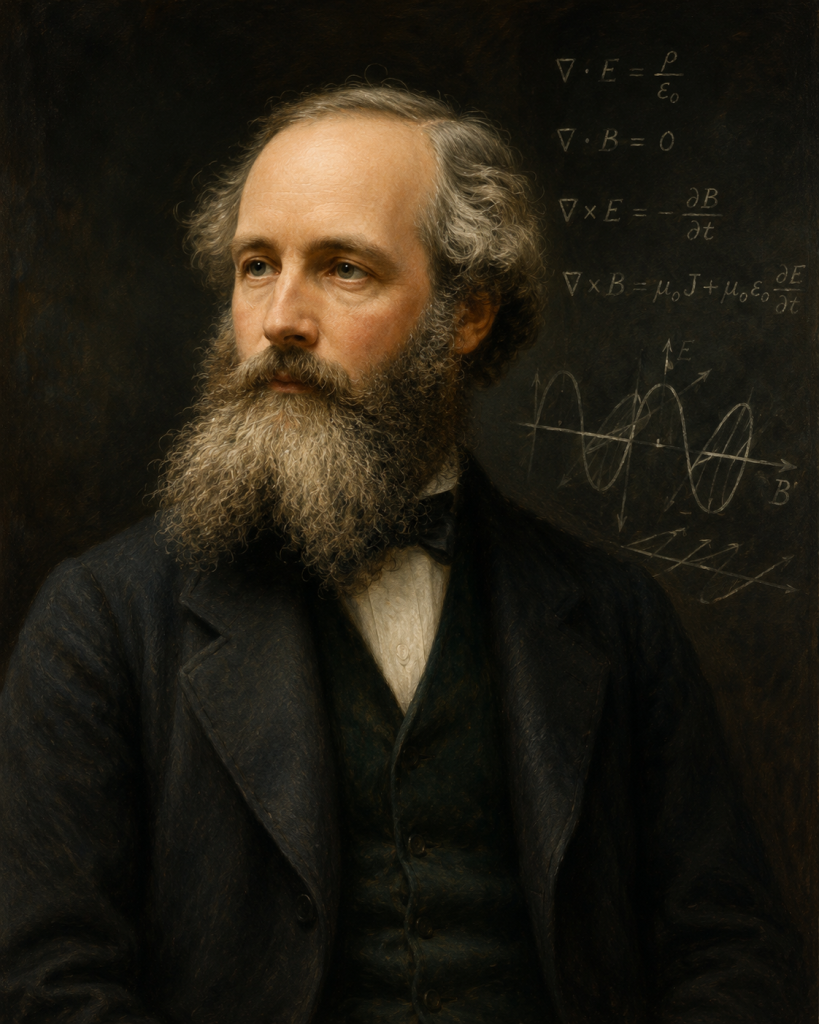
Every radio signal, every mobile phone call and every beam of light travelling across the Universe follows laws first brought together by James Clerk Maxwell. Yet few people know the name of the quiet Scottish physicist who revealed that electricity, magnetism and light are all part of the same phenomenon.
James Clerk Maxwell was born in Edinburgh, Scotland, in 1831. From an early age he displayed an extraordinary curiosity about nature. As a child he constantly asked how things worked, often beginning his questions with one simple word:
“Why?”
That curiosity never left him.
Unlike many of the great scientists who came before him, Maxwell enjoyed an excellent education and showed remarkable mathematical ability from an early age. Yet despite his brilliance, he remained modest, thoughtful and deeply kind. Friends and colleagues admired not only his intellect but also his gentle personality and quiet sense of humour.
Maxwell was fascinated by the discoveries of Michael Faraday. Faraday had shown through brilliant experiments that electricity and magnetism were closely connected, but he described these invisible forces using physical intuition rather than mathematics. Maxwell recognised that Faraday’s ideas contained a deeper truth waiting to be expressed mathematically.
Using his extraordinary mathematical insight, Maxwell united all the known laws of electricity and magnetism into a single elegant theory.
His greatest revelation came when he realised that his equations described waves travelling through space at exactly the speed of light.
Light itself is an electromagnetic wave.
It was one of the greatest moments in the history of physics.
Maxwell’s Four Equations
The following four equations are often described as the most beautiful equations in physics. Together they explain how electricity and magnetism behave and reveal that light itself is an electromagnetic wave.
1. Gauss’s Law for Electricity
∇ · E = ρ / ε₀
Meaning: Electric charges create electric fields.
Every charged particle—whether an electron or a proton—produces an electric field around itself. The greater the amount of charge, the stronger the electric field it creates.
2. Gauss’s Law for Magnetism
∇ · B = 0
Meaning: There are no magnetic monopoles.
Every magnet has both a north and a south pole. If you cut a magnet in half, you do not obtain separate north and south poles—you simply create two smaller magnets. Magnetic field lines always form continuous loops.
3. Faraday’s Law of Electromagnetic Induction
∇ × E = − ∂B / ∂t
Meaning: A changing magnetic field creates an electric field.
This is the principle behind electric generators. Moving magnets generate electricity. Nearly every power station in the world operates because of this remarkable law first discovered experimentally by Michael Faraday.
4. Ampère-Maxwell Law
∇ × B = μ₀J + μ₀ε₀ (∂E / ∂t)
Meaning: Electric currents—and even changing electric fields—produce magnetic fields.
This final term, added by Maxwell himself, was the key insight that completed the theory. It showed that changing electric and magnetic fields continuously generate one another, allowing electromagnetic waves to travel through empty space.
From these four equations Maxwell made an astonishing prediction:
Light itself is an electromagnetic wave travelling through space.
Years later, Heinrich Hertz generated and detected radio waves in the laboratory, confirming Maxwell’s prediction. Today radio, television, mobile phones, Wi-Fi, radar, satellite communications and much of modern technology rely upon this extraordinary discovery.
Maxwell’s work transformed Faraday’s experimental discoveries into one of the most elegant mathematical theories ever created. It inspired generations of physicists and became one of the essential foundations upon which Albert Einstein later built the theories of Special and General Relativity.
Albert Einstein once wrote that the work of James Clerk Maxwell was “the most profound and the most fruitful that physics has experienced since the time of Newton.”
Maxwell also made important contributions to colour vision, the kinetic theory of gases and statistical physics. His curiosity extended far beyond electromagnetism, reflecting a remarkable ability to see connections between different areas of science.
James Clerk Maxwell reminds us that the deepest truths of nature are often hidden beneath seemingly unrelated phenomena. Through imagination, mathematics and careful reasoning, he revealed a profound unity in nature that continues to shape science today.
Legacy
James Clerk Maxwell united electricity, magnetism and light into a single theory, demonstrating that they are different aspects of the electromagnetic field. His work laid the foundation for modern communications, electronics and much of twentieth-century physics. Albert Einstein regarded Maxwell’s achievements as the greatest advance in physics since Isaac Newton.
What We Can Learn
Curiosity begins with asking “Why?”
Mathematics can reveal hidden patterns in nature.
Great scientific advances often unite seemingly separate ideas.
Quiet humility and extraordinary brilliance can exist together.
The deepest discoveries often reveal that nature is simpler and more beautiful than we first imagined.