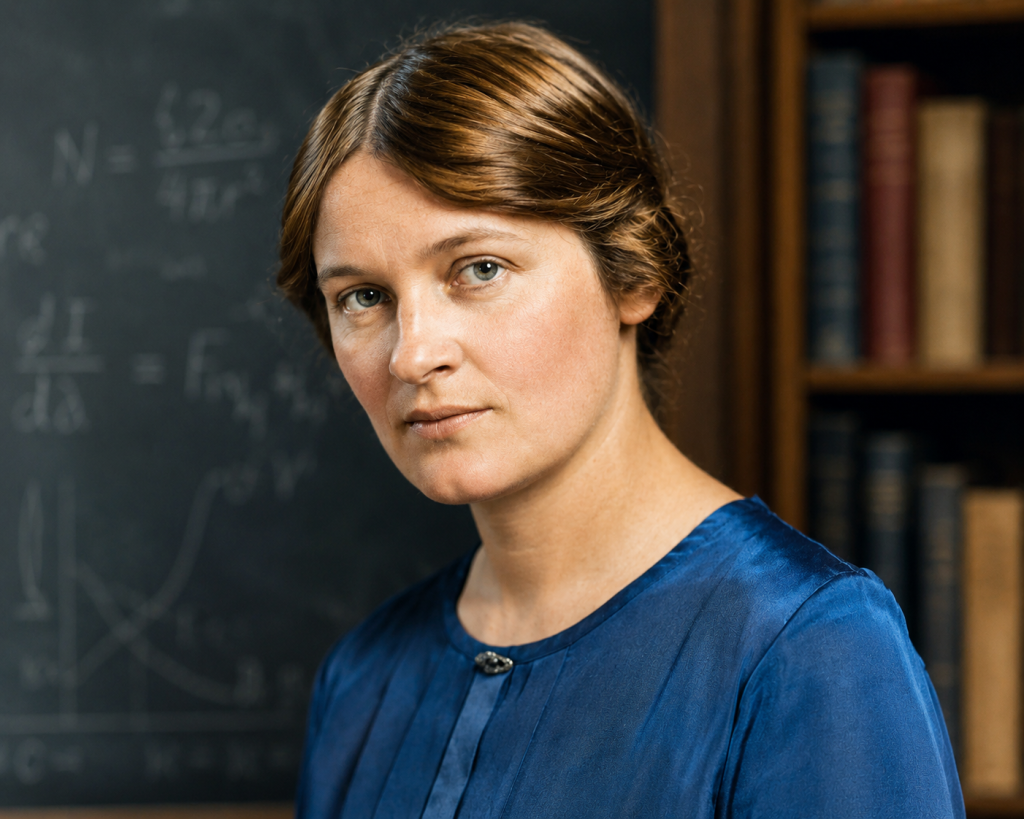
Cecilia Payne-Gaposchkin transformed astronomy by discovering what the stars are made of. At a time when few women were welcomed into scientific research, she showed that the Universe is built primarily from hydrogen and helium—a conclusion so revolutionary that even the world’s leading astronomers doubted it. History would prove that she was right.
Cecilia Payne was born in 1900 in Wendover, England. From an early age she displayed an exceptional curiosity and a love of learning. She studied at the University of Cambridge, where she attended a lecture by the astronomer Arthur Eddington describing the results of the 1919 solar eclipse that confirmed Albert Einstein’s General Theory of Relativity. The lecture inspired her to devote her life to astronomy.
Although Cambridge provided an excellent education, women were not awarded full degrees at the time. Realising that her opportunities in Britain were limited, Payne accepted a fellowship to Harvard College Observatory in the United States, where she began the research that would change astronomy forever.
Astronomers had long believed that the Sun and the Earth were made of roughly the same materials. After all, the chemical elements identified in sunlight appeared similar to those found on Earth.
Payne questioned this assumption.
Using the newly developed science of stellar spectroscopy together with the work of the Indian physicist Meghnad Saha, she carefully analysed the spectra of stars. She realised that the strength of spectral lines depended not only on the amount of each element but also on the temperature inside the star.
Her conclusion was astonishing.
The Sun and the stars are composed overwhelmingly of hydrogen, with helium as the second most abundant element. All the heavier elements—including those that make up the Earth and ourselves—exist only in relatively tiny amounts.
This completely changed humanity’s understanding of the stars.
When Payne submitted her doctoral dissertation in 1925, the result seemed so unbelievable that the distinguished astronomer Henry Norris Russell persuaded her to describe her conclusion as probably incorrect.
Several years later, Russell carried out his own investigation and reached exactly the same conclusion. He openly acknowledged that Cecilia Payne had been right all along.
Today, her doctoral dissertation is widely regarded as one of the greatest PhD theses ever written in astronomy.
Despite her extraordinary achievements, Payne faced many obstacles simply because she was a woman. For years she carried out research, taught students and made important discoveries without receiving the recognition or academic position she deserved.
Her perseverance eventually changed that as well. In 1956 she became the first woman to be appointed a full professor at Harvard University and later the first woman to chair its Department of Astronomy.
Throughout her life she remained remarkably humble. She encouraged young scientists to pursue knowledge not for fame but for the joy of discovery. She believed that science advances because curious people continue asking questions that others have overlooked.
Cecilia Payne-Gaposchkin died in 1979, leaving behind a legacy that transformed both astronomy and opportunities for future generations of scientists.
Legacy
Cecilia Payne-Gaposchkin revolutionised astronomy by discovering that stars are composed primarily of hydrogen and helium. Her work transformed our understanding of stellar physics and became one of the foundations of modern astrophysics. Equally important, her career opened doors for generations of women in science, proving that scientific ability knows no gender.
What We Can Learn
Never be afraid to question accepted ideas.
Evidence is more important than authority.
Great discoveries often begin with careful observation and independent thinking.
Perseverance can overcome prejudice and barriers.
Curiosity and determination can change both science and society.