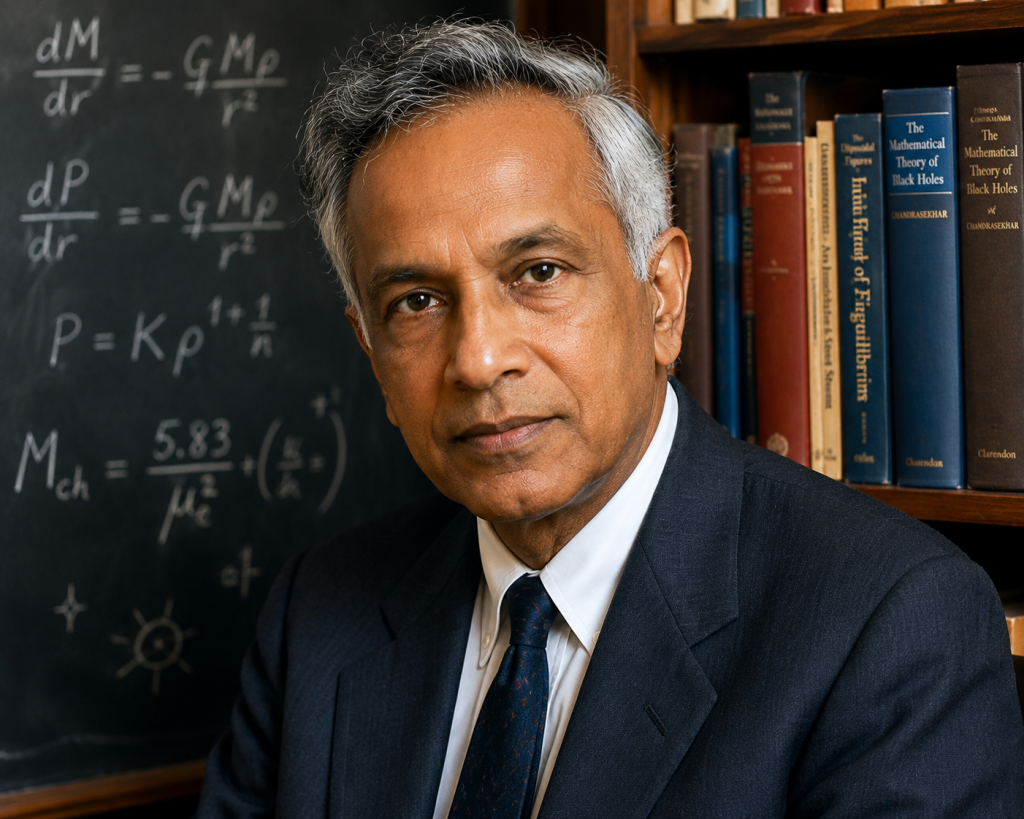
At just nineteen years of age, a young student from Lahore (now in Pakistan) boarded a ship bound for England. During the long voyage he filled notebook after notebook with calculations about dying stars. Those calculations would eventually change astrophysics forever. His name was Subrahmanyan Chandrasekhar.
Subrahmanyan Chandrasekhar was born in 1910 in Lahore, then part of British India, now in Pakistan. From an early age he showed an extraordinary talent for mathematics and physics. He grew up in a family that valued education, and one of his greatest inspirations was his uncle, Sir Chandrasekhara Venkata Raman, who later received the Nobel Prize in Physics.
In 1930, at the age of nineteen, Chandrasekhar left India to study at the University of Cambridge. During the long sea voyage to England, he began calculating what happens when a star exhausts its nuclear fuel. Combining Einstein’s Special Theory of Relativity with the newly developed quantum mechanics, he reached a remarkable conclusion.
There is a limit to how much mass a white dwarf star can support against its own gravity.
If the remaining core of a dying star is less than about 1.4 times the mass of our Sun, it can survive as a white dwarf. If it is more massive than this limit, gravity becomes too strong. The star must continue collapsing, eventually forming a neutron star or, if massive enough, a black hole.
Today this critical value is known as the Chandrasekhar Limit.
For a young scientist, it was an astonishing discovery.
Not everyone agreed.
When Chandrasekhar presented his work before the Royal Astronomical Society in London, the distinguished British astronomer Sir Arthur Eddington publicly rejected his conclusions. Eddington believed that nature would somehow prevent stars from collapsing indefinitely.
The criticism deeply disappointed Chandrasekhar, but it did not stop him.
Rather than arguing publicly, he quietly continued his research.
Over the following decades, observations and theoretical developments proved that Chandrasekhar had been correct. His calculations became one of the foundations of modern astrophysics and opened the way to understanding white dwarfs, neutron stars, supernovae and black holes.
Chandrasekhar never allowed one success to define his career. Throughout his life he explored many different areas of physics and astronomy, including stellar structure, radiative transfer, hydrodynamics, relativity and black holes. Whatever subject he studied, he approached it with extraordinary precision and mathematical elegance.
His students and colleagues admired not only his brilliance but also his humility, discipline and dedication. He believed that scientific research should be pursued with patience and honesty, wherever the evidence might lead.
In 1983, more than fifty years after making his famous discovery, Chandrasekhar received the Nobel Prize in Physics for his theoretical studies of the structure and evolution of stars.
He died in 1995, leaving behind a legacy that continues to shape modern astrophysics.
Legacy
Subrahmanyan Chandrasekhar transformed our understanding of how stars end their lives. His discovery of the Chandrasekhar Limit explained why some stars become white dwarfs while others continue collapsing into neutron stars or black holes. His work forms one of the essential foundations of modern stellar evolution and high-energy astrophysics.
What We Can Learn
Great ideas can come at any age.
Never abandon a good idea simply because others disagree.
Science advances through careful reasoning, patience and evidence.
Humility and perseverance are often more powerful than recognition.
One person’s calculations can change humanity’s understanding of the Universe.