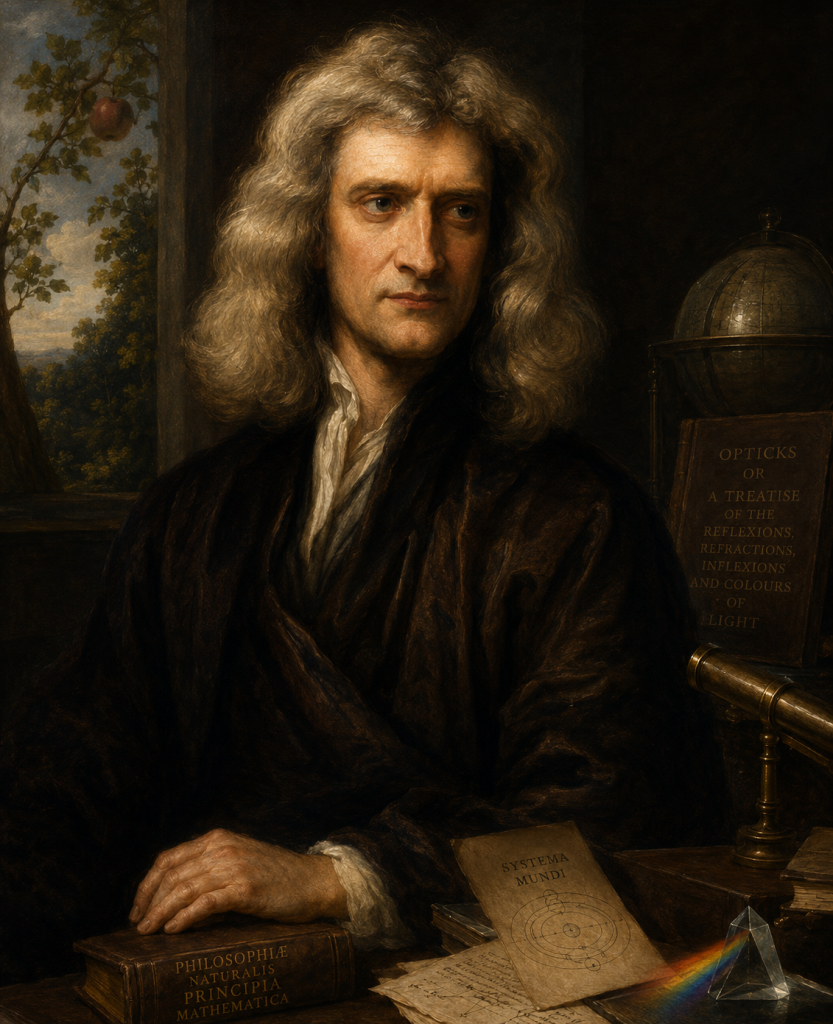
Few individuals have had a greater influence on science than Isaac Newton.
Born in England in 1642, Newton grew up during a time when humanity’s understanding of nature was still limited. Through his extraordinary insight and dedication, he helped lay the foundations of modern physics and mathematics.
Newton’s achievements were remarkable. He formulated the laws of motion and the law of universal gravitation, showing that the same force that causes an apple to fall also governs the motion of the Moon and planets. For the first time, the heavens and the Earth were united by a single set of laws.
His work, published in Philosophiæ Naturalis Principia Mathematica in 1687, transformed humanity’s understanding of the universe and became one of the most influential books in the history of science.
Newton also made important contributions to optics, demonstrating that white light is composed of different colors. He invented the reflecting telescope, an instrument whose design is still widely used by astronomers today.
Perhaps one of Newton’s greatest strengths was his ability to recognize patterns in nature and express them through mathematics. His work provided a framework that guided science for more than two centuries and remains essential even today.
Despite his immense accomplishments, Newton remained aware of the vastness of the unknown. One of his most famous reflections reveals his humility:
“I do not know what I may appear to the world, but to myself I seem to have been only like a boy playing on the seashore, while the great ocean of truth lay all undiscovered before me.”
These words remind us that even the greatest minds remain students of nature.
Newton’s ideas eventually paved the way for Einstein’s theories, which refined and expanded our understanding of gravity and the universe.
Perhaps Isaac Newton’s greatest lesson is that patience, curiosity, and careful observation can reveal the hidden order of nature.
And although centuries have passed since his time, the laws he discovered continue to guide our understanding of the cosmos.
Legacy
Isaac Newton laid the foundations of classical physics and mathematics. His laws of motion and universal gravitation changed humanity’s understanding of nature and prepared the way for the scientific revolution.
What We Can Learn from Isaac Newton
- Great discoveries often begin with simple questions.
- Patience and perseverance are essential.
- Mathematics is a powerful language of nature.
- Humility and greatness can coexist.
- No matter how much we discover, there is always more to learn.