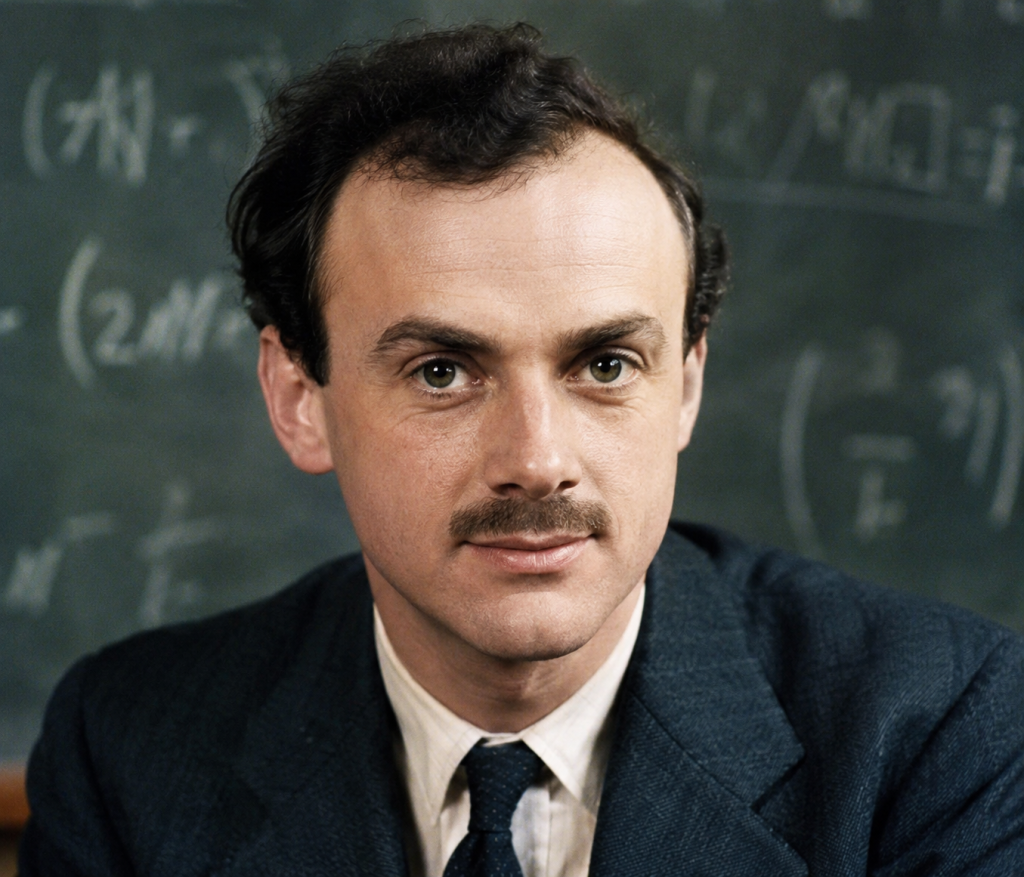
(AD 1902–1984)
Paul Dirac was one of the quietest and most original minds in twentieth-century physics.
Born in Bristol, England, in 1902, Dirac grew up with a deep love for mathematics. He was not a man of many words. He was careful, precise and famously silent. Yet from that silence came some of the most powerful ideas in modern science.
Dirac worked at a time when physics was changing rapidly. Quantum mechanics had revealed that the world of atoms did not behave like the world of everyday experience. Einstein’s theory of relativity had transformed our understanding of space and time. Dirac helped bring these two great revolutions together.
His most famous achievement was the Dirac equation, which combined quantum mechanics with special relativity. The equation described the behaviour of the electron in a new and deeper way. But it also contained something unexpected: it predicted the existence of a particle like the electron, but with positive charge.
At first this seemed strange. But Dirac trusted the mathematics. A few years later, the positron was discovered. It was the first known particle of antimatter.
This was one of the greatest triumphs of theoretical physics. Mathematics had pointed toward something nature had not yet revealed.
Dirac believed deeply in mathematical beauty. To him, a theory should not only work; it should also possess elegance and simplicity. His work showed that beauty in mathematics can sometimes lead us toward hidden truths about the Universe.
Dirac was also remembered for his extraordinary silence. His colleagues joked that there was a unit of speech called a dirac: one spoken word per hour. Whether the story is exact history or scientific folklore, it captures something real about him. Dirac spoke little, but when he did, his words were usually precise.
He reminds us that not every great mind changes the world through speeches, lectures or public charm. Some change it quietly, by thinking with unusual depth.
Paul Dirac showed that the Universe can sometimes be understood not by adding complexity, but by finding the simple and beautiful structure beneath it.
What We Can Learn
Great discoveries do not always come from the loudest voices.
Mathematics can reveal truths before experiments confirm them.
Simplicity and beauty are powerful guides in science.
A quiet mind can still change the Universe.
Sometimes, thinking deeply is more powerful than speaking often.