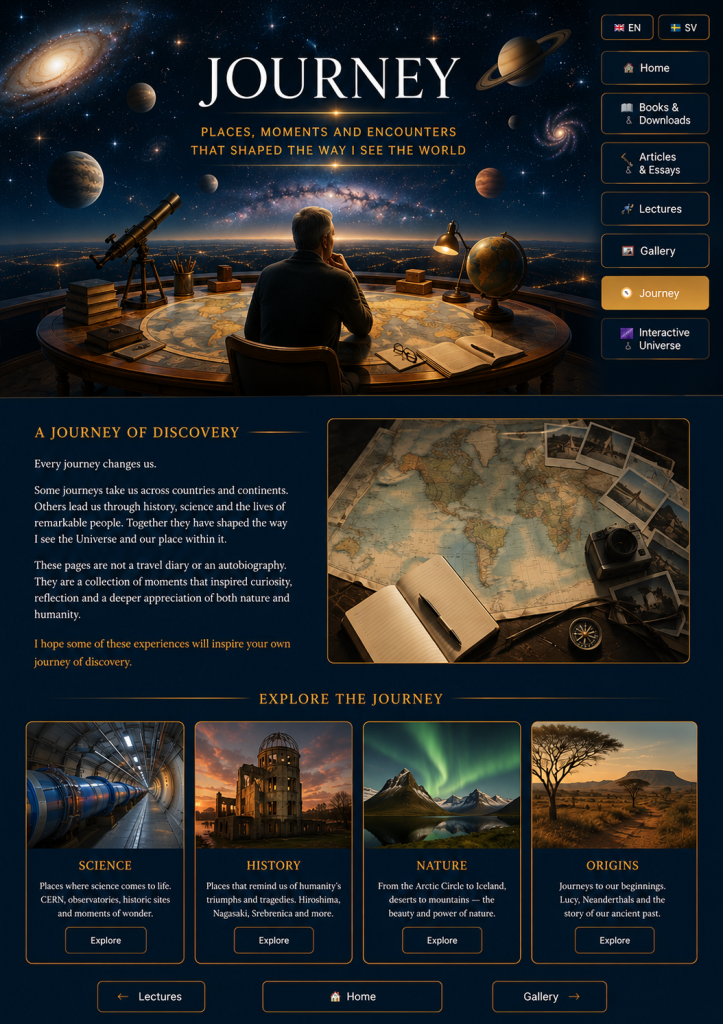
Every journey begins long before we realise we are travelling.
Mine began as a young boy on the rooftop of our home in Sialkot. On warm evenings I would lie beneath the stars, looking up into the darkness. I often felt lonely, but I was never truly alone. The birds, the Moon and the stars became my silent companions, and in my imagination they were friends with whom I could share questions that no one around me seemed able to answer.
Curiosity found its way into the smallest things. I filled my pockets with stones, fascinated that a single stone could contain so many different colours. I wondered how water reached the tops of tall trees when there were no visible pumps. I looked at the world and sensed that beneath its endless variety there must be a hidden simplicity waiting to be discovered.
Whenever I could, I visited the public library in Sialkot. There I discovered the Encyclopaedia Britannica. Much of it was far beyond my understanding, yet that hardly mattered. I was captivated by the idea that human beings had gathered so much knowledge between the covers of those volumes. I admired not only what they contained but also the people who had devoted their lives to discovering it and sharing it with others.
Looking back, I realise that my journey was never driven by a desire to collect places or achievements. It was, and still is, a journey guided by questions. Every country I have visited, every observatory, every historic place and every conversation has added another small piece to a puzzle that is still far from complete.
This website is part of that same journey.
It is a collection of ideas, memories and discoveries gathered over a lifetime of curiosity. Some pages explore the Universe through science, others through history, travel and reflection. Together they tell the story of a lifelong search—not only to understand the cosmos, but also to better understand ourselves.
I hope that somewhere along these pages you will discover a question of your own, because every meaningful journey begins with curiosity.
Looking Up
Long before I knew anything about astronomy, I knew the night sky. As evening fell, the rooftop of our home became my favourite place. There, beneath the stars, the world seemed quieter and much larger than the streets below. I did not yet know the names of the constellations or understand the movements of the planets, but I sensed that the sky was telling a story waiting to be discovered.
I often wondered what lay beyond the stars. How far away were they? Why did they shine? Was the same sky visible to people living in distant countries? Those questions had no immediate answers, yet they filled me with a quiet excitement. Looking back, I realise that my fascination with the Universe did not begin with books or telescopes. It began simply by looking up.
Stones in My Pocket
My curiosity did not end when I climbed down from the rooftop. It followed me wherever I went. During walks I often picked up stones and slipped them into my pockets, fascinated by their colours and patterns. Some were smooth, others rough. Some contained streaks of different colours, and I found it difficult to believe that they all came from the same Earth.
I remember turning them over in my hands and wondering how a single stone could contain so many different colours. Who had painted them? Why were no two alike? I had no knowledge of geology, only the conviction that nature must have its reasons. Every stone seemed to be carrying a story that I was not yet able to read.
Looking back, I realise that those stones taught me an important lesson. The world was full of questions long before I found books that could answer them. Curiosity does not begin in a classroom. It begins by noticing the ordinary and asking why it is the way it is.
The Trees Without Pumps
As my curiosity grew, I began asking questions about things that most people simply accepted. One question stayed with me for a long time. How could water reach the tops of tall trees? There were no pumps, no pipes and no engines hidden inside their trunks, yet every spring the leaves returned, fresh and green.
I would stand beneath those trees, looking upward, trying to imagine how nature accomplished something that seemed almost impossible. It was difficult to believe that such an elegant process could happen silently and without anyone noticing. I did not know the answer, but I was fascinated that the natural world could solve problems so effortlessly.
Years later I learned about roots, capillary action and the remarkable way water moves through tiny vessels inside a tree. The scientific explanation was beautiful, but it never diminished the sense of wonder I had felt as a child. If anything, understanding the process made nature even more impressive.
Looking back, I realise that questions like these shaped the way I still approach the world today. Before searching for answers, I first learned to notice the questions. That, perhaps, is where every scientific journey truly begins.
The Library
There was another place that became just as important as the rooftop where I watched the stars. It was the public library in Sialkot. Whenever I had the opportunity, I would wander among its shelves, drawn by the quiet atmosphere and the promise that somewhere inside those books lay answers to questions I could barely put into words.
What fascinated me most was the Encyclopaedia Britannica. I was far too young to understand much of what I read, yet that never discouraged me. Instead, I found myself turning the pages in quiet admiration. I was amazed that human beings had been able to gather so much knowledge into a collection of books. It was not only the information that impressed me, but also the countless people who had devoted their lives to discovering it, preserving it and sharing it with others.
Looking back, I realise that those visits taught me something that has remained with me ever since. Knowledge is never the work of one person or one generation. Every discovery builds upon the work of those who came before. Long before I learned the expression “standing on the shoulders of giants,” I had already begun to understand what it meant.
The library became more than a place to find answers. It became a place that taught me to respect knowledge itself and to appreciate the people who dedicate their lives to expanding our understanding of the world.
The World as My Classroom
As I grew older, my curiosity no longer stopped at books. It began to lead me beyond the familiar streets of my hometown and eventually beyond the borders of my own country. Travelling became another way of asking questions—not only about nature, but also about people, history and cultures.
I never travelled to collect countries or tick places off a map. Every journey was an opportunity to understand how people live, what they value and how history has shaped their lives. Whether walking through an ancient city, visiting a museum, standing beneath a clear Arctic sky or meeting people whose lives were very different from my own, I discovered that every place has a story to tell.
Looking back, I realise that travel became another form of education. Some lessons were found in observatories and scientific institutions, others in quiet conversations, historic places and landscapes that inspired reflection. Every journey added another piece to the puzzle I had begun to assemble as a child.
Meeting Abdus Salam
One of the people I had long hoped to meet was Professor Abdus Salam, Pakistan’s first Nobel Prize laureate and one of the greatest physicists of the twentieth century. Long before our paths crossed, I had admired not only his scientific achievements but also his unwavering belief that knowledge belongs to all humanity and that science has the power to unite rather than divide us.
When I finally had the opportunity to meet him in Stockholm, the moment was brief, yet it has remained with me ever since. Here was a man whose ideas had transformed our understanding of the fundamental forces of nature, but what impressed me most was neither his reputation nor his Nobel Prize. It was his warmth, humility and generosity. He spoke with a quiet dignity that reflected both intellectual greatness and genuine humanity.
Meeting Professor Salam reminded me that the people we admire from a distance are, above all, human beings. Their achievements may change the world, but it is often their character that leaves the deepest impression. As I left that meeting, I carried with me not only admiration for a brilliant physicist but also respect for a man who never lost sight of the importance of education, curiosity and compassion.
David
I have never enjoyed standing in long queues. Yet, in Florence, I found myself standing in the rain for more than two hours outside the Galleria dell’Accademia. I had come for one reason alone—to see Michelangelo’s David. Friends had told me that it was extraordinary, but nothing could have prepared me for the moment I finally stood before it.
It was difficult to believe that this masterpiece had once been nothing more than a block of marble, abandoned for years because others believed it could not be used. Under Michelangelo’s hands, that neglected stone was transformed into one of the greatest works of art ever created. Every detail seemed alive—the anatomy, the veins beneath the skin, the balance of the figure and the quiet confidence in its expression. Walking around the statue, each new angle revealed another level of perfection.
Standing before David, I realised that human greatness is expressed in many different ways. Science seeks to understand the Universe, while art reveals the extraordinary potential of the human spirit. Both begin with imagination. Both require patience, dedication and the courage to see possibilities where others see only limitations.
As I left the museum, I found myself thinking not only about Michelangelo’s genius but also about the remarkable journey of that forgotten block of marble. Sometimes, hidden within the ordinary, lies something extraordinary—waiting for someone with the vision to uncover it.
CERN
For anyone with a lifelong fascination for the Universe, visiting CERN felt almost like making a pilgrimage. For decades I had read about the discoveries made there and the remarkable scientists who had devoted their lives to understanding the fundamental building blocks of nature. Standing inside the world’s largest laboratory for particle physics, I felt both excited and deeply humbled.
What impressed me most was not the size of the machines or the complexity of the technology. It was the spirit of collaboration. Scientists from many different countries, cultures and backgrounds were working together, united by a common purpose: to understand how the Universe works. In a world so often divided by differences, CERN reminded me that curiosity has the power to bring people together.
As I walked through the laboratories and looked at the extraordinary engineering that made these experiments possible, I found myself thinking about the little boy lying on a rooftop in Sialkot, wondering why the stars shone and how the Universe had begun. The questions had become more sophisticated, but they were still the same questions.
Leaving CERN, I realised that science is far more than equations, laboratories and machines. At its heart, it is a shared human adventure—a journey driven by curiosity, imagination and the courage to ask questions whose answers we do not yet know.
Einstein’s Room
For many years, I had dreamed of visiting Albert Einstein’s apartment in Bern. It was there, while working as a young patent clerk, that he developed the extraordinary ideas which, in 1905, transformed our understanding of space, time, light and matter. To stand in the very room where those thoughts first took shape was a deeply personal experience.
One object, more than anything else, captured my attention. It was the simple wooden desk that Einstein had used during his years at the Swiss Patent Office. Inside one of its drawers he kept the notes on which he worked, and with his characteristic sense of humour he called that drawer “The Physics Department.” Standing beside the desk, I gently placed my hand upon it, aware that this ordinary piece of furniture had silently witnessed one of the greatest intellectual revolutions in human history.
After quietly walking through the apartment, I found a corner of the room and sat down on the floor. For a few moments, I tried to place myself in Einstein’s world. I imagined him sitting there, absorbed in thought, asking questions that no one had asked before. I reflected on the thought experiments that had begun in that room—imagining what it would be like to ride alongside a beam of light or to watch clocks behave differently as they moved through space. It was through such simple yet profound ideas that Einstein forever changed the way we understand the Universe.
I was not trying to become Einstein, nor to retrace his discoveries. What moved me was the realisation that one of humanity’s greatest scientific revolutions had begun not in a magnificent laboratory, but in the quiet mind of a curious individual who dared to question accepted ideas.
As I left the apartment, I carried with me a renewed appreciation for the power of imagination. Every great discovery begins with a question, and every question begins in the mind. Long before we explore the Universe with telescopes and spacecraft, we first explore it through thought.
The San People
Among the many journeys that have stayed with me, one of the most memorable was my visit to the Kalahari Desert, where I had the privilege of meeting members of the San people. Living in one of the world’s oldest continuous cultures, they possess a profound understanding of the natural world, developed over thousands of years through careful observation and experience.
What impressed me most was not the simplicity of their way of life, but the depth of their knowledge. They could read the landscape in ways that I could barely imagine. The smallest footprint, a broken twig or the movement of the wind revealed stories that remained invisible to me. Their understanding of nature had not been learned from books, but from generations of living in close harmony with their environment.
We did not speak the same language. Their language, with its distinctive click sounds, was completely unfamiliar to me, and they spoke no English. Yet somehow we understood one another. Through smiles, gestures, patience and a shared curiosity, we found a way to communicate that went far beyond words. It reminded me that kindness and a willingness to learn can bridge even the widest cultural divide.
One of the most unforgettable moments came when they decided to teach me how to make fire using nothing more than wood, dry grass and friction. Imagine a city boy who had never even considered such a possibility, sitting on the ground in the Kalahari Desert under the patient guidance of people whose ancestors had mastered this skill thousands of years ago. I followed their instructions carefully, rubbing the wooden spindle until smoke began to rise. Moments later, a tiny glowing ember appeared. With gentle breaths, it burst into flame.
I cannot fully describe the feeling of pride and joy I experienced at that moment. It was far more than learning a practical skill. It was a lesson in trust, generosity and the sharing of knowledge across cultures. For a few minutes, differences of language, background and geography disappeared. We were simply people learning from one another.
As I left the Kalahari, I carried with me a renewed respect for one of humanity’s oldest cultures. The encounter reminded me that wisdom is not measured by technology alone. Sometimes the deepest lessons come from people who have learned to live with nature rather than trying to conquer it. My classroom that day was not a university or an observatory, but the desert itself.
Above the Arctic Circle
For reasons I have never been able to fully explain, I have always felt drawn to the far north. I was born and raised in a city, surrounded by streets, people and buildings, with little contact with wilderness or open water. Yet every time I travelled above the Arctic Circle, I experienced an unexpected feeling of belonging. It was as though the landscape itself was quietly calling me home.
Above the tree line, the world changes. Forests give way to vast open landscapes where mountains, rivers and endless skies meet in perfect harmony. The silence is unlike any other silence I have known. It is not empty, but alive. There are no crowds, no traffic and no distractions—only nature in its purest form. Standing there, surrounded by untouched wilderness, I have often felt both wonderfully small and deeply connected to something far greater than myself.
One of the natural wonders that fascinated me most was the giant potholes carved into solid rock by rushing water. For thousands of years, small stones became trapped in powerful whirlpools, slowly grinding their way through the rock beneath them until they created deep, perfectly rounded cavities—some so large that I could stand inside them. It was astonishing to realise that something as small as a stone, given enough time, could reshape solid rock.
Standing inside one of those giant potholes, I realised that nature rarely works through sudden miracles. Its greatest achievements are often the result of patience, persistence and the quiet passage of time. Perhaps human life is not so different. We are shaped not only by the great events we experience, but also by countless small moments that gradually leave their mark upon us.
During my journeys in the north, I also had the privilege of meeting Sami families and learning about their history, traditions and way of life. I was fascinated by their close relationship with nature, their knowledge of the changing seasons and their long traditions of reindeer herding and fishing. Living in such a demanding environment requires patience, resilience and a deep respect for the land—qualities that have shaped Sami culture for countless generations.
Like many indigenous peoples around the world, the Sami have endured difficult chapters in their history. They were pressured to abandon parts of their own traditions, embrace Christianity and travel long distances to attend the summer church. Yet despite these hardships, they preserved their language, their identity and their cultural heritage with remarkable strength and dignity. Meeting them reminded me that culture is not something preserved only in museums or history books. It lives in people, in their stories, their traditions and their relationship with the land.
Whenever I leave the north, I know that I will return. It is one of the few places where I feel completely at peace, where silence becomes a companion rather than an absence, and where the landscape gently reminds me how small we are—and how fortunate we are to be part of such a remarkable world.
The Māori
New Zealand has long been one of my favourite countries. Its landscape reminds me in many ways of another place I love deeply—Iceland. In both countries, the Earth still feels alive. Geysers, volcanic landscapes and steaming water rising from deep beneath the ground are constant reminders that our planet is still being shaped by powerful forces hidden beneath our feet. I found that endlessly fascinating.
Yet as beautiful as the landscape was, it was the people who left the deepest impression on me. Everywhere I travelled, I was met with warmth, kindness and an openness that felt almost unbelievable. More than once I found myself smiling and saying to people I had just met, “What’s wrong with you people? Stop being so nice—you scare me.” They always laughed, but behind the joke was genuine admiration. Rarely had I encountered such friendliness and generosity.
Meeting the Māori added another dimension to that experience. I visited several of their cultural and spiritual centres, where I was welcomed not as a stranger, but as a guest. There was a quiet confidence in the way they shared their traditions, their history and their identity. They were proud of who they were and eager to preserve their heritage while generously inviting others to understand it.
I was deeply impressed by how successfully Māori culture has remained a living part of New Zealand society. Their language stands proudly alongside English as an official language, and their traditions continue to be respected and celebrated. It was one of the finest examples I had ever seen of an Indigenous people preserving their identity while remaining an integral part of modern society.
One lesson has stayed with me ever since. The Māori taught me that even the smallest things can carry profound meaning. I remember learning about pounamu, the treasured greenstone that holds such an important place in Māori culture. From the outside it appears dark and unremarkable, but when cut open it reveals a beautiful green heart within. I often think of that stone as a quiet reminder that people, too, should never be judged by appearances alone.
When I left New Zealand, I carried with me far more than memories of magnificent landscapes. I carried with me an admiration for a people whose kindness, generosity and pride in their heritage left a lasting mark on me. For a while, I even joked that I wanted a T-shirt that simply read: “Wanna Be Kiwi.” Behind the humour was something sincere. Few places have made me feel so welcome, and few people have taught me so much about the simple art of making others feel at home.
Hiroshima
For many years, I had wondered how I would react if I ever visited Hiroshima. I had read about the events of August 1945, seen the photographs and watched documentaries, but I knew that no book could prepare me for standing in a place where human suffering had reached such unimaginable proportions.
Nothing prepared me for the emotions that overwhelmed me.
As I walked through the Peace Memorial Museum and later through the city itself, words seemed to lose their meaning. I was no longer thinking as a visitor or as someone interested in history. I was simply a human being trying to understand what had happened there. Yet I could not.
I walked for what felt like hours. It became the longest walk of my life. Lost in thought, I paid no attention to where I was going. When I finally looked around, I realised that I had no idea where I was. I had wandered so far that I could not even find my way back to my hotel.
Looking back, I realise that I was not truly lost in the streets of Hiroshima. I was lost in the questions that the city had awakened within me. How could human beings inflict such suffering upon one another? How could science, capable of revealing the beauty of the Universe, also be used to bring such devastation? Those questions have never completely left me.
Some places leave us with photographs. Hiroshima left me with silence.
Nagasaki
If Hiroshima left me with silence, Nagasaki reminded me that even after humanity’s darkest moments, compassion can still find a way to speak.
Visiting the Peace Museum was another deeply emotional experience. Like Hiroshima, it tells the story of unimaginable suffering, loss and destruction. As I walked through the exhibits, I found myself overwhelmed once again. The stories, the photographs and the personal belongings of those who never returned made it impossible to remain untouched. At one point, the emotions became too much, and I found myself quietly crying.
A young Japanese schoolgirl noticed my tears. Without saying a word, she walked over to me and gently placed a small hand-made origami in my hand. It had been folded by schoolchildren as a symbol of peace and left at the museum for visitors. We spoke no words. We did not need to. In that simple gesture, she offered comfort to a stranger from the other side of the world.
I have often thought about that moment. She knew nothing about me. She did not know my name, my country or why I had come to Nagasaki. She simply saw another human being in pain and responded with kindness. That small paper figure has become one of the most precious memories of all my travels.
History teaches us how easily humanity can destroy itself. That little girl reminded me that humanity also possesses an extraordinary capacity for compassion. Sometimes the smallest gesture carries the greatest meaning.
I left Nagasaki carrying far more than an origami. I carried with me a renewed belief that peace begins not with governments or treaties, but with ordinary people choosing kindness, one person at a time.
Srebrenica
I had mixed feelings as I travelled to Srebrenica. I had already visited Mostar and Sarajevo, but it was Srebrenica that frightened me the most. I was not afraid of the place itself. I was afraid of how I would react when I arrived at the place where evil had danced naked and humanity had surrendered.
In my world, people have always been more important than places. Yet there are places that do more than tell a story—they become history themselves. It hurts even to speak their names, but they exist, and they remind us that human beings have too often been the architects of unimaginable suffering. The list is long: the Holocaust, the concentration camps, Cambodia, Rwanda and many others. But Srebrenica was close to home, and it happened within our own lifetime.
The images are impossible to escape. Frightened boys and men separated from their mothers, wives and daughters. Ordered to kneel beside ditches before they were executed. Women humiliated and raped. Mass graves. All of it happened—and we watched.
The air over Srebrenica felt heavy with sorrow when I arrived. There were new houses and signs of reconstruction, but the streets and the ruined buildings told another story. From the moment I arrived, I found myself walking without direction. I avoided looking people in the eye. A feeling of shame and guilt weighed heavily upon me.
Yet even there, I found small rays of hope. On a small sports field I saw a group of young people, boys and girls together, laughing and training. A little further on stood a nursery school. Children were playing in the playground, laughing, shouting and simply being children. I walked around the playground four times, just to listen to their laughter. I wanted to stay there for a long time. I wanted to speak to them, perhaps even to join their games for a while.
But it felt inappropriate for a stranger simply to stand watching children, so I quietly walked away.
The images of terrified people being tortured and murdered had become deeply etched in my mind. I struggled, almost desperately, to replace them with the laughter of those children. It became an emotional battle between humanity at its worst and humanity at its beginning.
The night was even more difficult. I was the only guest in the hostel. Memories and images returned again and again, like a film that refused to end. For many years I believed that I had no tears left to cry, but I was wrong. My pillow became wet, and my body trembled.
Throughout the night, I kept asking myself the same question.
Why did I want to come here?
Even today, I do not know the answer.
But I do know this.
Had I not come, I would have carried an even heavier burden.
Coming to Srebrenica was my way of paying my respects to those who never had the chance to grow old.
The Journey Continues…
Looking back, I realise that my journey has never really been about astronomy, travel or collecting memories. It has been a lifelong search for understanding. Every place I have visited, every person I have met and every experience I have lived has quietly become a teacher.
Some teachers knew they were teaching. Many did not.
A scientist opened my eyes to the beauty of ideas. An artist showed me that greatness can emerge from an ordinary block of stone. Indigenous peoples taught me that wisdom is not measured by technology but by our relationship with nature, with one another and with the generations who came before us. Children reminded me that kindness needs no common language. Landscapes taught me silence, patience and humility. Even places marked by humanity’s darkest moments became teachers, reminding me how precious compassion, dignity and peace truly are.
The greatest lesson of all has been that learning never ends. We often imagine that education belongs to our younger years, yet I have discovered that some of life’s most important lessons arrive much later. They appear unexpectedly—in a conversation with a stranger, in the laughter of children, in the silence of a mountain, in a museum, or beneath a sky filled with stars. They are there for anyone willing to slow down, to listen and to see.
People sometimes ask me what I have gained from travelling. My answer is always the same. I have not travelled to collect countries. I have travelled to collect understanding. Every journey has changed me in ways I could never have imagined before setting out.
Today I still feel the same curiosity that I felt as a little boy lying on the rooftop of our home in Sialkot, looking up at the stars and wondering what lay beyond them. The questions have changed, but the curiosity has remained the same. I hope it always will.
This website is simply another step along that journey. Within these pages I have shared my thoughts, my questions, my memories and the people and places that have inspired me. They are not presented as answers, but as invitations—an invitation to wonder, to ask questions and to continue exploring.
If these pages encourage even one person to look up at the night sky, to open a book, to visit a museum, to meet people from another culture, or simply to pause for a moment and see the world with fresh eyes, then this journey has been worthwhile.
This is my Universe.
This is my Journey.
I hope that somewhere along these pages, they become a small part of yours.
Thank you for walking with me.
Journey