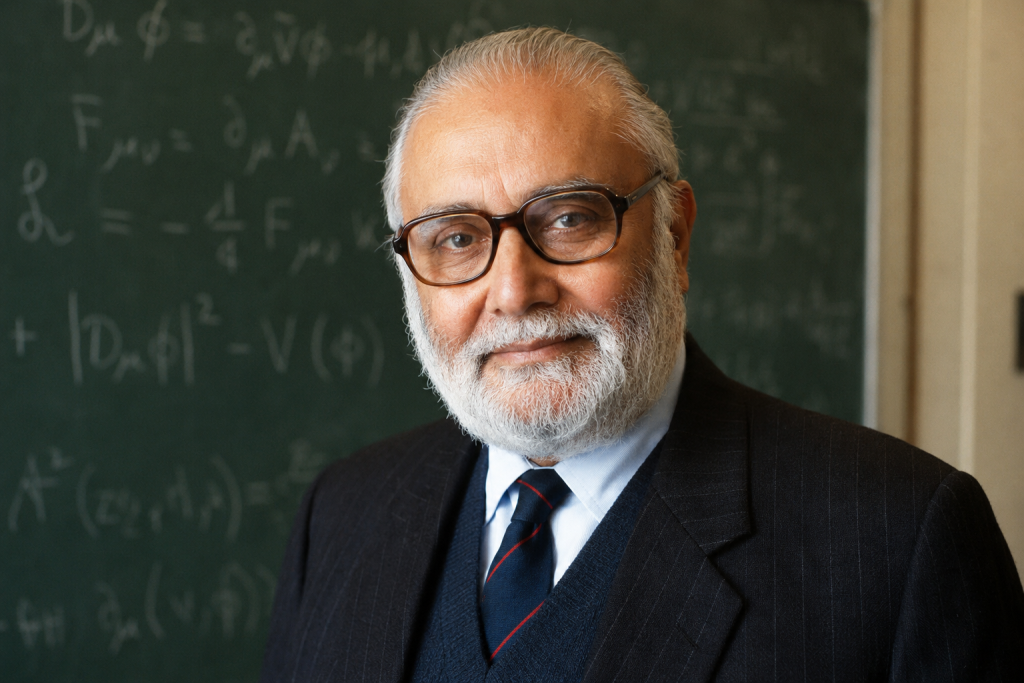
Among the great physicists of the twentieth century, Abdus Salam occupies a unique place.
Born in Jhang, in what is now Pakistan, in 1926, Salam displayed exceptional intellectual abilities from an early age. His passion for mathematics and physics eventually led him to Cambridge University, where he began a distinguished scientific career that would have a profound impact on modern physics.
Salam devoted much of his life to understanding the fundamental laws of nature. Together with Sheldon Glashow and Steven Weinberg, he developed the electroweak theory, which unified two of nature’s fundamental forces—the electromagnetic force and the weak nuclear force. This remarkable achievement became one of the cornerstones of the Standard Model of particle physics.
For this work, Abdus Salam was awarded the Nobel Prize in Physics in 1979, becoming the first scientist from Pakistan and the first Muslim physicist to receive this honor.
Yet Salam’s legacy extends far beyond his scientific achievements.
He firmly believed that science belongs to all humanity and that talent knows no national boundaries. Throughout his life, he worked tirelessly to promote scientific research and education in developing countries. In 1964, he founded the International Centre for Theoretical Physics (ICTP) in Trieste, Italy, which has since provided opportunities for thousands of scientists from around the world.
Salam often spoke about the beauty and harmony of nature. For him, science was not merely a profession but a quest to understand the deep order underlying the universe.
Despite international recognition, he remained a man of humility and kindness. Those who knew him often spoke of his generosity and his dedication to helping young scientists achieve their potential.
His life demonstrated that intellectual excellence and human compassion are not separate qualities but natural companions.
Abdus Salam’s work helped humanity take another step toward understanding the unity of nature.
Yet perhaps his greatest contribution was his belief that knowledge should be shared and that science should serve all people.
His example continues to inspire scientists, teachers, and students around the world.
For he showed that curiosity, perseverance, and generosity can transcend borders and cultures.
And perhaps that is one of the most beautiful lessons science can teach.
Legacy
Abdus Salam helped establish the electroweak theory, one of the foundations of the Standard Model of particle physics. Through the ICTP and his lifelong commitment to education, he also became a champion for scientific development throughout the world.
What We Can Learn from Abdus Salam
- Great science knows no borders.
- Education should be accessible to everyone.
- Humility and brilliance can go hand in hand.
- Knowledge gains value when it is shared.
- Curiosity and perseverance can overcome many obstacles.
Great Minds