1201–1274
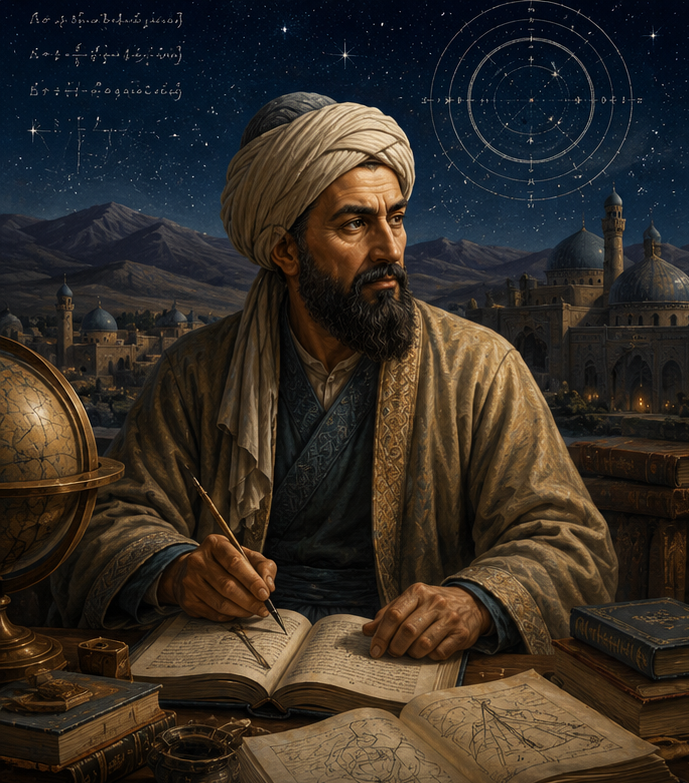
Note: No authentic portrait of Nasir al-Din al-Tusi exists. The illustration above is an artist’s interpretation based on historical descriptions and the period in which he lived.
Nasir al-Din al-Tusi was one of the greatest astronomers and mathematicians of the medieval world. Living during the Islamic Golden Age, he played a crucial role in advancing astronomy at a time when much of the scientific knowledge of the ancient world was being preserved, expanded and refined.
Al-Tusi is best known for founding the famous Maragheh Observatory in present-day Iran, one of the greatest scientific institutions of its time. Equipped with advanced astronomical instruments and supported by scholars from many disciplines, the observatory became an important centre for astronomical research and observation.
His greatest scientific contribution was the development of the Tusi Couple, an ingenious geometric model that allowed straight-line motion to be produced from combinations of circular motion. Although highly mathematical, this elegant idea solved important problems in planetary astronomy and later influenced the development of heliocentric astronomy in Europe.
Al-Tusi also produced important work in mathematics, trigonometry and philosophy. He helped establish trigonometry as an independent branch of mathematics and wrote numerous scientific works that were studied for centuries.
Many historians believe that the mathematical ideas developed at the Maragheh Observatory eventually reached Europe and influenced later astronomers, including Nicolaus Copernicus. While historians continue to study the exact pathways through which this knowledge travelled, there is little doubt that Al-Tusi’s work formed an important link in the long chain of scientific discovery.
Nasir al-Din al-Tusi reminds us that scientific progress is rarely the achievement of one civilization alone. Knowledge is preserved, improved and passed from one generation to the next, crossing borders, languages and cultures along the way.
Today he is remembered as one of the greatest scientific minds of the medieval world and as an important bridge between the astronomy of antiquity and the scientific revolution that would follow centuries later.
 Great Minds