Hidden within every living cell is a remarkable molecule that carries the instructions for life itself.
This molecule, known as DNA, contains the genetic information that determines how organisms grow, develop, and function. From the smallest bacteria to the largest whales, all life on Earth relies on the same fundamental code.
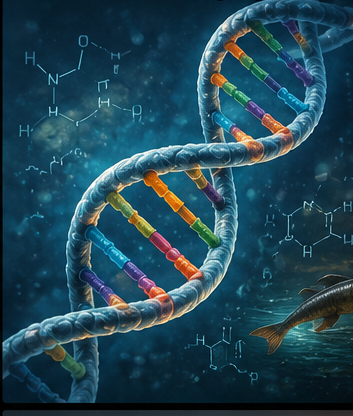
DNA, short for deoxyribonucleic acid, has the shape of a double helix, often described as a twisted ladder. Along this ladder are four chemical building blocks represented by the letters A, T, C, and G. By arranging these four letters in countless combinations, nature creates the extraordinary diversity of life that surrounds us.
The structure of DNA was discovered in 1953 by James Watson and Francis Crick, building upon the important work of Rosalind Franklin and Maurice Wilkins. Their discovery transformed biology and opened a new understanding of heredity and evolution.
Every cell in the human body contains billions of DNA letters. Together, they form the instructions that determine traits such as eye color, height, and countless other characteristics. Yet the same basic genetic language is shared by all living organisms.
This common language provides powerful evidence that all life on Earth is related and descended from common ancestors that lived billions of years ago.
Modern genetics has revolutionized medicine, agriculture, and forensic science. It has also allowed scientists to trace the history of life and better understand the connections between species.
Perhaps the most remarkable aspect of DNA is its simplicity.
From only four chemical letters arises the immense variety of life on our planet.
In this sense, DNA is one of nature’s greatest masterpieces.
It is the language through which life writes its story.