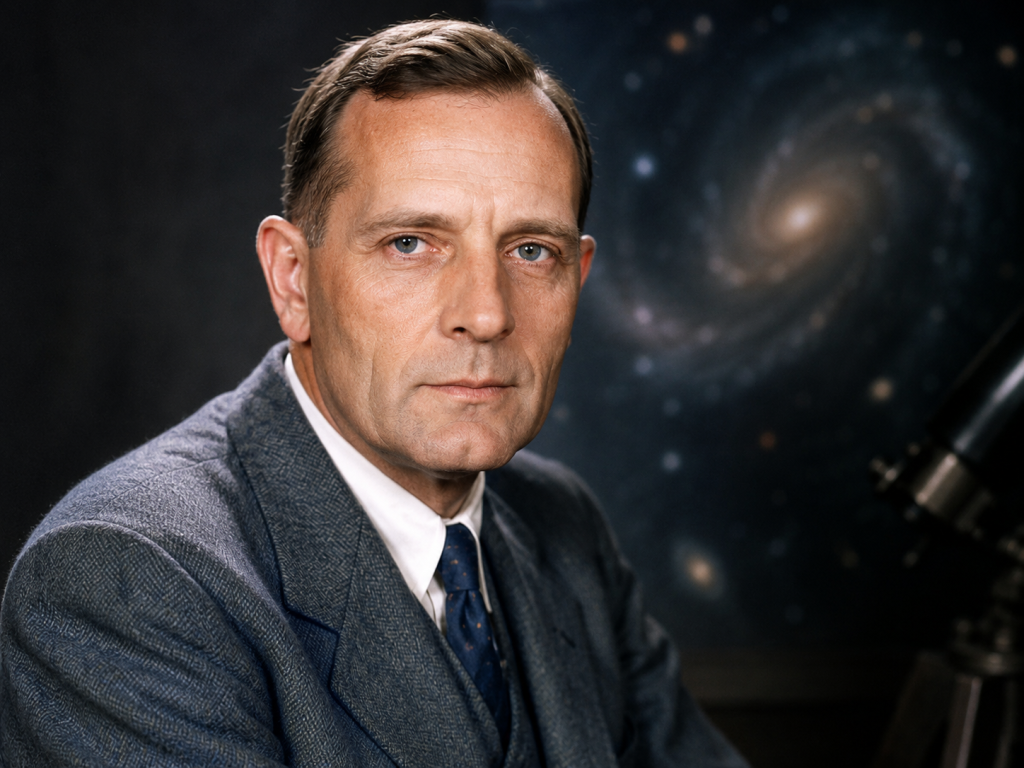
Edwin Hubble changed forever our understanding of the Universe. He proved that the Milky Way is only one galaxy among billions and discovered that the Universe itself is expanding. His journey to astronomy was anything but ordinary—he was a talented boxer, earned a degree in law and briefly practised as a lawyer before following his true passion. His story reminds us that it is never too late to change direction and pursue what truly inspires us.
Edwin Powell Hubble was born in 1889 in Marshfield, Missouri, USA. As a young man he excelled both academically and athletically. He was an outstanding student, a champion boxer and a gifted basketball player. Those who knew him admired not only his intelligence but also his determination and discipline.
Although Hubble loved astronomy, he honoured his father’s wishes and studied law at the University of Oxford as a Rhodes Scholar. After returning to the United States, he briefly worked as a lawyer. It soon became clear, however, that the courtroom was not where his heart belonged. He left the legal profession and chose instead to devote his life to astronomy—a decision that would transform our understanding of the cosmos.
After military service during the First World War, Hubble joined the Mount Wilson Observatory in California, home to the world’s largest telescope at the time—the 100-inch Hooker Telescope. It was there that he made the discoveries that would change astronomy forever.
For centuries, many astronomers believed that the Milky Way was the entire Universe. Strange fuzzy objects known as spiral nebulae could be seen through telescopes, but no one knew what they really were.
Hubble carefully studied one of these objects—the Andromeda Nebula. By identifying a special type of variable star known as a Cepheid variable, he was able to calculate its distance. The result was astonishing. Andromeda lay far beyond the boundaries of the Milky Way.
It was not a nebula at all.
It was an entirely separate galaxy.
Suddenly, the Universe became unimaginably larger than anyone had believed.
But Hubble’s greatest discovery was still to come.
By studying the light from distant galaxies, he found that almost all of them are moving away from us. Even more remarkably, the farther away a galaxy is, the faster it appears to be receding. This relationship became known as Hubble’s Law and provided the first convincing evidence that the Universe is expanding.
This discovery transformed modern cosmology. If the Universe is expanding today, it must once have been much smaller, denser and hotter. Hubble’s observations laid the observational foundation for what later became known as the Big Bang theory.
Ironically, Albert Einstein had believed the Universe was static and had introduced the cosmological constant into his equations to keep it from expanding or collapsing. Hubble’s observations showed that the Universe is not static after all. Einstein later visited Hubble and reportedly described the addition of the cosmological constant as his “greatest blunder.”
Although Hubble became one of the most famous astronomers of the twentieth century, he remained devoted to careful observation rather than speculation. He believed that nature itself should guide our understanding of the Universe.
Edwin Hubble died in 1953, but every modern image of distant galaxies, every measurement of the expanding Universe and every study of cosmology builds upon the foundation he helped establish.
Legacy
Edwin Hubble transformed our view of the cosmos. He proved that the Milky Way is only one galaxy among billions and discovered that the Universe is expanding. His observations opened the door to modern cosmology and provided the crucial evidence that eventually led to the Big Bang theory. Today, one of humanity’s greatest scientific instruments, the Hubble Space Telescope, proudly bears his name.
What We Can Learn
It is never too late to follow your true passion.
Great discoveries often begin with careful observation.
The Universe is far larger and more wonderful than we first imagine.
Sometimes a single observation can change humanity’s understanding forever.
Curiosity, perseverance and the courage to change direction can reshape both a life and the history of science.