For centuries, the planet Mars has fascinated humanity.
Its reddish color, visible even to the naked eye, inspired ancient civilizations to associate it with war and fire. Yet beneath its striking appearance lay a mystery that would captivate astronomers, dreamers, and scientists alike.
In the nineteenth century, observations by astronomers such as Giovanni Schiaparelli and Percival Lowell gave rise to speculation about canals and perhaps even intelligent life on Mars. Although these ideas were eventually proven incorrect, they helped ignite humanity’s fascination with the Red Planet.
The space age transformed speculation into exploration.
In the 1960s, NASA’s Mariner spacecraft provided the first close-up images of Mars. Instead of lush vegetation and artificial canals, they revealed a cold and barren world marked by craters and ancient landscapes.
In 1976, the Viking missions became the first spacecraft to land successfully on Mars. Viking 1 and Viking 2 carried instruments designed to search for signs of life and returned thousands of images of the Martian surface. Although no definitive evidence of life was found, the missions revolutionized our understanding of the planet.
A new era began in 1997 when the Mars Pathfinder mission delivered the small rover Sojourner. For the first time, a robotic vehicle explored another planet, demonstrating technologies that would pave the way for future rovers.
In 2004, NASA landed the twin rovers Spirit and Opportunity. Designed for missions lasting only ninety days, they far exceeded expectations. Spirit operated for more than six years, while Opportunity explored Mars for nearly fifteen years, traveling over forty-five kilometers and transforming our understanding of the planet’s history.
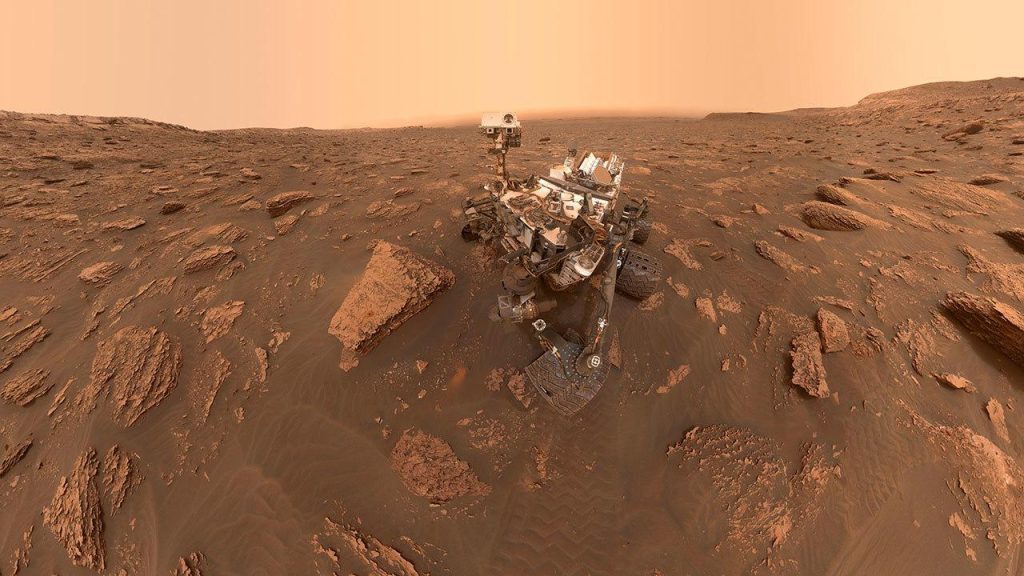
Curiosity, which landed in 2012, represented another major leap forward. Equipped with sophisticated instruments, it discovered evidence that ancient Mars once possessed lakes, rivers, and environmental conditions that may have been suitable for microbial life.
In 2021, the Perseverance rover arrived in Jezero Crater, the site of an ancient river delta. Its mission is to search for signs of past life and collect samples that may eventually be returned to Earth.
Accompanying Perseverance was Ingenuity, a small helicopter that achieved the first powered flight on another world. Originally intended as a technology demonstration, Ingenuity far exceeded expectations and opened a new chapter in planetary exploration.
Today, Mars is no longer merely a distant object in the sky.
It is a world we know.
We have mapped its mountains, explored its valleys, and studied its atmosphere. Evidence suggests that billions of years ago, Mars possessed rivers, lakes, and perhaps even oceans.
One of the greatest questions in science remains unanswered:
Did life ever arise on Mars?
Future missions may provide the answer.
Scientists are developing plans to return Martian samples to Earth, while space agencies and private companies envision human expeditions to the Red Planet.
Some dream that Mars may someday become humanity’s second home.
Whether or not that dream is realized, Mars has already transformed our understanding of the Solar System and our place within it.
Perhaps no other world beyond Earth has inspired such a mixture of curiosity, hope, and imagination.
And perhaps that is because Mars whispers to us of possibilities.
It reminds us that exploration is part of our nature.
For throughout history, humanity has always looked toward the horizon and wondered what lies beyond.
Today, Mars has become the next horizon.
And perhaps, one day, human footprints will join those left by our remarkable robotic explorers.
Key Ideas
- Mars has fascinated humanity for centuries.
- The Mariner missions provided the first close-up images.
- Viking became the first successful landers on Mars.
- Sojourner, Spirit, Opportunity, Curiosity, and Perseverance transformed our understanding of the planet.
- Ingenuity achieved the first powered flight on another world.
- Ancient Mars may once have possessed rivers, lakes, and oceans.
- Future human missions may one day make Mars humanity’s second home.
What We Can Learn
- Curiosity drives exploration.
- Great discoveries are often built upon many smaller achievements.
- Science continually transforms speculation into knowledge.
- Mars teaches us about Earth’s past and the possibility of life elsewhere.
- The desire to explore is deeply rooted in human nature.