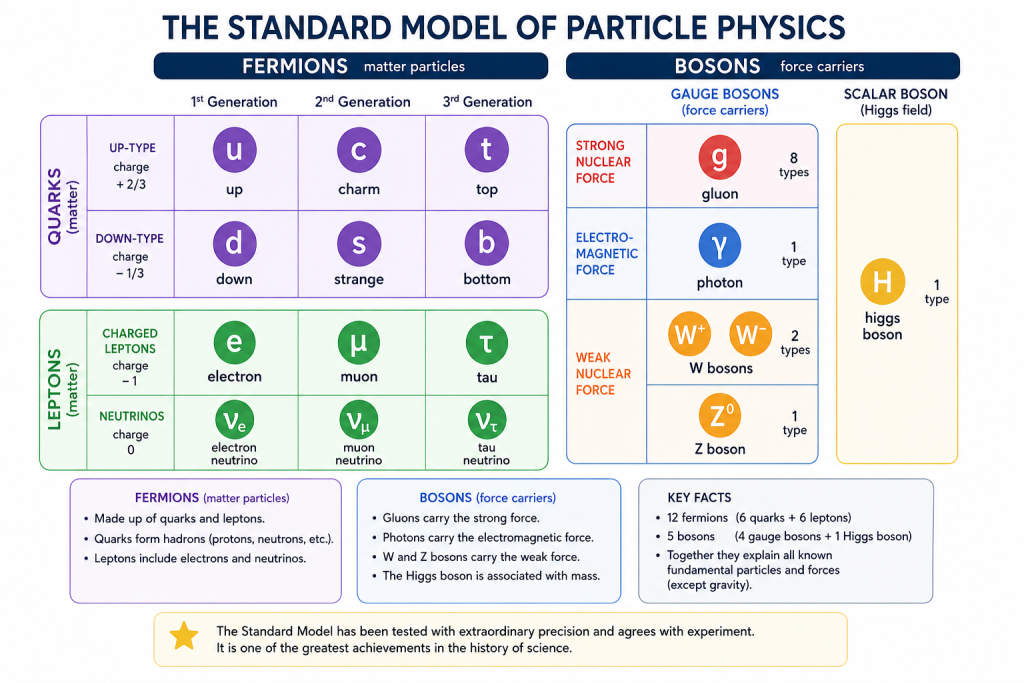
The Standard Model of particle physics is one of the greatest achievements in the history of science.
It represents humanity’s most successful attempt to describe the fundamental building blocks of matter and the forces that govern their interactions. Developed during the twentieth century through the work of many scientists, including Richard Feynman, Abdus Salam, Steven Weinberg, and Sheldon Glashow, the Standard Model has been tested with extraordinary precision and has consistently agreed with experiment.
According to this theory, everything we see around us is composed of a small number of elementary particles.
These particles fall into two broad categories.
The first are the fermions, which constitute matter itself. They include quarks and leptons. Quarks combine to form protons and neutrons, while leptons include electrons and neutrinos.
The second category consists of bosons, which act as carriers of the fundamental forces. Photons transmit the electromagnetic force, gluons are responsible for the strong nuclear force, and the W and Z bosons mediate the weak nuclear force.
In 2012, the discovery of the Higgs boson at CERN provided spectacular confirmation of one of the last missing pieces of the Standard Model. The Higgs field plays an important role in giving mass to many elementary particles.
Together, these particles and interactions explain an enormous range of physical phenomena, from the behavior of atoms and chemical elements to the processes occurring inside stars.
Yet despite its extraordinary success, the Standard Model is not a complete description of nature.
It does not include gravity, which is described separately by Einstein’s theory of general relativity. Nor does it explain dark matter, dark energy, or why matter dominates over antimatter in the universe.
Many physicists therefore regard the Standard Model not as the final answer, but as an important step toward a deeper understanding of reality.
Its elegance and predictive power have revealed a remarkable truth.
Beneath the immense complexity of the universe lies a surprisingly simple and beautiful structure.
And perhaps this is one of the most inspiring lessons of science.
Nature often possesses an underlying harmony that becomes visible only through patience, curiosity, and imagination.
For all its mysteries, the universe appears to be governed by laws that the human mind is capable of discovering.
And that, in itself, is something truly remarkable.
Key Ideas
- Matter consists of quarks and leptons.
- Bosons carry the fundamental forces.
- The Higgs boson was discovered in 2012.
- The Standard Model has been confirmed with extraordinary accuracy.
- Important mysteries, including gravity and dark matter, remain unsolved.
What We Can Learn
- Simplicity often lies beneath complexity.
- Scientific progress is built upon the work of many people.
- Even our most successful theories are incomplete.
- Curiosity and mathematics reveal hidden structures in nature.
- Every answer opens the door to new questions.