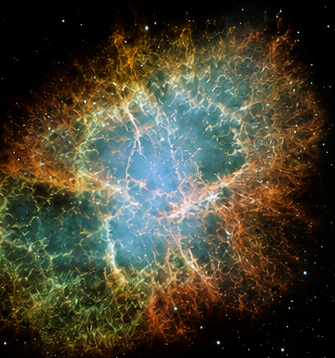
On a summer day in the year 1054, astronomers in China recorded the appearance of a brilliant new star. So bright was this object that it remained visible during daylight for several weeks and could be seen in the night sky for nearly two years.
What observers had witnessed was not the birth of a star, but its death.
The explosion occurred about 6,500 light-years away in the constellation Taurus. Today, the expanding remains of that explosion are known as the Crab Nebula, one of the most studied objects in the universe.
The Crab Nebula is the remnant of a massive star that ended its life in a spectacular supernova explosion. During this violent event, enormous amounts of energy and matter were hurled into space, creating the beautiful and intricate cloud we observe today.
At the center of the nebula lies one of the most extraordinary objects known to science—a neutron star.
This tiny remnant contains more mass than the Sun compressed into a sphere only about twenty kilometers across. It rotates approximately thirty times every second and possesses an extremely powerful magnetic field.
Because beams of radiation are emitted from its magnetic poles, the neutron star appears to flash as it rotates, much like a cosmic lighthouse. Such objects are known as pulsars.
The Crab Pulsar was discovered in 1968 and provided the first direct evidence that neutron stars truly exist.
The nebula itself continues to expand outward at thousands of kilometers per second. It emits radiation across the entire electromagnetic spectrum, from radio waves to gamma rays, making it an invaluable laboratory for studying extreme physical processes.
But beyond its scientific importance, the Crab Nebula tells a deeper story.
It reminds us that destruction and creation are often intertwined.
The death of one star enriched space with heavier elements that would later become part of new stars, planets, and perhaps even life itself.
In a very real sense, the Crab Nebula represents one chapter in the ongoing cycle of cosmic evolution.
Its brilliant filaments and energetic pulsar stand as a monument to a stellar death that occurred nearly a thousand years ago.
Yet the story is far from over.
Long after the explosion has faded and the nebula has dispersed into interstellar space, its material will continue its journey, contributing to future generations of stars and worlds.
Perhaps that is one of the most beautiful lessons astronomy teaches us.
Nothing in the universe truly stands alone.
Everything is connected.
And every ending carries within it the seeds of a new beginning.