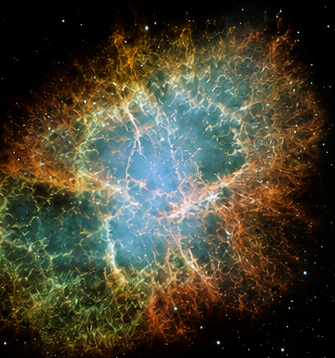
When massive stars reach the end of their lives, they may explode as supernovae. What remains behind depends largely on the mass of the collapsing core.
If the remnant is not massive enough to form a black hole, gravity compresses the core into one of the most extraordinary objects in the universe—a neutron star.
A neutron star contains more mass than the Sun compressed into a sphere only about twenty kilometers in diameter. In such an object, matter is packed together so densely that a teaspoonful would weigh billions of tons on Earth.
These stars are supported not by ordinary pressure but by quantum mechanical effects. In a sense, neutron stars represent one of nature’s most remarkable balances between gravity and the laws of quantum physics.
Neutron stars are also among the fastest rotating objects known. As the core of a star collapses, its rotation speeds up dramatically, much like a spinning ice skater pulling in their arms.
Some neutron stars rotate several times each second, while others complete hundreds of rotations every second.
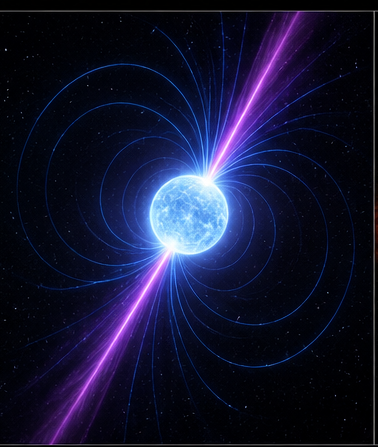
In addition to their rapid rotation, neutron stars possess immensely powerful magnetic fields. Charged particles accelerated by these fields emit beams of radiation from regions near the magnetic poles.
If these beams sweep across Earth as the star rotates, astronomers observe regular pulses of radiation.
Such objects are known as pulsars.
Pulsars were discovered in 1967 by Jocelyn Bell Burnell and Antony Hewish. The remarkable regularity of the pulses initially led to speculation that they might originate from extraterrestrial civilizations. In fact, the first source was jokingly nicknamed “Little Green Men.”
Soon it became clear that pulsars were natural objects—the rapidly rotating remnants of dead stars.
Today, pulsars serve as extraordinarily precise cosmic clocks. Their regular pulses allow astronomers to study gravity, test Einstein’s theory of relativity, and even search for gravitational waves.
Among the most famous pulsars is the Crab Pulsar, located at the center of the Crab Nebula. Rotating about thirty times each second, it provides a vivid reminder that stellar death can give rise to some of the most fascinating objects in the cosmos.
Perhaps neutron stars represent one of nature’s greatest demonstrations of extremes.
They are tiny yet incredibly massive.
Ancient yet energetic.
Born in violence, yet capable of emitting pulses with astonishing regularity.
And they remind us that even after the death of a star, remarkable stories continue to unfold.