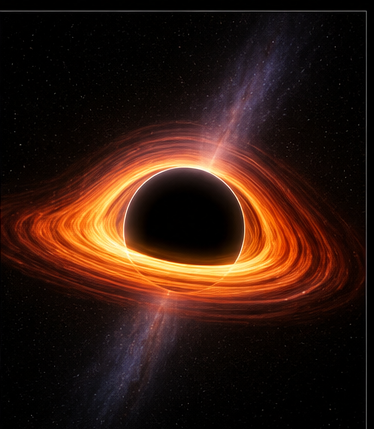
Among the strangest objects in the universe are black holes—regions where gravity becomes so extreme that even light cannot escape.
Their existence emerged naturally from Einstein’s theory of general relativity, which revealed that gravity is not merely a force but a manifestation of the curvature of space and time.
When massive stars exhaust their nuclear fuel, gravity may overwhelm all opposing forces. If the remaining core is sufficiently massive, collapse continues beyond the neutron star stage.
The result is a black hole.
A black hole is a region of space where gravity is so intense that nothing—not even light—can escape once it crosses a boundary known as the event horizon.
Because black holes emit no light of their own, they cannot be observed directly. Their presence is revealed through their influence on nearby stars, gas clouds, and radiation.
At the center of every black hole lies a concept known as a singularity—a region where matter is thought to be compressed to extraordinary densities and where our present understanding of physics breaks down.
This does not necessarily mean that singularities truly exist in nature. Rather, they may indicate that our current theories are incomplete.
Black holes come in different sizes. Stellar black holes form from the deaths of massive stars and may contain several times the mass of the Sun.
Supermassive black holes, containing millions or even billions of solar masses, reside at the centers of most galaxies, including our own Milky Way.
Far from being cosmic vacuum cleaners, black holes influence their surroundings primarily through gravity. If the Sun were somehow replaced by a black hole of the same mass, Earth would continue orbiting almost exactly as it does today.
One of the most remarkable predictions of modern physics is that black holes are not entirely black. According to Stephen Hawking, quantum effects near the event horizon allow black holes to emit extremely faint radiation, now known as Hawking radiation. Over unimaginably long timescales, this process could eventually cause black holes to evaporate.
In recent years, astronomers have achieved extraordinary successes. Gravitational waves from merging black holes have been detected, confirming predictions made by Einstein more than a century ago. In 2019, the Event Horizon Telescope collaboration produced the first image of a black hole’s shadow, providing direct evidence for the existence of these remarkable objects.
Yet many mysteries remain.
What truly happens inside a black hole?
Do singularities exist?
Can general relativity and quantum mechanics be reconciled?
These questions remain among the greatest unsolved problems in physics.
Black holes remind us that nature often becomes most mysterious where our understanding reaches its limits.
And sometimes, the greatest discoveries begin precisely where certainty ends.