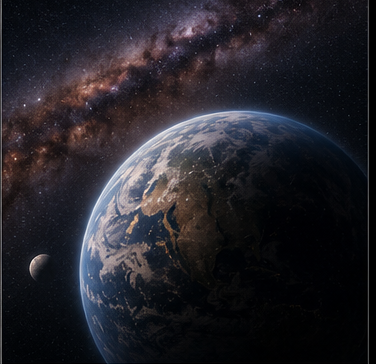
Since the dawn of civilization, humanity has wondered whether life exists beyond Earth.
For most of history, this question belonged to philosophy and speculation. Today, however, it has become a subject of scientific investigation.
Modern astronomy has revealed that planets are abundant throughout the universe. Our Milky Way galaxy alone may contain hundreds of billions of stars, many of them accompanied by planetary systems. Beyond our galaxy lie hundreds of billions of other galaxies, each containing countless stars and worlds.
The sheer number of planets suggests that the conditions necessary for life may not be unique to Earth.
Yet life requires more than simply the presence of a planet.
Scientists believe that liquid water, suitable temperatures, and certain chemical elements are among the essential ingredients for life as we know it. For this reason, astronomers pay special attention to planets located within the habitable zones of their stars, where liquid water may exist.
Within our own Solar System, several worlds have attracted interest. Mars once possessed rivers and lakes. Jupiter’s moon Europa and Saturn’s moon Enceladus hide vast oceans beneath their icy surfaces. These environments may provide conditions favorable to simple forms of life.
Beyond the Solar System, thousands of exoplanets have been discovered, and some appear to resemble Earth in size and temperature.
Despite decades of research, no evidence of life beyond Earth has yet been found.
This absence of evidence has given rise to one of the most intriguing puzzles in science, known as the Fermi Paradox.
If intelligent civilizations are common, why do we not see signs of them?
Numerous explanations have been proposed. Perhaps intelligent life is extremely rare. Perhaps civilizations are separated by immense distances and timescales. Or perhaps we have only just begun our search.
Projects such as SETI continue to listen for possible signals from distant civilizations, while future telescopes may be capable of detecting signs of biological activity in the atmospheres of exoplanets.
Whether or not we eventually discover life elsewhere, the search itself has already changed our perspective.
It has reminded us that Earth is not the center of the universe, nor is the Sun a special star.
We live on a small world orbiting an ordinary star in one galaxy among hundreds of billions.
Yet on this small planet, the universe has produced beings capable of asking one of its deepest questions.
Are we alone?
Perhaps the answer will come tomorrow.
Perhaps it will come centuries from now.
Or perhaps the greatest discovery of all will be the realization that life, curiosity, and consciousness are far more widespread than we ever imagined.
Until then, the question remains open.
And sometimes, the most beautiful questions are those whose answers still lie ahead.