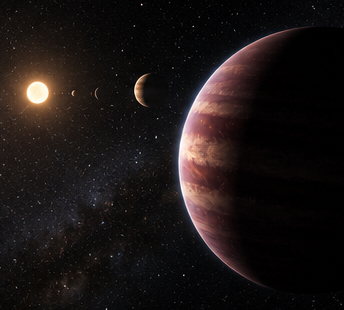
For most of human history, humanity knew of only one planetary system—our own.
The Sun, the planets, and their moons seemed to represent the entire known family of worlds. Whether planets existed around other stars remained one of astronomy’s greatest unanswered questions.
Today, we know that planets around other stars are not rare exceptions.
They are everywhere.
These distant worlds are known as exoplanets, meaning planets that orbit stars beyond our Solar System.
The first confirmed discovery of an exoplanet around a Sun-like star was announced in 1995. Since then, advances in technology and dedicated missions such as the Kepler Space Telescope have revolutionized our understanding of planetary systems.
Thousands of exoplanets have now been discovered, and astronomers estimate that our galaxy alone may contain hundreds of billions of them.
These worlds display a remarkable diversity.
Some are giant planets larger than Jupiter, orbiting extremely close to their stars. Others are rocky worlds similar in size to Earth. Some possess scorching temperatures capable of melting metals, while others may contain oceans beneath icy surfaces.
Many planetary systems look very different from our own, reminding us that nature often proves more imaginative than our expectations.
Detecting exoplanets is a challenging task because planets are usually overwhelmed by the brightness of their host stars. Astronomers therefore employ indirect methods. One of the most successful techniques measures the slight dimming of a star when a planet passes in front of it, while another detects tiny motions of a star caused by the gravitational pull of orbiting planets.
These methods have transformed our understanding of the universe.
Perhaps the most exciting discoveries involve planets located within the so-called habitable zone, where temperatures may allow liquid water to exist on their surfaces.
Although the presence of water does not guarantee life, it increases the possibility that suitable conditions might exist.
At present, no evidence for life beyond Earth has been found.
Yet the sheer number of planets now known strongly suggests that our world is unlikely to be unique.
For the first time in human history, we possess observational evidence that planets are common throughout the galaxy.
Perhaps among the countless worlds orbiting distant stars, there are places where life has emerged and evolved.
And perhaps, somewhere beneath another sky, other beings are looking upward and asking the same questions we ask.
For centuries, humanity wondered whether we were alone.
Today, we know that we are surrounded by worlds.
Whether we are surrounded by life remains one of the greatest unanswered questions in science.