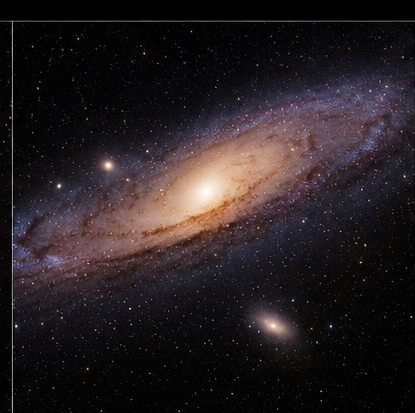
If stars are the building blocks of the universe, then galaxies are the great structures that bring them together.
A galaxy is a vast collection of stars, gas, dust, and dark matter held together by gravity. Some galaxies contain only a few million stars, while the largest contain trillions.
Our own home, the Milky Way, contains hundreds of billions of stars and spans approximately one hundred thousand light-years. The Sun is located in one of its spiral arms, orbiting the galactic center once every 230 million years.
Galaxies come in many shapes and sizes.
Spiral galaxies, such as the Milky Way and the Andromeda Galaxy, are characterized by graceful arms filled with young stars, gas, and dust. Elliptical galaxies are generally more rounded and contain older stellar populations. Irregular galaxies lack a well-defined shape and often owe their appearance to interactions with neighboring galaxies.
Far from being isolated islands, galaxies frequently interact and sometimes collide. These encounters can trigger bursts of star formation and profoundly alter their structure. Over billions of years, smaller galaxies may merge to form larger ones.
At the centers of most galaxies reside supermassive black holes containing millions or even billions of times the mass of the Sun. These mysterious objects play an important role in the evolution of galaxies and may influence the formation of stars on enormous scales.
Galaxies themselves are not randomly distributed throughout the universe. They gather into groups and clusters, forming immense cosmic structures connected by filaments of matter. Between these filaments lie enormous voids where relatively few galaxies are found.
This intricate arrangement, known as the cosmic web, represents one of the largest structures in nature.
Modern telescopes have revealed that the observable universe contains hundreds of billions of galaxies, each filled with countless stars and potentially countless worlds.
Such numbers are difficult to comprehend.
Yet among all these galaxies, one small spiral galaxy contains a modest star around which a small planet circles.
On that planet, life emerged.
And on that world, beings evolved that became capable of asking questions about the universe.
Perhaps that is one of the most extraordinary facts of all.
Amid hundreds of billions of galaxies spread across unimaginable distances, the universe has produced at least one place where it has become aware of itself.
And perhaps there are others.