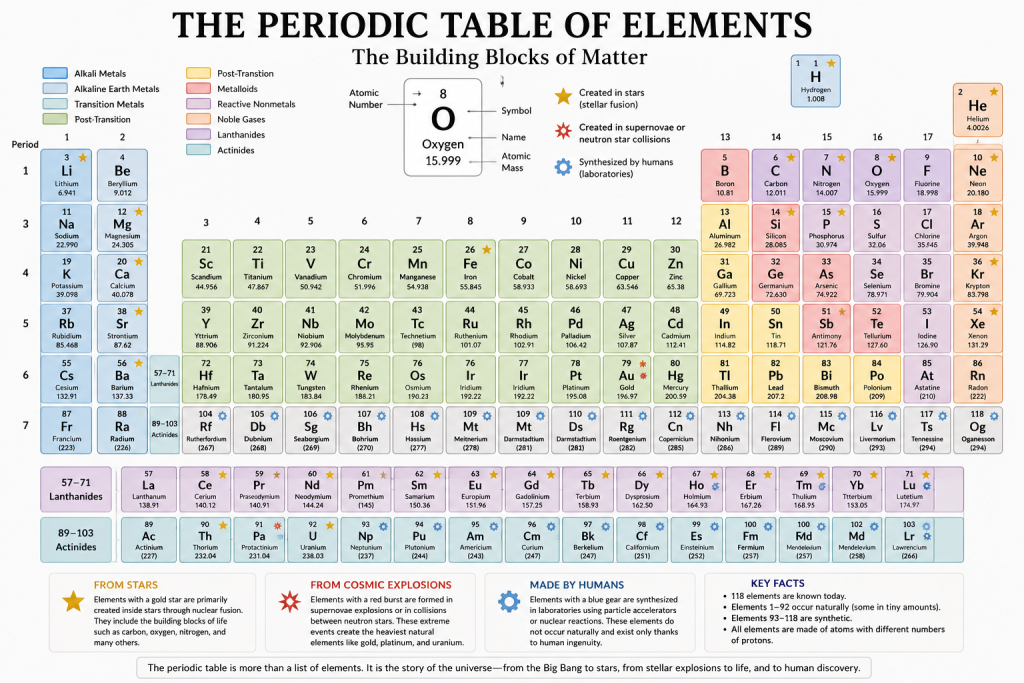
Everything around us—stars, planets, oceans, trees, and even ourselves—is made from a surprisingly small number of ingredients.
These ingredients are the chemical elements.
At first glance, the periodic table may appear complicated. Yet beneath its many boxes and symbols lies a remarkable simplicity.
All elements are built according to the same basic principle.
Hydrogen, the simplest and most abundant element in the universe, consists of a nucleus containing a single proton surrounded by one electron. It was one of the first elements to appear after the Big Bang and remains the primary fuel of stars.
From this humble beginning, nature constructs all the other elements.
By adding more protons to the nucleus, heavier elements are formed. Two protons produce helium. Six protons produce carbon. Eight produce oxygen. Twenty-six produce iron. Seventy-nine produce gold. Ninety-two produce uranium.
In this sense, the diversity of matter arises from a remarkably simple idea.
Nature does not require different kinds of atoms for different substances. Instead, the same underlying structure is repeated with different numbers of protons.
Inside stars, immense temperatures and pressures allow lighter elements to fuse into heavier ones. Massive stars create elements up to iron in their interiors. Even heavier elements, including gold and uranium, are forged during supernova explosions and collisions between neutron stars.
Thus, the atoms in our bodies have a cosmic history.
The hydrogen in water originated shortly after the Big Bang. The carbon in our cells and the oxygen we breathe were created inside ancient stars. The iron in our blood was forged in stellar furnaces billions of years ago.
Human ingenuity has extended the periodic table even further. Using particle accelerators and nuclear reactors, scientists have produced elements beyond uranium, creating entirely new forms of matter that do not occur naturally in significant amounts.
Today, the periodic table contains 118 known elements.
Yet despite this variety, all matter is built according to the same elegant principle.
Perhaps this is one of the most beautiful lessons science can teach.
Nature is often far simpler than we imagine.
From the simplest hydrogen atom to the heaviest synthetic elements, the universe demonstrates that extraordinary complexity can emerge from simple rules.
And perhaps that is why the periodic table is more than a chart of chemical elements.
It is a story.
A story that begins with hydrogen.
And ultimately leads to stars, planets, life, and ourselves.
For in understanding the elements, we discover something profound.
We are not separate from the universe.
We are one of its creations.