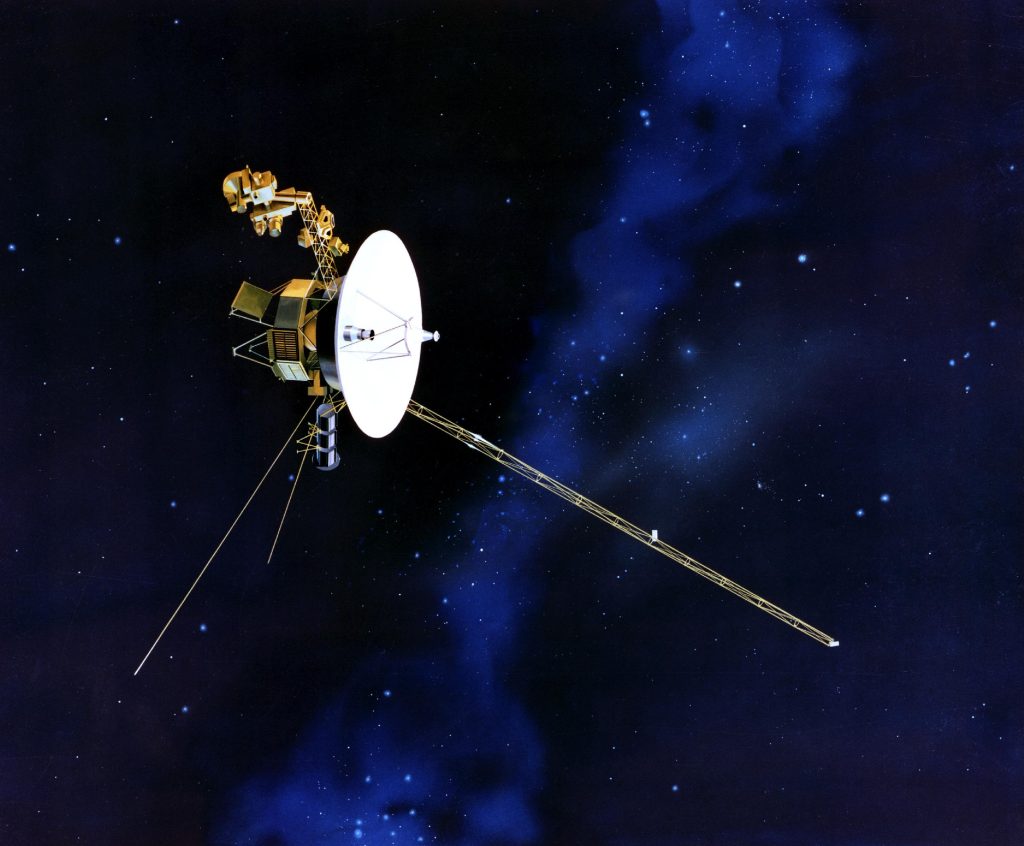
In 1977, humanity launched two spacecraft that would become the most distant objects ever created by our species.
Voyager 1 and Voyager 2 were designed to explore the outer planets of the Solar System. What began as a mission to study Jupiter and Saturn evolved into one of the greatest scientific adventures in history.
Taking advantage of a rare alignment of the planets, the two spacecraft embarked on a journey that would transform our understanding of the Solar System. Voyager 1 and Voyager 2 revealed Jupiter’s turbulent atmosphere and discovered active volcanoes on its moon Io. They provided breathtaking views of Saturn and its rings and uncovered new details about Uranus and Neptune.
Voyager 2 remains the only spacecraft ever to visit Uranus and Neptune.
The discoveries made by the Voyagers changed planetary science forever.
Yet perhaps their most remarkable feature is something very different.
Attached to each spacecraft is a golden phonograph record, known simply as the Golden Record.
Created under the leadership of Carl Sagan and his colleagues, the record contains greetings in many languages, sounds from Earth, and music from different cultures. It also includes photographs and information intended to tell the story of our world.
The Golden Record was not designed with the expectation that it would necessarily be found.
Instead, it represented something deeply human.
It was a message.
A greeting from one small planet to the universe.
Today, the Voyager spacecraft have reached distances unimaginable when they were launched in 1977. They are now more than a light-day away from Earth, meaning that radio signals traveling at the speed of light take over twenty hours to reach them and nearly the same time to return. No human-made object has ever traveled farther.
They remain the most distant ambassadors of our species, continuing their silent journey through interstellar space.
Voyager 1 crossed the boundary of the heliosphere in 2012, becoming the first human-made object to enter interstellar space. Voyager 2 followed in 2018.
Although their power sources are gradually weakening, the spacecraft continue to send valuable scientific information back to Earth.
Long after their instruments fall silent, the Voyagers will continue to travel among the stars.
In about 40,000 years, Voyager 1 will pass near another star. For millions and perhaps billions of years, these tiny machines will wander through the Milky Way.
Perhaps no one will ever find them.
But that was never the point.
The Voyager spacecraft are symbols of curiosity, hope, and the desire to understand our place in the cosmos.
They remind us that even though humanity occupies only a tiny corner of the universe, we are capable of reaching outward and asking profound questions.
The Voyagers will outlive every monument humanity has ever built. Long after cities have changed and civilizations have come and gone, these small machines may still be traveling through the Milky Way, carrying with them a golden record and a message from a small blue world.
And perhaps, somewhere in the distant future, the Golden Record may tell another civilization that once, on a small blue world orbiting an ordinary star, there lived beings who wondered about the universe and wished to say hello.
Key Ideas
- Voyager 1 and Voyager 2 were launched in 1977.
- They explored the outer planets of the Solar System.
- Voyager 2 remains the only spacecraft to visit Uranus and Neptune.
- Both spacecraft now travel through interstellar space.
- Each carries a Golden Record containing sounds and messages from Earth.
- They are the most distant objects ever created by humanity.
What We Can Learn
- Exploration can continue far beyond its original goals.
- Curiosity is one of humanity’s defining qualities.
- Science and imagination often work together.
- The universe is vast, but we are capable of reaching toward it.
- Even small messages can carry great meaning.
- Some creations may outlive the civilizations that built them.