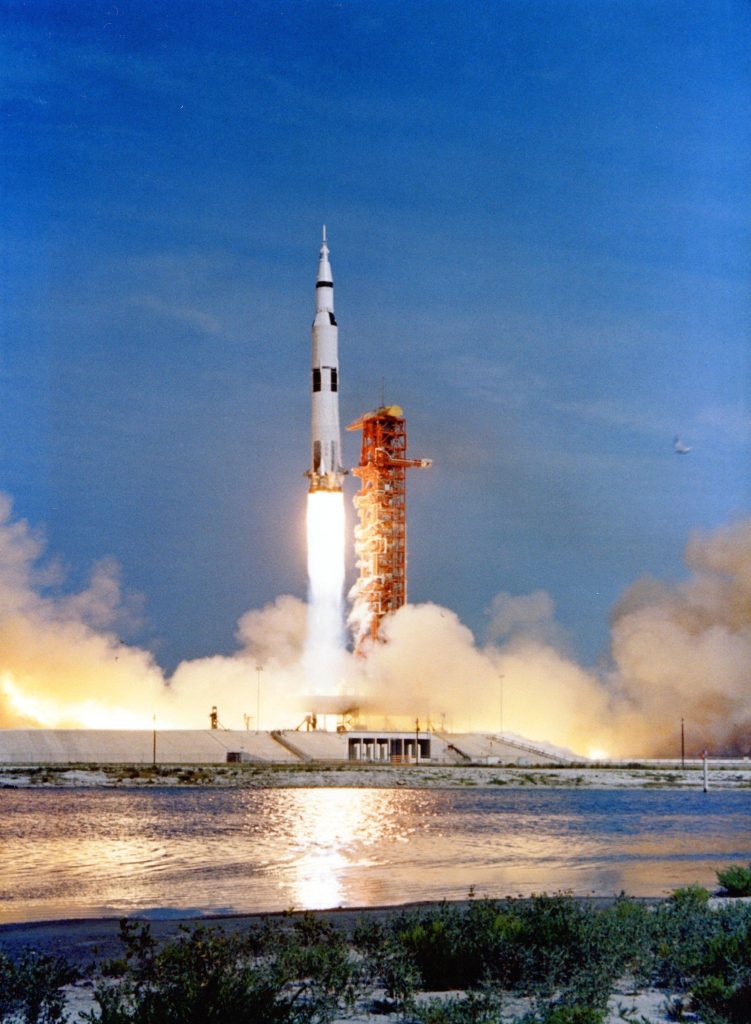
The Apollo Program stands as one of humanity’s greatest achievements.
Developed by NASA during the 1960s and early 1970s, the program had a bold and ambitious goal: to land humans on the Moon and return them safely to Earth.
The challenge was enormous.
At the beginning of the 1960s, no human had ventured beyond Earth orbit. The technologies required for a journey to the Moon had yet to be invented. Thousands of scientists, engineers, technicians, and astronauts would work together to turn an extraordinary dream into reality.
The origins of the Apollo Program can be traced to the Space Race between the United States and the Soviet Union. Following the launch of Sputnik and Yuri Gagarin’s historic flight, President John F. Kennedy announced in 1961 that the United States would send a man to the Moon and bring him safely back before the end of the decade.
It was one of the most ambitious goals ever set by a nation.
To accomplish this task, NASA developed the powerful Saturn V rocket, the largest and most powerful rocket ever successfully flown. Standing over one hundred meters tall, the Saturn V was capable of carrying astronauts beyond Earth orbit and toward the Moon.
The Apollo spacecraft consisted of three main parts: the Command Module, where the astronauts lived during most of the mission; the Service Module, which provided power and propulsion; and the Lunar Module, designed to land on the Moon’s surface.
The Apollo Program was not without tragedy.
In 1967, astronauts Gus Grissom, Ed White, and Roger Chaffee lost their lives during a ground test in what became known as the Apollo 1 disaster. Their sacrifice led to important improvements in spacecraft safety and reminded everyone of the risks involved in exploration.
Between 1968 and 1972, nine Apollo missions traveled to the Moon. Six of these missions successfully landed astronauts on its surface.
Apollo 11 achieved the first Moon landing in July 1969, fulfilling President Kennedy’s challenge and marking one of the most celebrated moments in human history.
The Apollo missions brought back hundreds of kilograms of lunar rocks and greatly expanded our understanding of the Moon and the early history of the Solar System.
Yet the Apollo Program represented something greater than science and technology.
It demonstrated what human beings can accomplish when imagination, determination, and cooperation are united toward a common goal.
Today, more than half a century later, the images of the Saturn V rocket and the footprints left on the Moon continue to inspire people around the world.
The Apollo Program remains a reminder that seemingly impossible dreams can become reality.
And perhaps its greatest legacy is the realization that humanity’s future need not be confined to one world.
Key Ideas
- The Apollo Program was developed by NASA during the 1960s and early 1970s.
- Its goal was to land humans on the Moon and return them safely to Earth.
- The Saturn V rocket made lunar missions possible.
- Apollo 1 was a tragic setback that improved spacecraft safety.
- Six Apollo missions successfully landed astronauts on the Moon.
What We Can Learn
- Great achievements require courage and cooperation.
- Exploration involves both triumph and sacrifice.
- Ambitious goals can inspire generations.
- Science and engineering can turn dreams into reality.
- Humanity’s future may extend far beyond Earth.