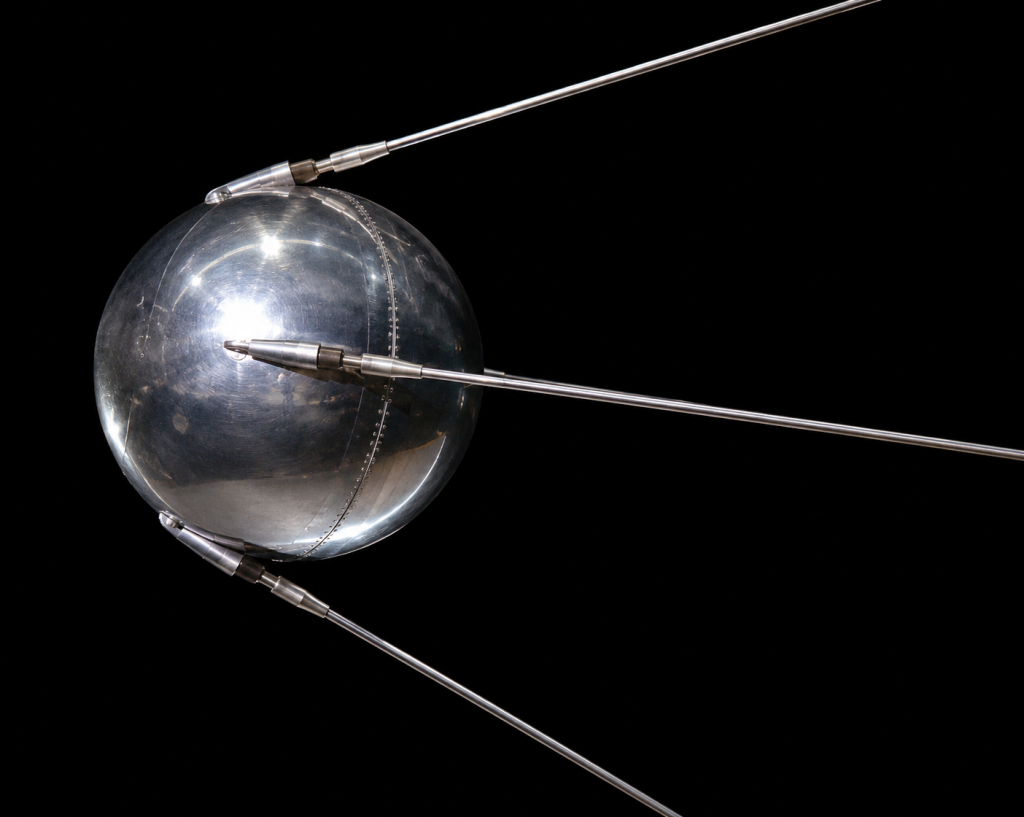
On October 4, 1957, humanity entered a new era.
On that day, the Soviet Union launched Sputnik 1, the first artificial satellite ever placed into orbit around the Earth. Although small and simple by modern standards, this polished sphere marked the beginning of the Space Age and transformed humanity’s relationship with the cosmos.
Sputnik measured only about 58 centimeters in diameter and weighed approximately 84 kilograms. Four long antennas extended from its surface, transmitting a steady radio signal that could be detected around the world.
To many people, the repetitive “beep-beep” from Sputnik became the sound of a new age.
For the first time in history, a human-made object had escaped the Earth’s surface and entered orbit.
The achievement astonished the world.
It demonstrated that spaceflight was possible and revealed the extraordinary capabilities of rocket technology. At the same time, it intensified the rivalry between the Soviet Union and the United States, leading to what became known as the Space Race.
The launch of Sputnik had consequences far beyond politics.
Scientists gained valuable information about the Earth’s upper atmosphere and the behavior of radio waves in space. Governments increased investments in science and education. In 1958, the United States established NASA, an organization that would later play a central role in humanity’s exploration of the Moon and the planets.
Sputnik itself remained in orbit for about three months before re-entering the Earth’s atmosphere in January 1958.
Although its mission was brief, its impact was immense.
From that small sphere grew an extraordinary chain of achievements.
Yuri Gagarin became the first human in space.
Astronauts walked on the Moon.
Robotic probes explored the planets.
The Hubble Space Telescope transformed our view of the universe.
Voyager carried humanity’s message toward the stars.
And today, powerful observatories such as the James Webb Space Telescope continue to reveal the wonders of the cosmos.
Looking back, it is remarkable that so much began with such a modest machine.
Sputnik did not carry cameras, astronauts, or scientific laboratories.
It carried something equally important.
It carried a dream.
For the first time, humanity had taken its first small step beyond its home world.
And although few people realized it at the time, the journey had only just begun.
Key Ideas
- Sputnik 1 was launched on October 4, 1957.
- It was the first artificial satellite to orbit the Earth.
- Its success marked the beginning of the Space Age.
- Sputnik helped inspire scientific and technological progress.
- The launch eventually led to many of humanity’s greatest achievements in space exploration.
What We Can Learn
- Great journeys often begin with small steps.
- Scientific discoveries can transform society.
- Curiosity and imagination drive exploration.
- Even simple machines can change history.
- Humanity’s reach can extend beyond its home planet.