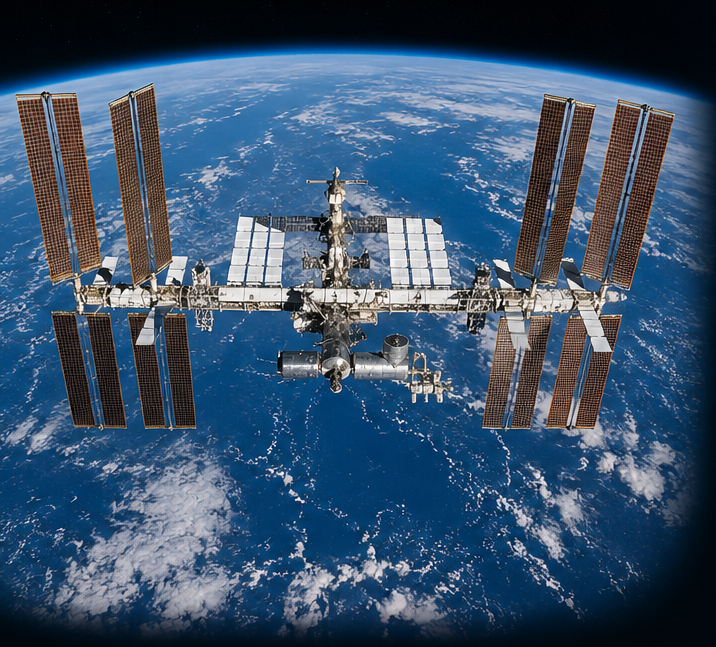
Orbiting hundreds of kilometers above the Earth, the International Space Station stands as one of humanity’s greatest achievements in cooperation and exploration.
The idea of a permanently inhabited laboratory in space became a reality in 1998, when the first components of the station were launched. Since then, astronauts and cosmonauts from many nations have lived and worked together aboard this remarkable outpost.
Traveling around the Earth at a speed of nearly 28,000 kilometers per hour, the International Space Station completes an orbit every ninety minutes. From its windows, astronauts witness sixteen sunrises and sunsets each day, offering breathtaking views of our planet.
The station serves as a unique laboratory where scientists study the effects of weightlessness on the human body, conduct experiments in biology, physics, and medicine, and test technologies that may one day enable humanity to travel to the Moon, Mars, and beyond.
Perhaps even more important than its scientific achievements is what the International Space Station represents. Built and operated through the cooperation of many nations, it demonstrates that humanity can work together in the pursuit of knowledge and exploration.
For more than two decades, the station has been continuously inhabited, making it one of the longest-lasting human endeavors in space.
The International Space Station reminds us that space exploration is not merely about machines and technology.
It is also about people, cooperation, and our shared desire to reach beyond the boundaries of Earth.
High above our world, it stands as a symbol of what humanity can achieve when we work together.