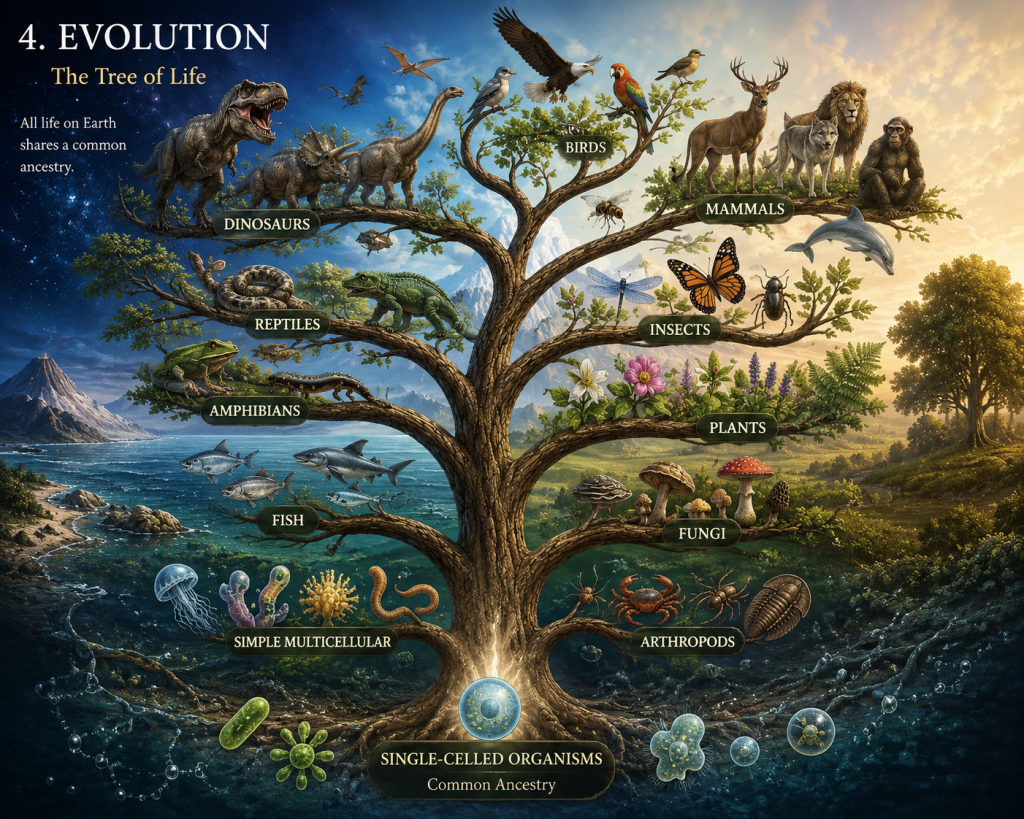
One of the most profound discoveries in science is that life on Earth has not remained unchanged.
Over billions of years, living organisms have gradually evolved, adapting to changing environments and giving rise to the extraordinary diversity of life that surrounds us today.
The idea of evolution reached its fullest expression through the work of Charles Darwin and Alfred Russel Wallace in the nineteenth century. They recognized that individuals within a species vary, and that those best suited to their environment are more likely to survive and reproduce. Over many generations, these small changes accumulate, leading to the emergence of new species.
Evolution is not a journey toward perfection, nor does it follow a predetermined plan. Rather, it is a natural process shaped by inheritance, variation, and the pressures of the environment.
The history of life on Earth stretches back more than 3.5 billion years. From simple single-celled organisms arose fish, plants, insects, amphibians, reptiles, birds, mammals, and eventually human beings.
Modern genetics has provided overwhelming evidence for evolution. The shared DNA of living organisms reveals that all species are related and descended from common ancestors. In this sense, every living creature on Earth belongs to one vast family tree.
Evolution has produced an astonishing variety of forms and adaptations. The wings of birds, the eyes of insects, the intelligence of dolphins, and the human brain are all products of this long and remarkable process.
Far from diminishing the wonder of life, evolution enriches it.
It tells us that we are connected not only to one another, but to every living thing on our planet.
The story of evolution is, in many ways, the story of life itself.
And it reminds us that all life on Earth shares a common ancestry and a common home.