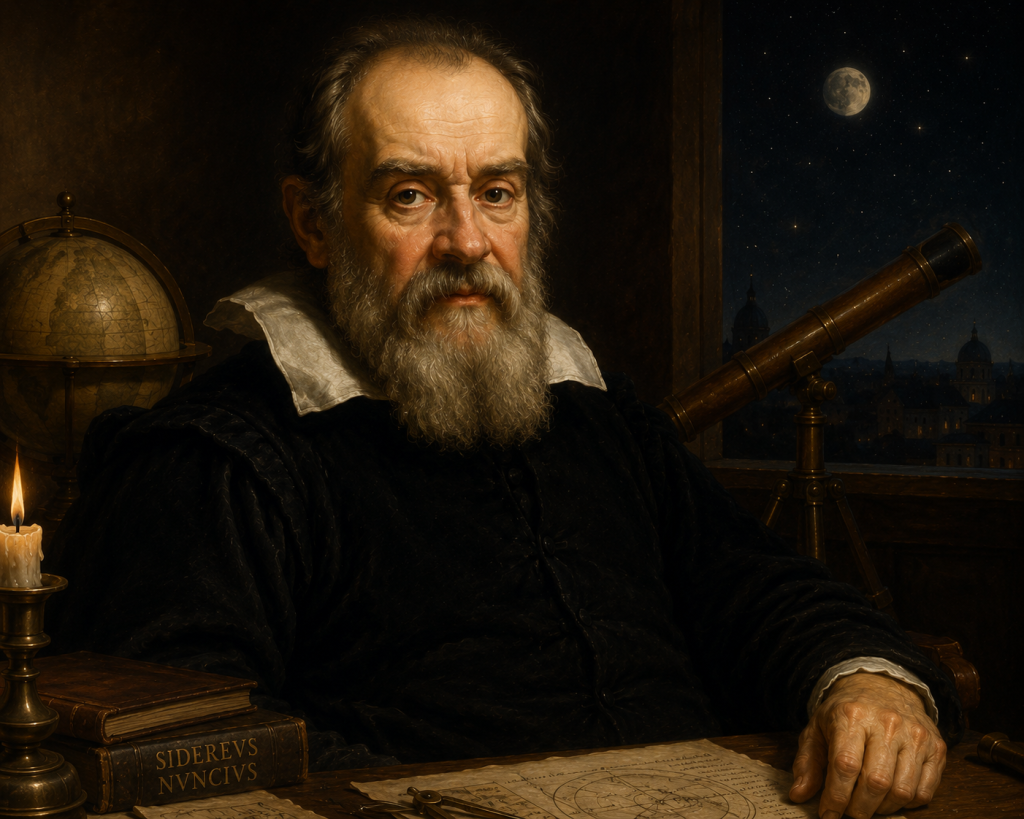
One evening in 1609, a man pointed a small telescope toward the night sky. What he saw forever changed humanity’s understanding of the Universe. That man was Galileo Galilei.
Galileo Galilei was born in Pisa, Italy, in 1564. From an early age he showed an extraordinary curiosity about the natural world and a remarkable talent for mathematics. Although he studied medicine at university, his true passion lay in understanding how nature works through observation, experiment and reason.
When Galileo learned of a new optical instrument invented in the Netherlands, he built his own improved telescope and turned it toward the heavens. What he saw astonished him.
For the first time in history, a human being observed mountains and craters on the Moon, proving that the heavenly bodies were not the perfect spheres described by ancient philosophy. He discovered four large moons orbiting Jupiter, demonstrating that not everything revolved around the Earth. He observed the phases of Venus, providing powerful evidence that the planet orbited the Sun. He also studied sunspots and revealed that even the Sun was not perfect and unchanging.
Each observation weakened the traditional picture of the Universe and strengthened the heliocentric model proposed by Nicolaus Copernicus.
Galileo did not ask people to believe him.
He asked them to look through the telescope for themselves.
His discoveries were published in Sidereus Nuncius (The Starry Messenger) in 1610 and quickly attracted attention throughout Europe. More importantly, they transformed the telescope from a simple optical curiosity into one of the greatest scientific instruments ever created.
Galileo’s work extended far beyond astronomy. Through careful experiments he investigated falling bodies, motion and the strength of materials, laying the foundations of modern physics. His insistence that scientific knowledge should be based upon observation and experiment marked a turning point in the history of science.
His support for Copernicus’ heliocentric system eventually brought him into conflict with the Roman Catholic Church. In 1633 he was summoned before the Roman Inquisition and placed on trial. Under great pressure, he was required to renounce his public support for the idea that the Earth moves around the Sun and was sentenced to spend the remainder of his life under house arrest.
Today, the trial is often remembered as a conflict between science and religion. In reality, it was a complex event shaped by scientific debate, religious authority, politics and the personalities of the time. What history ultimately demonstrated, however, was that Galileo’s observations were correct. The Earth does indeed move around the Sun.
According to a famous tradition, as Galileo left the courtroom after being forced to recant, he quietly murmured:
“Eppur si muove.”
“And yet it moves.”
Whether Galileo actually spoke these words can never be known with certainty. The story first appeared many years after his death. Yet the phrase has become one of history’s greatest symbols of scientific integrity. It reminds us that truth does not change because people refuse to accept it. The Earth continued to move around the Sun, just as it always had.
Despite his confinement, Galileo continued his scientific work and writing. Even when his eyesight failed in later life, his curiosity never faded.
Galileo’s greatest contribution was not simply what he discovered but how he discovered it. He demonstrated that nature must be understood by observing it carefully, testing ideas through experiment and allowing evidence—not authority—to decide what is true.
His life reminds us that genuine scientific courage is not the refusal to question authority for its own sake. It is the willingness to follow the evidence wherever it leads, even when doing so demands great personal sacrifice.
Legacy
Galileo Galilei transformed astronomy by becoming the first scientist to use a telescope systematically to explore the heavens. His discoveries provided powerful evidence for the heliocentric Universe and helped establish observation and experiment as the foundations of modern science. He is rightly regarded as one of the fathers of modern physics and observational astronomy.
What We Can Learn
Observe nature before drawing conclusions.
Evidence is stronger than assumption.
Great discoveries often require the courage to challenge accepted beliefs.
Science advances through observation, experiment and critical thinking.
Curiosity is one of humanity’s greatest strengths.