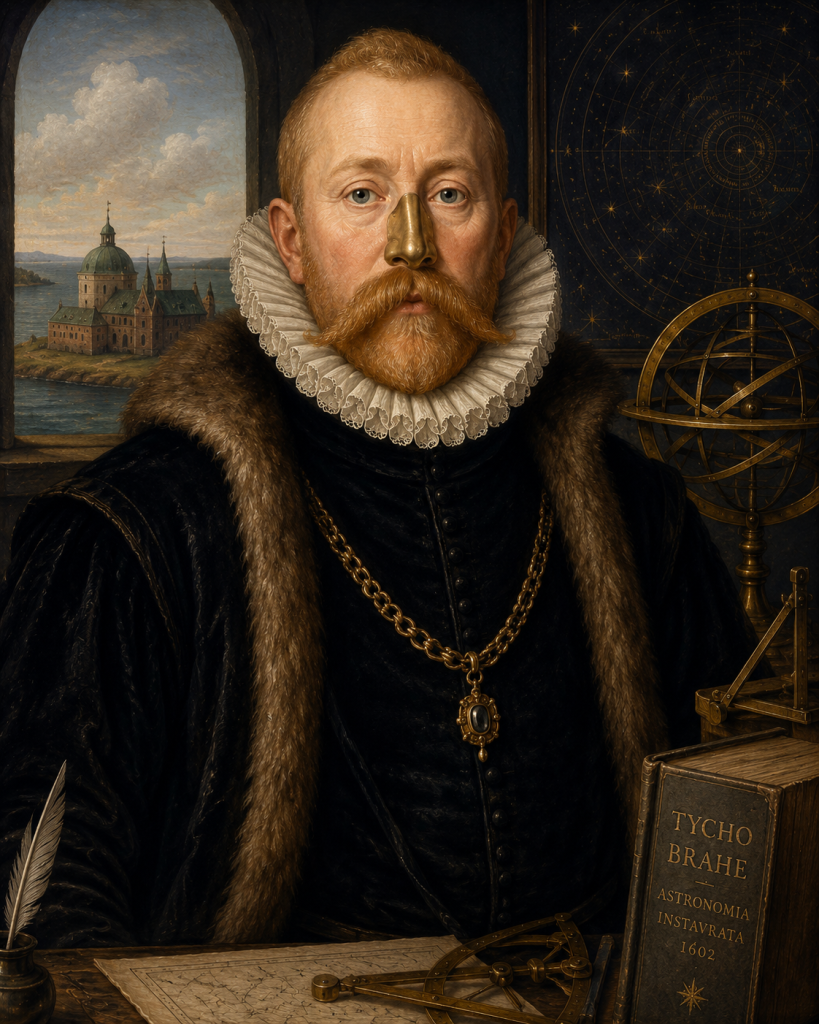
Few astronomers have transformed careful observation into scientific discovery as profoundly as Tycho Brahe. At a time when telescopes did not yet exist, he measured the heavens with such extraordinary precision that his observations became the foundation upon which modern astronomy was built.
Tycho Brahe was born in 1546 into a noble Danish family. From an early age he developed a fascination with the night sky, eventually dedicating his life to understanding the motions of the stars and planets. His passion for astronomy led him to become the greatest observational astronomer of the sixteenth century.
As a young man, Tycho became involved in a duel with another student over a mathematical disagreement and lost part of his nose. For the rest of his life he wore a carefully crafted metal prosthetic, a feature that became one of the most recognizable aspects of his appearance. Yet it was not his unusual nose that earned him a place in history, but his extraordinary devotion to scientific observation.
With the support of King Frederick II of Denmark, Tycho built Uraniborg on the island of Hven, one of the world’s first purpose-built astronomical research centres. There he established workshops, laboratories, libraries and carefully designed observing instruments unlike anything that had existed before. Long before the invention of the telescope, Uraniborg became the most advanced observatory in Europe.
Night after night, Tycho and his assistants measured the positions of stars and planets with remarkable precision. His observations were so accurate that many remained unsurpassed until the telescope transformed astronomy decades later.
In 1572, Tycho observed the appearance of a brilliant new star in the constellation Cassiopeia. Today we know it was a supernova. At the time, however, its appearance challenged the ancient belief that the heavens were perfect and unchanging. A few years later he carefully studied the Great Comet of 1577 and demonstrated that comets travelled far beyond Earth’s atmosphere, further weakening long-held ideas about the structure of the heavens.
Although Tycho admired the mathematical elegance of Copernicus, he was not fully convinced that the Earth moved around the Sun. Instead, he proposed a compromise in which the planets revolved around the Sun while the Sun itself revolved around the Earth. His model was ultimately incorrect, but it reflected his determination to make theory agree with observation rather than accept ideas without sufficient evidence.
Among those who came to work with Tycho in Prague was the brilliant young German mathematician Johannes Kepler. Tycho immediately recognized Kepler’s exceptional talent but remained protective of the observations that represented decades of his life’s work. He entrusted Kepler with the difficult task of analysing the orbit of Mars while retaining control of most of his precious data.
After Tycho’s death, Kepler gained access to the complete observational record. Using Tycho’s extraordinarily precise measurements—especially those of Mars—he discovered that planets move in elliptical rather than circular orbits. Those discoveries became Kepler’s famous laws of planetary motion and later enabled Isaac Newton to explain the force of gravity.
Tycho Brahe reminds us that great discoveries are not always made by the person who reaches the final conclusion. Sometimes the greatest contribution is to gather observations so accurate that future generations can uncover truths that would otherwise have remained hidden.
His life stands as one of the finest examples of science as a shared human journey. Tycho measured the heavens with unmatched precision. Kepler discovered the laws hidden within those measurements. Newton explained why those laws worked. Each stood upon the shoulders of those who came before.
Today, visitors still travel to the island of Hven, where Uraniborg once stood, and to Prague, where Tycho Brahe rests, remembering the remarkable observer whose careful work helped transform humanity’s understanding of the Universe.
Legacy
Tycho Brahe elevated astronomical observation to an entirely new level of precision. His meticulous measurements of the heavens became the essential foundation upon which Johannes Kepler discovered the laws of planetary motion. Through his dedication to careful observation, Tycho helped open the path to modern astronomy.
What We Can Learn
Careful observation is the foundation of scientific discovery.
Great achievements often require patience over many years.
Accurate data can become the key to discoveries made by future generations.
Science advances through collaboration across generations.
Our greatest legacy is often the knowledge we leave for others to build upon.