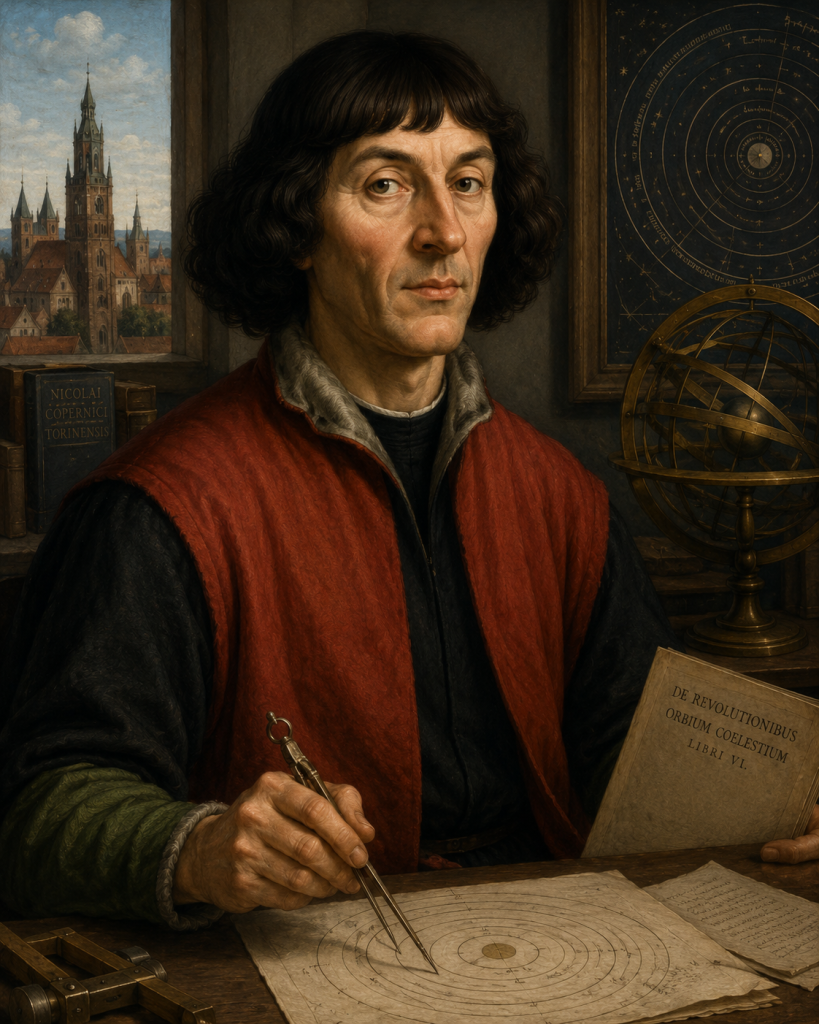
Few individuals have changed humanity’s view of the Universe as profoundly as Nicolaus Copernicus. By placing the Sun, rather than the Earth, at the centre of the planetary system, he began a scientific revolution that forever transformed our understanding of the cosmos and our place within it.
Nicolaus Copernicus was born in 1473 in the city of Toruń, in present-day Poland. Educated in mathematics, astronomy, medicine and canon law, he possessed a remarkably broad intellectual background. Although he served the Church throughout much of his life as a canon, his deepest passion remained the study of the heavens.
For more than a thousand years, astronomers had accepted the geocentric model developed by Claudius Ptolemy, which placed the Earth at the centre of the Universe. The model successfully predicted many celestial motions, yet it had become increasingly complex, requiring circles upon circles to explain the wandering paths of the planets.
Copernicus believed that nature should be simpler.
After years of careful observation and mathematical calculation, he proposed a bold alternative. He suggested that the Sun occupied the central position in the planetary system and that the Earth was itself a planet, moving around the Sun once each year while rotating on its own axis every twenty-four hours. The daily motion of the heavens, he argued, was not caused by the stars revolving around the Earth but by the Earth’s own rotation.
This idea was revolutionary.
It challenged not only centuries of astronomical tradition but also humanity’s understanding of its own place in creation. The Earth was no longer the unmoving centre of the Universe. It became one world among others, travelling through space around an ordinary star.
Copernicus understood the extraordinary nature of his proposal. To place the Sun, rather than the Earth, at the centre of the planetary system was to challenge more than fifteen centuries of accepted belief. Rather than rushing to publish, he spent nearly forty years refining his calculations, testing his ideas and searching for the strongest possible evidence. He was a careful scholar who valued accuracy above recognition.
Although he dedicated his book to Pope Paul III, Copernicus knew that his ideas would provoke controversy among both scholars and religious authorities. According to a long-standing tradition, the first printed copy of his masterpiece, De revolutionibus orbium coelestium (On the Revolutions of the Heavenly Spheres), reached him on 24 May 1543, the day he died. Whether he was fully aware of the book in his final hours can no longer be known with certainty, but the story has become one of the most enduring and symbolic moments in the history of science.
Although his heliocentric model was not immediately accepted, it marked the beginning of the Scientific Revolution. Later astronomers, including Tycho Brahe, Johannes Kepler and Galileo Galilei, would refine, test and strengthen the evidence until the Sun-centred system became firmly established.
Copernicus demonstrated one of the most important principles of science: long-established beliefs must always remain open to question when the evidence points in a different direction. His work reminds us that progress often begins with the courage to reconsider ideas that everyone else accepts as certain.
Today, every spacecraft launched into the Solar System, every planet discovered around another star and every modern model of the cosmos traces part of its intellectual heritage back to the quiet scholar who dared to move the Earth.
Nicolaus Copernicus did more than rearrange the planets.
He changed humanity’s perspective.
He reminded us that our place in the Universe must be discovered through observation, reason and evidence—not through assumption.
His life reminds us that genuine scientific courage is often quiet. It is found not in seeking attention, but in patiently following the evidence wherever it leads.
Legacy
Nicolaus Copernicus began the Scientific Revolution by restoring the Sun to the centre of the planetary system. His heliocentric model transformed astronomy, inspired generations of scientists and fundamentally changed humanity’s understanding of its place in the cosmos. His work paved the way for Tycho Brahe, Johannes Kepler, Galileo Galilei, Isaac Newton and all of modern astronomy.
What We Can Learn
- Great discoveries often begin by questioning accepted beliefs.
- Simplicity can reveal deeper truths about nature.
- Scientific ideas should be guided by evidence rather than tradition.
- Patience and careful observation are essential to lasting discovery.
- True courage sometimes means quietly defending an idea until the evidence speaks for itself.