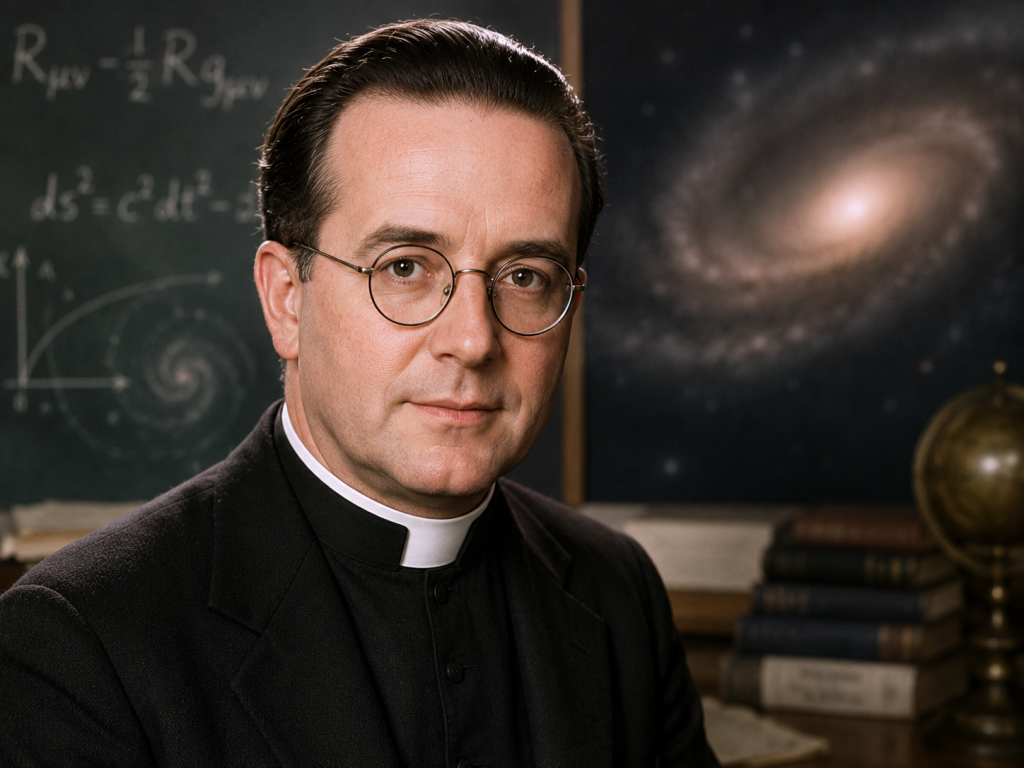
Georges Lemaître changed our understanding of the Universe by proposing that it had a beginning. A mathematician, astronomer and Catholic priest, he showed that Einstein’s theory of General Relativity pointed not to a static Universe but to one that is expanding. From this insight he developed the idea of the “primeval atom,” which later became known as the Big Bang theory. His life reminds us that curiosity, reason and faith can coexist while each remains true to its own purpose.
Georges Lemaître was born in 1894 in Charleroi, Belgium. From an early age he showed an exceptional ability in mathematics and a deep curiosity about the natural world. At the same time, he felt a strong religious calling. Rather than seeing science and faith as opposing forces, he believed they asked different questions. Science seeks to understand how the Universe works, while religion explores questions of meaning and purpose.
His education was interrupted by the First World War, during which he served as an artillery officer in the Belgian Army. After the war he resumed his studies, earning degrees in mathematics and physics before being ordained as a Catholic priest in 1923.
Lemaître continued his scientific education at the University of Cambridge, where he studied under the renowned astronomer Sir Arthur Eddington. He later spent time at Harvard University and the Massachusetts Institute of Technology, becoming one of the few scientists of his generation equally comfortable with mathematics, astronomy and theoretical physics.
Inspired by Albert Einstein’s General Theory of Relativity and Edwin Hubble’s observations of distant galaxies, Lemaître reached a remarkable conclusion. If the Universe is expanding today, then it must once have been much smaller, denser and hotter.
In 1927 he became the first scientist to propose that the Universe is expanding and even derived the relationship between the distances of galaxies and their recession speeds—two years before Hubble’s famous publication. Unfortunately, his work was published in a little-known Belgian scientific journal and received very little attention.
A few years later he developed an even more revolutionary idea.
He suggested that the entire Universe had once been concentrated into an extremely small, dense state that he called the “primeval atom.” This tiny beginning expanded and evolved into the vast Universe we see today.
Many scientists initially found the idea difficult to accept. Some even mocked it. Ironically, the name “Big Bang” was coined by the British astronomer Fred Hoyle during a radio broadcast. Hoyle intended it as a criticism because he supported a Universe that had always existed. Instead, the name remained and became one of the best-known terms in science.
Even Albert Einstein was at first sceptical of Lemaître’s expanding Universe. After hearing Lemaître present his work, Einstein is reported to have remarked:
“Your calculations are correct, but your physics is abominable.”
As more observations accumulated, however, Einstein changed his mind and recognised that Lemaître’s ideas were pointing in the right direction.
One of the most remarkable aspects of Lemaître’s life was his intellectual honesty. Although he was a Catholic priest, he insisted that the Big Bang should never be presented as scientific proof of the biblical creation story. When Pope Pius XII suggested that modern cosmology supported religious doctrine, Lemaître respectfully urged him not to mix science with theology. For Lemaître, scientific theories had to stand on evidence alone.
Today, observations of the expanding Universe, the Cosmic Microwave Background and the abundance of the light elements all strongly support the picture that Lemaître first envisioned.
Georges Lemaître died in 1966, only a short time after astronomers discovered the Cosmic Microwave Background—the strongest observational evidence yet for the theory he had proposed decades earlier.
Legacy
Georges Lemaître laid the foundations of modern cosmology by proposing that the Universe had a beginning and has been expanding ever since. His idea of the “primeval atom” became the basis of the Big Bang theory, one of the cornerstones of modern astronomy. His work demonstrated how mathematical reasoning, careful observation and intellectual honesty can work together to reveal the history of the Universe.
What We Can Learn
Great discoveries often begin by asking a simple question.
New ideas are sometimes rejected before they are accepted.
Science advances by following evidence wherever it leads.
Different ways of exploring truth do not have to be in conflict.
Independent thinking and intellectual honesty are among a scientist’s greatest strengths.