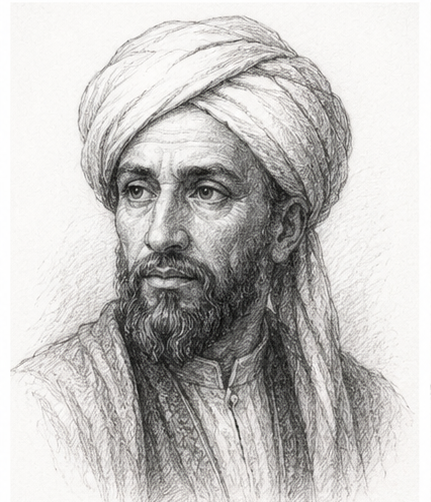
Among the great minds of science, Ibn al-Haytham occupies a special place as one of the pioneers of the scientific method.
Born around 965 CE in present-day Iraq, Ibn al-Haytham devoted his life to understanding the natural world through observation, experimentation, and reason. Living during the Islamic Golden Age, he made important contributions to mathematics, astronomy, and physics, but he is best remembered for his groundbreaking work on light and vision.
For centuries, many believed that the eyes emitted rays that allowed us to see. Ibn al-Haytham demonstrated that the opposite is true: light enters the eye from external objects. Through careful experiments, he laid the foundations of modern optics and greatly improved our understanding of lenses, reflection, and refraction.
His masterpiece, the Book of Optics, influenced scientists for hundreds of years and helped shape the development of modern science in both the Islamic world and Europe.
Perhaps even more important than his discoveries was his approach to knowledge. Ibn al-Haytham insisted that ideas should be tested by observation and experiment rather than accepted simply because authorities had taught them. In this sense, he was one of the earliest champions of the scientific method.
His influence can be seen in the work of later scientists such as Kepler, Galileo, and Newton.
Today, every camera, telescope, microscope, and pair of eyeglasses owes something to the insights of Ibn al-Haytham.
His life reminds us that science advances not through certainty, but through curiosity, careful observation, and the willingness to question our assumptions.
Few individuals have done more to illuminate the path that leads from wonder to understanding.