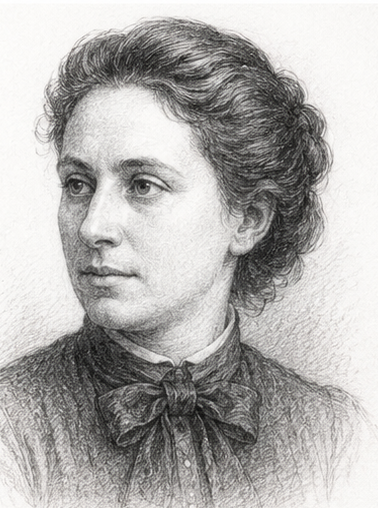
Among the great minds of the twentieth century, few have had a deeper influence on modern physics and mathematics than Emmy Noether.
Born in Germany in 1882, Noether overcame many obstacles at a time when women faced severe barriers in higher education and scientific research. Through perseverance and extraordinary talent, she became one of the most brilliant mathematicians of her generation.
Noether’s most famous achievement is a profound connection between symmetry and the laws of nature. Her remarkable theorem showed that whenever a physical system possesses a symmetry, there exists a corresponding conservation law. For example, the symmetry of time gives rise to the conservation of energy, while the symmetry of space leads to the conservation of momentum.
This insight transformed theoretical physics and became one of the cornerstones of modern science. Today, Noether’s theorem lies at the heart of quantum mechanics, relativity, and the Standard Model of particle physics.
Albert Einstein greatly admired her work and described her as one of the most important mathematical thinkers since higher education became accessible to women.
Despite her genius, Emmy Noether received far less recognition during her lifetime than many of her male colleagues. Yet her ideas have endured, and her influence continues to shape our understanding of the universe.
Her life stands as a testament to the power of intellect, determination, and the pursuit of truth.
Few people have revealed so beautifully the hidden harmony that underlies the laws of nature.
Through symmetry, Emmy Noether showed us that the universe possesses an elegance far deeper than anyone had imagined.