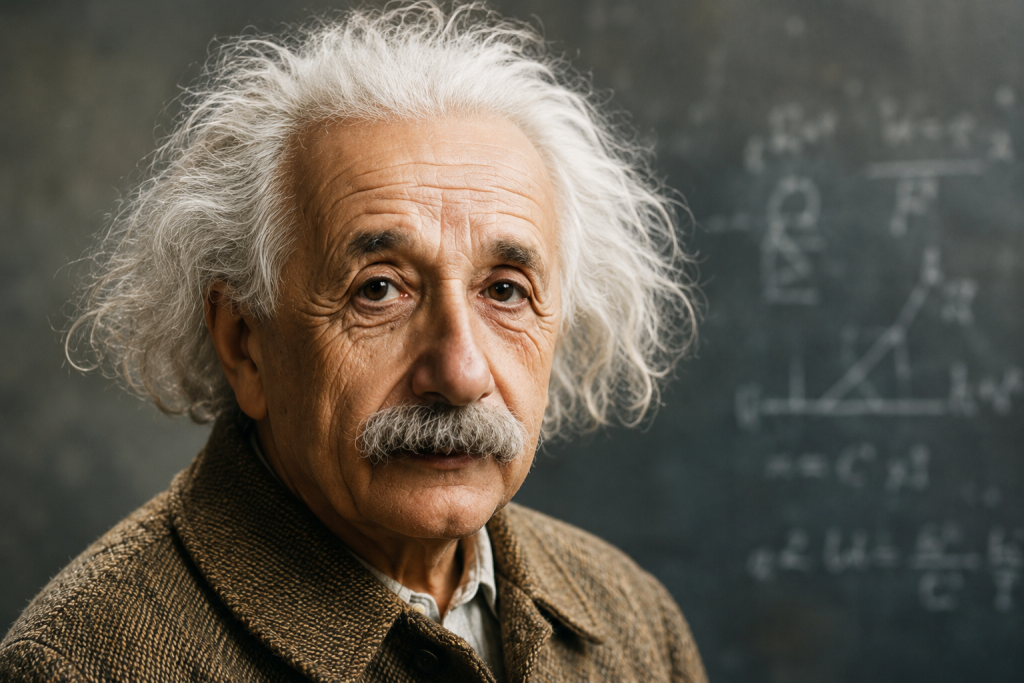
Albert Einstein transformed our understanding of space, time, gravity and the Universe itself. He showed that space and time are woven together, that gravity is not an invisible force but the curvature of spacetime, and that matter and energy are two forms of the same thing. His ideas reshaped modern physics and opened the door to black holes, gravitational waves, cosmology and much of the astronomy we explore today.
Albert Einstein was born in 1879 in the German city of Ulm. As a child he was quiet, thoughtful and endlessly curious. One of his earliest memories was being fascinated by a small magnetic compass. No matter how he turned it, the needle always pointed north. Invisible forces were clearly at work, and that mystery stayed with him throughout his life.
Contrary to popular myth, Einstein was an excellent student, particularly in mathematics and physics. What he disliked was learning by rote. He preferred to question accepted ideas and search for deeper explanations rather than simply memorising facts.
After studying at the Swiss Federal Polytechnic in Zürich, Einstein struggled to find an academic position. Instead, he accepted a job at the Swiss Patent Office in Bern. Ironically, this ordinary office became one of the most extraordinary workplaces in the history of science. While examining inventions during the day, he spent his evenings thinking about light, motion and time.
The year 1905 became known as his Annus Mirabilis—his Miracle Year. In just a few months he published four scientific papers that changed physics forever.
One explained that light behaves as tiny packets of energy, later called photons, helping to establish quantum theory.
Another demonstrated the existence of atoms through the random motion of tiny particles suspended in liquids, providing convincing evidence that atoms are real.
A third introduced the Special Theory of Relativity, showing that the laws of physics are the same for all observers moving at constant speed and that the speed of light is always constant.
The fourth produced perhaps the most famous equation in science:
E = mc²
This famous equation tells us that matter and energy are really two forms of the same thing. The letter E stands for energy, m stands for mass, and c represents the speed of light. Einstein used the letter c because it comes from the Latin word celeritas, meaning “speed” or “swiftness.” Because the speed of light is an enormous number, and it is squared (multiplied by itself), even a tiny amount of matter contains an astonishing amount of energy. This equation explains how the Sun and other stars produce the energy that makes life on Earth possible. It also explains the tremendous amount of energy released in nuclear reactions, making E = mc² one of the most important equations ever written.
Even a tiny amount of matter contains an enormous amount of energy because it is multiplied by the square of the speed of light. It explains how the Sun shines, how stars produce the elements from which we are made, and later also led to nuclear power and nuclear weapons.
Although Special Relativity transformed physics, Einstein knew it was incomplete because it did not include gravity.
For the next ten years he pursued one of the greatest intellectual challenges ever attempted. In 1915 he presented the General Theory of Relativity.
Newton had described gravity as an invisible force acting across space.
Einstein offered a completely different picture.
Mass and energy bend the fabric of spacetime itself. Planets are not pulled by an invisible force but simply follow the natural curves created by massive objects such as the Sun.
General Relativity predicted remarkable phenomena long before they were observed. Light should bend around massive objects. Time should pass more slowly in stronger gravitational fields. Black holes could exist. Gravitational waves should ripple through spacetime. Even the Universe itself could expand.
During a solar eclipse in 1919, astronomers confirmed Einstein’s prediction that starlight bends around the Sun. Overnight he became one of the world’s most famous scientists.
Einstein received the Nobel Prize in Physics in 1921—not for relativity, which was still considered controversial by some physicists, but for explaining the photoelectric effect, one of the foundations of quantum physics.
Later in life he became uneasy about some aspects of quantum mechanics. Although he accepted its extraordinary success, he believed the theory was incomplete and famously remarked:
“God does not play dice with the Universe.”
His debates with Niels Bohr remain among the greatest scientific discussions in history.
When the Nazis came to power in Germany, Einstein emigrated to the United States, where he joined the Institute for Advanced Study in Princeton. Although he signed a letter warning that Germany might develop atomic weapons, he did not work on the Manhattan Project and later became a strong advocate for peace and international cooperation.
Albert Einstein died in 1955, leaving behind a scientific legacy unlike any before him.
Legacy
Albert Einstein transformed our understanding of reality itself. His theories of Special and General Relativity changed our concepts of space, time and gravity, while his famous equation E = mc² revealed the deep connection between matter and energy. Modern cosmology, black holes, gravitational waves, GPS navigation and much of today’s astrophysics are built upon the foundations he established.
What We Can Learn
-
Imagination is often the beginning of great discoveries.
-
Never be afraid to question accepted ideas.
-
Simple questions can lead to revolutionary answers.
-
Curiosity and independent thinking are among humanity’s greatest strengths.
-
The greatest discoveries change not only science but also the way we see ourselves and the Universe.