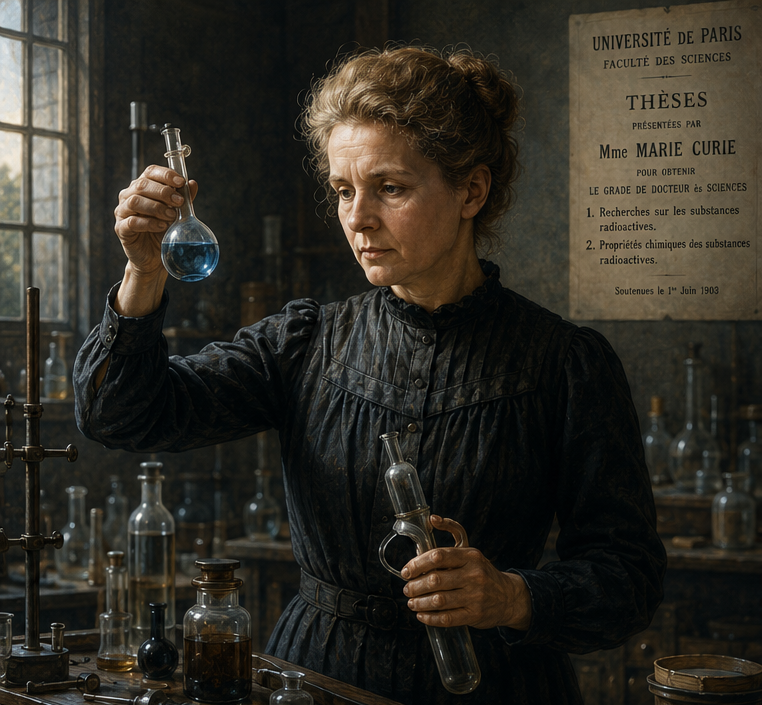
1867–1934
Note: Although photographs of Marie Curie exist, the illustration above is an artist’s interpretation created to match the visual style of the Great Minds series.
Marie Curie was one of the greatest scientists in history. Her pioneering research transformed both physics and chemistry and opened humanity’s eyes to the hidden world within the atom. Through patience, determination and extraordinary scientific ability, she helped lay the foundations of modern nuclear physics and medical radiation therapy.
Born in Warsaw, Poland, at a time when women had very limited educational opportunities, Marie Curie refused to let social barriers define her future. She moved to Paris to continue her studies at the Sorbonne, where her exceptional talent soon became evident.
Working alongside her husband, Pierre Curie, she investigated mysterious rays emitted by uranium. Their research led to the discovery of two new elements, polonium, named after her homeland, and radium, one of the most remarkable discoveries in the history of science. Marie Curie also introduced the term radioactivity, helping to establish an entirely new field of scientific research.
Her achievements earned her the Nobel Prize in Physics in 1903, shared with Pierre Curie and Henri Becquerel. Eight years later she received a second Nobel Prize, this time in Chemistry, becoming the first person ever to win Nobel Prizes in two different scientific disciplines.
Marie Curie’s dedication to science never wavered. During the First World War she helped develop mobile X-ray units that allowed doctors to diagnose injuries on the battlefield, saving countless lives. She believed that scientific knowledge should serve humanity.
Much of her work was carried out before the dangers of radiation were fully understood. Years of exposure eventually damaged her health, and she died from an illness caused by the very phenomenon she had devoted her life to studying. Her personal sacrifice became part of her scientific legacy.
Marie Curie reminds us that curiosity, perseverance and courage can overcome prejudice and open entirely new paths of discovery. She demonstrated that scientific excellence is not limited by gender, nationality or background, but by the willingness to ask difficult questions and seek honest answers.
Today she is remembered not only as one of history’s greatest scientists, but also as a symbol of determination, integrity and the belief that knowledge can improve the lives of all humanity.