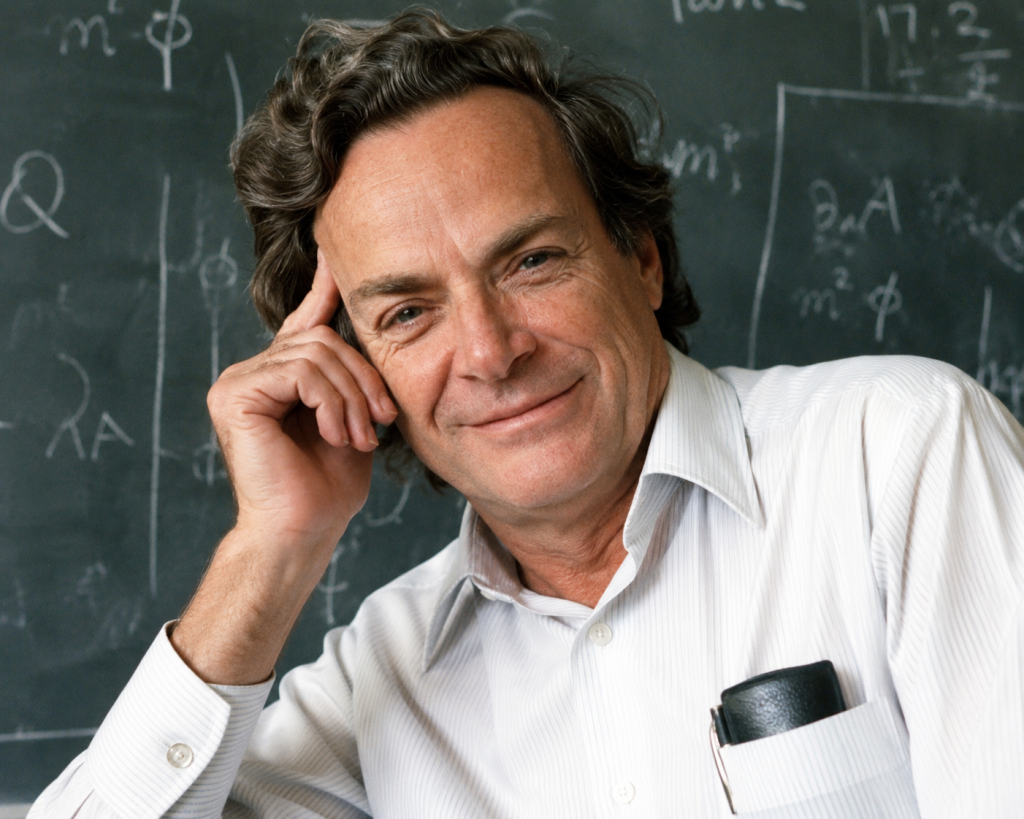
Few scientists combined brilliance, curiosity, and a sense of joy quite like Richard Feynman.
Born in New York in 1918, Feynman displayed an intense curiosity from an early age. Encouraged by his father to question everything and to think independently, he developed a lifelong fascination with understanding how nature works.
During the Second World War, Feynman joined the Manhattan Project, where he worked alongside some of the greatest physicists of his time. Although the project led to the development of the atomic bomb, Feynman later devoted much of his life to teaching and to exploring the deeper mysteries of the universe.
His greatest scientific contributions came in the field of quantum electrodynamics, a theory describing the interactions between light and matter. His work earned him the Nobel Prize in Physics in 1965.
Feynman possessed an extraordinary gift for explaining complex ideas in simple and intuitive ways. His famous diagrams revolutionized particle physics and are still used by physicists today.
Yet perhaps what made him truly remarkable was his attitude toward science.
For Feynman, understanding nature was not merely an intellectual pursuit—it was a source of delight and wonder.
He rejected arrogance and often reminded students that uncertainty is not something to be feared but embraced. He believed that science advances not through certainty, but through curiosity and the willingness to admit what we do not know.
One of his most memorable observations was:
“I would rather have questions that can’t be answered than answers that can’t be questioned.”
Feynman also loved music, art, and life itself. He played the bongo drums, enjoyed drawing, and approached the world with a childlike enthusiasm that never disappeared.
His lectures inspired generations of students, not because he made science easy, but because he conveyed the excitement of discovery.
Perhaps Richard Feynman’s greatest lesson was that learning should be joyful.
Curiosity is not a burden.
It is a privilege.
And understanding the universe is one of life’s greatest adventures.
More than anything else, Richard Feynman reminds us that science is not merely about knowledge.
It is about wonder.
Legacy
Richard Feynman transformed modern physics through his work on quantum electrodynamics and through his extraordinary ability to communicate science. His lectures and writings continue to inspire scientists and curious minds around the world.
What We Can Learn from Richard Feynman
- Never lose the joy of learning.
- Question everything.
- Accept uncertainty with humility.
- Understanding nature is one of life’s greatest pleasures.
- Curiosity and wonder belong together.