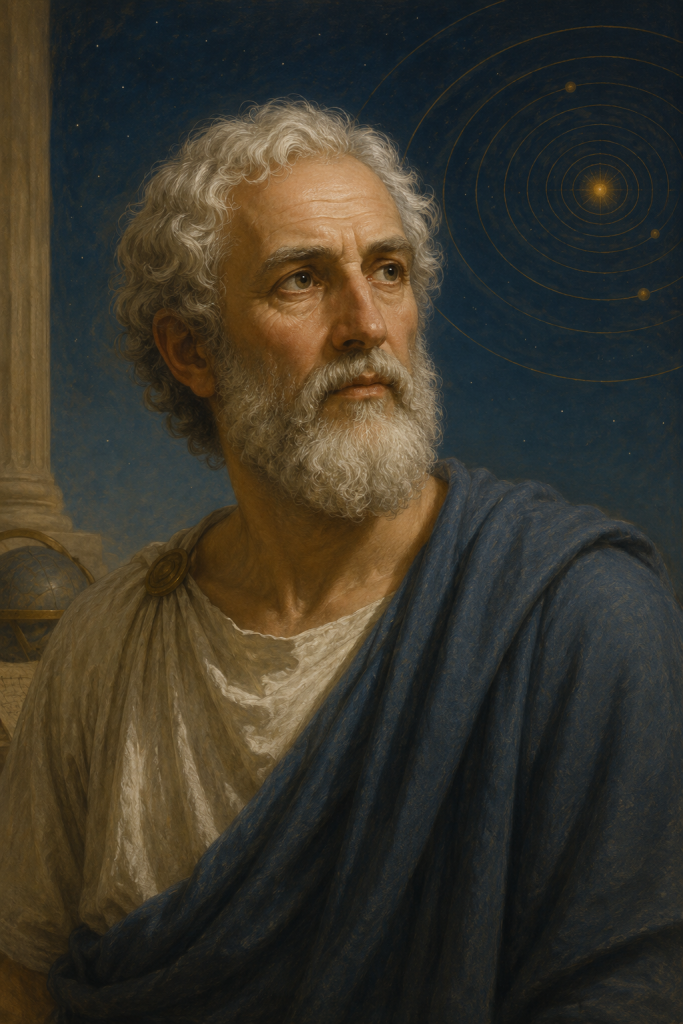
No reliable contemporary portrait of Aristarchus of Samos has survived. This illustration is a modern artist’s interpretation based on the appearance and clothing of Greek scholars of the Hellenistic period.
Few people in history have changed humanity’s view of the Universe as profoundly as Aristarchus of Samos. Nearly eighteen centuries before Nicolaus Copernicus, he proposed an astonishing idea that challenged one of the oldest beliefs in human history: perhaps the Earth was not the centre of the Universe after all.
At a time when nearly everyone believed that the Sun, Moon and stars revolved around the Earth, Aristarchus dared to imagine something entirely different. He suggested that the Sun occupied the central position and that the Earth travelled around it while also rotating on its own axis. Although his idea was rejected by most scholars of his time, it would eventually become one of the greatest scientific revolutions in history.
Aristarchus was born on the Greek island of Samos around 310 BC and later worked in Alexandria, the greatest centre of learning in the ancient world. There he studied mathematics and astronomy, building upon the logical foundations established by Euclid and inspired by generations of Greek philosophers and scientists who sought to understand nature through reason rather than mythology.
Unlike many ancient thinkers, Aristarchus believed that observation and mathematics should work together. By carefully studying the changing positions of the Sun and Moon, he attempted to estimate their sizes and distances from the Earth. Although his numerical values were not accurate by modern standards, his methods were remarkably advanced for his time and represented one of the earliest scientific attempts to measure the cosmos.
His greatest achievement, however, was not a measurement but an idea.
Aristarchus realized that the Sun appeared far larger and more important than the Earth. From this observation he proposed that it made more sense for the smaller Earth to travel around the much larger Sun than for the entire Universe to revolve around our planet every day. It was a bold conclusion that challenged centuries of accepted belief.
Unfortunately, his contemporaries were not ready to accept such a radical proposal. The geocentric model, in which the Earth occupied the centre of the Universe, remained dominant for nearly two thousand years, largely through the influence of Claudius Ptolemy. Aristarchus’ heliocentric model was almost forgotten.
Yet great ideas do not disappear simply because they are ignored.
Nearly eighteen centuries later, Nicolaus Copernicus independently arrived at the same conclusion and placed the Sun once again at the centre of the planetary system. His work began the Scientific Revolution and forever changed humanity’s understanding of the cosmos. Today, Aristarchus is recognized as the first known astronomer to imagine the Solar System in a form remarkably close to the one we know today.
The courage of Aristarchus lies not only in his calculations but in his willingness to question what everyone else believed. He reminds us that scientific progress often begins with a single person asking a question that others have never dared to ask.
His story teaches another important lesson. Being correct does not always mean being accepted. Sometimes the world needs centuries before it is ready for a new idea.
Although no telescope existed in his lifetime, Aristarchus looked beyond appearances and imagined a Universe far greater than anyone around him could see. His vision marked one of the earliest and most remarkable examples of scientific imagination.
Today, every spacecraft that explores the Solar System, every planet whose orbit we calculate and every student who learns that the Earth revolves around the Sun owes something to the courage of a Greek astronomer who simply dared to think differently.
More than two thousand years later, Aristarchus still reminds us that progress begins when curiosity becomes stronger than tradition.
Legacy
Aristarchus of Samos was the first known astronomer to propose a Sun-centred model of the Solar System. Although his revolutionary idea was rejected during his lifetime, it anticipated the work of Copernicus by almost eighteen centuries and became one of the earliest milestones in humanity’s understanding of the Universe.
What We Can Learn
- Great discoveries often begin by questioning accepted beliefs.
- A correct idea may take generations to be recognized.
- Observation and mathematics together reveal the workings of nature.
- Scientific courage means following evidence rather than tradition.
- One curious mind can change humanity’s view of the Universe.
Aristarchus of Samos – Great Minds →
→