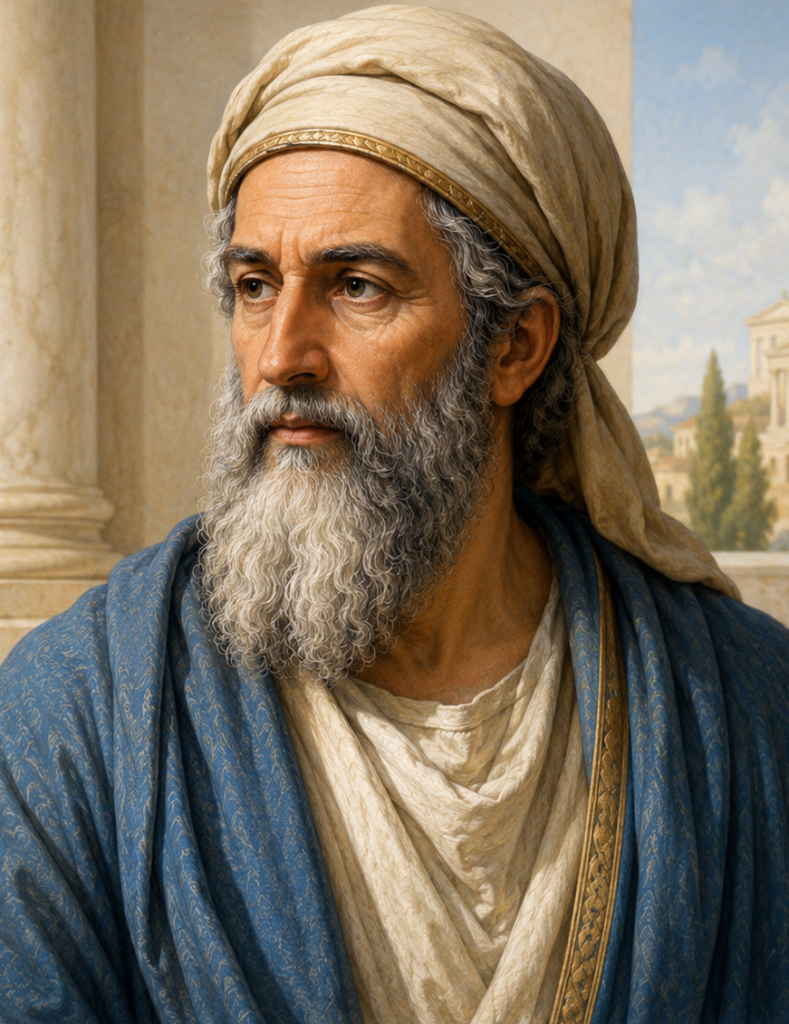
Few individuals have shaped human thought as profoundly as Euclid. More than two thousand years after his death, his ideas continue to form the foundation of geometry and mathematical reasoning. While little is known about the man himself, the work he left behind became one of the most influential books ever written and has guided scientists, engineers, architects and students for centuries.
Euclid did more than organize the mathematics of his time. He demonstrated that knowledge could be built step by step from simple principles, using logic rather than opinion. This method of careful reasoning became one of the cornerstones of mathematics and, ultimately, of modern science itself.
Every student who studies geometry today is, in one way or another, following a path that began with Euclid. His work reminds us that great discoveries are not always about finding something new. Sometimes they come from bringing order, clarity and reason to what was already known.
Although little is known about Euclid’s personal life, historians believe he lived and taught in Alexandria, Egypt, around 300 BC during the reign of Ptolemy I. Alexandria was one of the greatest centres of learning in the ancient world, home to the famous Library of Alexandria, where scholars gathered to exchange ideas from across the Mediterranean. It was within this remarkable intellectual environment that Euclid taught mathematics and produced the work for which he would become immortal.
His greatest achievement was Elements, a collection of thirteen books that organized the mathematical knowledge of the ancient world into a single logical system. Instead of presenting mathematics as a collection of disconnected facts, Euclid began with a handful of definitions, common notions and simple axioms. From these foundations he constructed hundreds of propositions, each one proved with careful reasoning.
This approach transformed mathematics forever. Euclid showed that knowledge should not depend upon authority or opinion but upon logic and proof. Every conclusion had to follow naturally from what came before. This method became the model not only for mathematics but also for scientific thinking itself.
For more than two thousand years, Elements remained the world’s most influential mathematics textbook. It was studied by students, philosophers, architects, engineers and scientists across Europe, the Middle East and Asia. Few books in history, apart from religious texts, have been copied, translated and studied by so many generations.
Euclid’s influence reaches far beyond the classroom. Geometry lies behind the design of buildings, bridges and monuments. It guides engineers constructing aircraft and spacecraft. It helps astronomers measure distances across the heavens and enables computer scientists to create modern graphics and navigation systems. Even today, countless technologies depend upon mathematical ideas whose foundations can be traced back to Euclid.
Perhaps Euclid’s greatest contribution was not a single theorem but a way of thinking. He taught that complex problems can be solved by beginning with simple truths and following reason patiently, step by step. This disciplined search for certainty became one of the defining characteristics of mathematics and science.
Although empires have risen and fallen since Euclid lived, his ideas have endured almost unchanged. His own life remains largely hidden from history, yet his work continues to shape education throughout the world. Every generation of scientists, mathematicians and engineers has, knowingly or not, stood upon the logical foundations he established.
Few individuals leave behind a legacy that lasts for centuries.
Euclid’s has endured for more than two millennia.
His work reminds us that knowledge grows strongest when it is built upon clear thinking, careful reasoning and an unwavering search for truth.
Legacy
Euclid transformed mathematics by organizing it into a logical system based on definitions, axioms and proof. His masterpiece, Elements, became the foundation of geometry and one of the most influential books ever written. More than two thousand years later, his method of logical reasoning continues to shape mathematics, science, engineering and education throughout the world.
What We Can Learn
Great discoveries often begin by organizing knowledge rather than creating something entirely new.
Clear thinking and logical reasoning are among humanity’s most powerful tools.
Strong foundations make lasting achievements possible.
Knowledge grows when each generation builds upon the work of those who came before.
The pursuit of truth requires patience, discipline and a willingness to follow evidence wherever it leads.