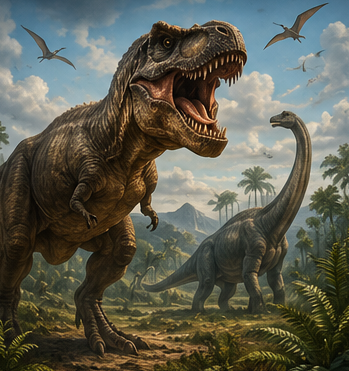
For more than 160 million years, dinosaurs dominated the Earth.
Appearing about 230 million years ago, these remarkable creatures evolved into an astonishing variety of forms. Some were small and agile, while others grew to enormous sizes and became the largest land animals ever to exist.
Dinosaurs inhabited a world very different from our own. Vast forests covered much of the planet, and the continents were arranged differently than they are today. During this long era, dinosaurs adapted to a wide range of environments and occupied many ecological roles.
Contrary to popular belief, not all dinosaurs were giant predators. Many were peaceful herbivores, while others were swift hunters. Some species were no larger than chickens, while giants such as Argentinosaurus stretched more than thirty meters in length.
Modern discoveries have revealed that many dinosaurs possessed feathers and that birds are, in fact, their living descendants. In this sense, dinosaurs never completely disappeared. Every sparrow, eagle, and penguin alive today carries a part of their ancient legacy.
About 66 million years ago, a large asteroid struck the Earth near present-day Mexico. The impact caused devastating environmental changes that led to the extinction of the non-avian dinosaurs, along with many other species.
Yet their disappearance opened the door for mammals to flourish. Over millions of years, mammals diversified and eventually gave rise to human beings.
Dinosaurs remind us that life on Earth has undergone extraordinary transformations and that entire worlds have come and gone long before our own.
Their story is one of success, adaptation, and ultimately extinction.
And perhaps that is why they continue to fascinate us.
They are a reminder that the Earth we inhabit today is only one chapter in a much larger story—a story that stretches back hundreds of millions of years and connects us to a distant and remarkable past.