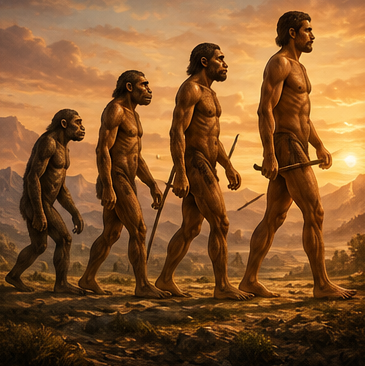
Human beings are a part of nature and share a long evolutionary history with all other forms of life on Earth.
Our story began millions of years ago in Africa, where the earliest ancestors of modern humans evolved from primates that lived in forests and grasslands. Over time, various species of early humans appeared, each possessing unique characteristics and adaptations.
Among these were Australopithecus, Homo habilis, Homo erectus, and the Neanderthals. These ancient relatives learned to walk upright, use tools, control fire, and cooperate in increasingly complex ways.
Modern humans, known as Homo sapiens, emerged in Africa about 300,000 years ago. Possessing remarkable intelligence and the ability to communicate through language, they gradually spread across the globe and adapted to a wide variety of environments.
Advances in genetics have revealed that all human beings belong to a single species and share common ancestors. Despite differences in appearance and culture, humanity is one family.
Our bodies still bear traces of our evolutionary past. The structure of our skeleton, our DNA, and even certain behaviors reflect our connection to earlier forms of life and to the animal kingdom itself.
Yet human evolution is not merely a story of biology. It is also a story of imagination, creativity, and curiosity.
Over thousands of years, humans developed agriculture, civilizations, science, art, and technology. We built cities, explored the oceans, and eventually ventured into space.
Perhaps the most extraordinary product of evolution is the human mind itself—a mind capable of reflecting on its origins and asking questions about the universe.
In this sense, we are more than observers of the cosmos.
We are one of the ways in which the universe has become aware of itself.
From humble beginnings on the African savannah arose a species capable of looking toward the stars and wondering what lies beyond.