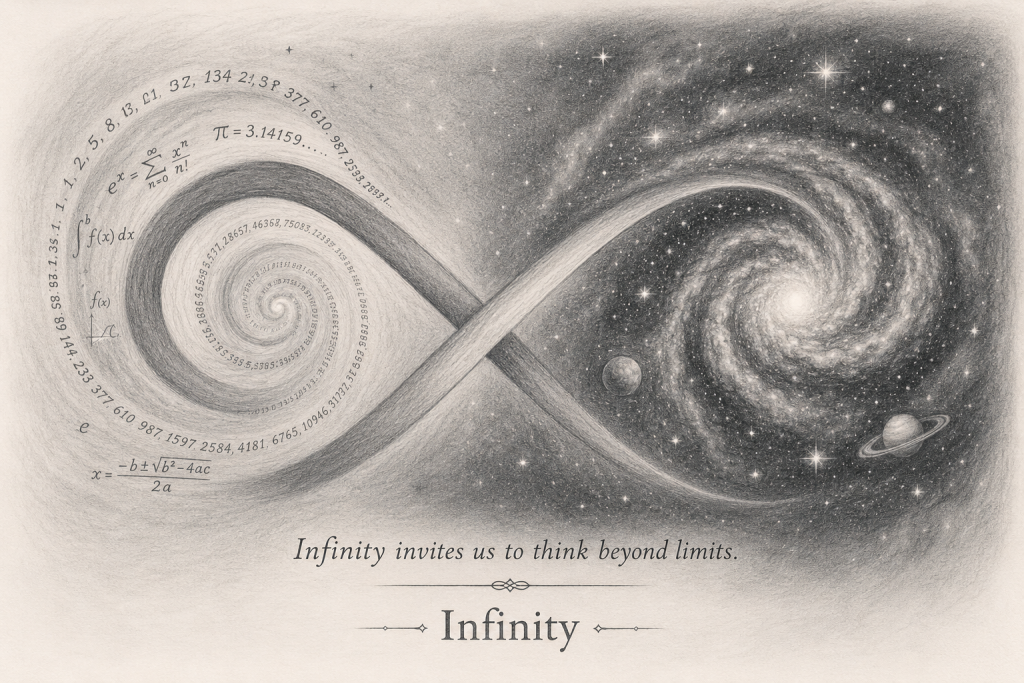
From the earliest civilizations to modern mathematics, infinity has fascinated and puzzled the human mind.
We encounter the idea naturally when we look at the night sky, imagine the endless sequence of numbers, or contemplate the vastness of space and time. Yet despite its familiarity, infinity remains one of the strangest concepts ever discovered.
Unlike ordinary numbers, infinity is not a quantity that can be reached.
No matter how large a number becomes, one can always add one more. In this sense, numbers continue without end.
For centuries, philosophers and mathematicians struggled with the idea of the infinite.
Aristotle believed that infinity existed only as a process of endless continuation rather than as a completed object. Later thinkers, including Galileo, encountered paradoxes that revealed how difficult infinity can be to understand.
In the nineteenth century, the German mathematician Georg Cantor transformed our understanding of infinity.
Cantor showed that not all infinities are equal.
The set of whole numbers is infinite.
So is the set of even numbers.
Surprisingly, these two sets contain the same number of elements, even though the even numbers form only a part of the whole numbers.
Even more astonishing, Cantor demonstrated that some infinities are larger than others.
The set of real numbers contains a greater infinity than the set of whole numbers. Thus, infinity itself possesses a rich and unexpected structure.
These discoveries shocked many mathematicians of the time.
Some considered Cantor’s ideas too strange to be accepted.
Yet over time, his work became one of the foundations of modern mathematics.
Infinity also appears throughout physics and cosmology.
The universe may be infinite in extent.
Time itself might continue forever.
Black holes contain regions where our present theories predict infinite density.
Such infinities often signal that our understanding is incomplete and that deeper theories are needed.
Despite centuries of study, infinity continues to challenge intuition.
It reminds us that the universe is not always constrained by everyday experience.
Some ideas are so profound that they force us to expand the limits of human thought itself.
Perhaps this is why infinity has inspired mathematicians, philosophers, theologians, and scientists for thousands of years.
For infinity represents both mystery and possibility.
It points beyond the familiar and invites us to contemplate realities that may forever exceed our understanding.
And perhaps that is one of the most beautiful lessons mathematics can offer.
The human mind, though finite, possesses the remarkable ability to explore the infinite.
And in doing so, it reveals something extraordinary about both the universe and ourselves.
Key Ideas
- Infinity is not an ordinary number.
- Numbers continue endlessly.
- Georg Cantor showed that different sizes of infinity exist.
- Infinity appears in mathematics, physics, and cosmology.
- Infinite concepts often challenge human intuition.
What We Can Learn
- Some ideas transcend everyday experience.
- Mathematics expands the boundaries of thought.
- Mystery and beauty often go together.
- Human beings are capable of exploring profound concepts.
- Curiosity allows us to approach the infinite.