Among all the ideas humanity has discovered, few are as simple—and as revolutionary—as zero.
Today we take it for granted. We use it in arithmetic, science, computers, and everyday life without giving it much thought. Yet for most of human history, the concept of nothing as a number did not exist.
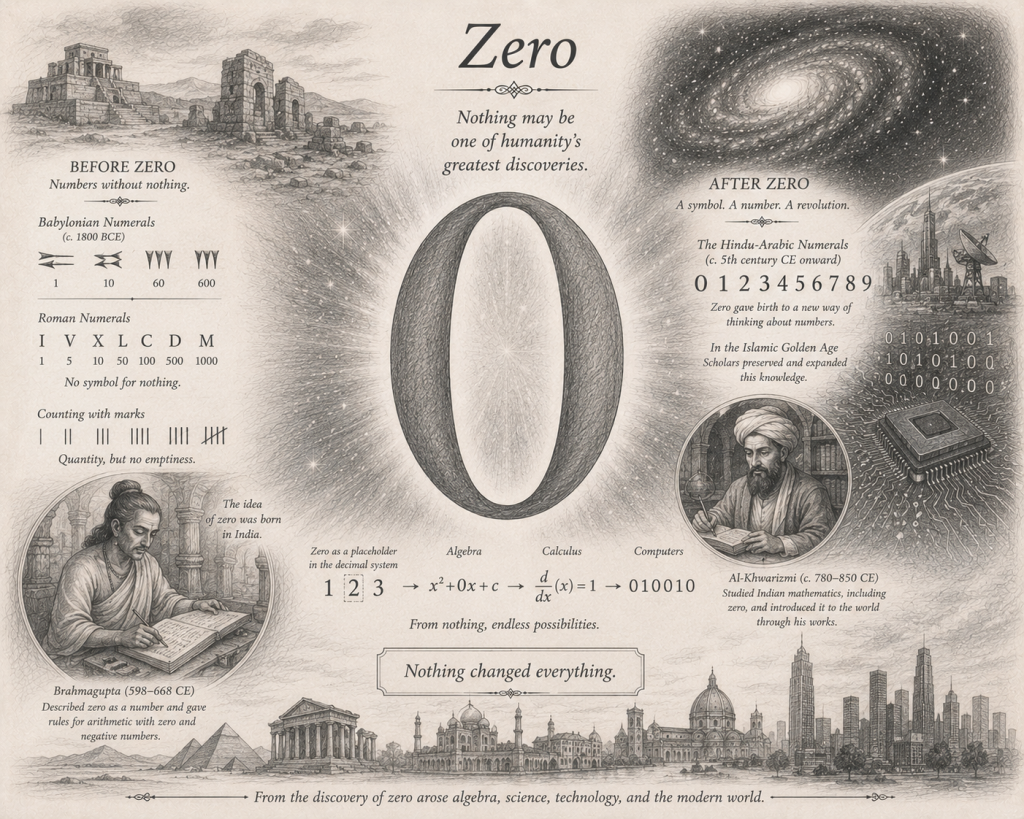
Ancient civilizations such as the Egyptians, Greeks, and Romans developed impressive mathematical systems, but none possessed a true symbol for zero. Roman numerals, for example, have no way of representing nothing.
The breakthrough came in India. Around the seventh century, the mathematician Brahmagupta treated zero not merely as a placeholder but as a number in its own right. He described rules for calculations involving zero and negative numbers, laying foundations that would eventually transform mathematics.
These ideas spread to the Islamic world, where scholars such as Al-Khwarizmi preserved, expanded, and transmitted them. Through Arabic texts, the Hindu-Arabic numeral system eventually reached Europe and became the foundation of modern mathematics.
The importance of zero is difficult to overstate.
Without zero, there would be no algebra, no calculus, no modern science, and no computers. Every digital device around us ultimately depends on combinations of zeros and ones.
What appears to be nothing turned out to be one of humanity’s greatest discoveries.
Perhaps this teaches us an important lesson. Sometimes the simplest ideas are the most powerful.
From nothing came endless possibilities.