Among the many numbers discovered by humanity, none is more famous than pi.
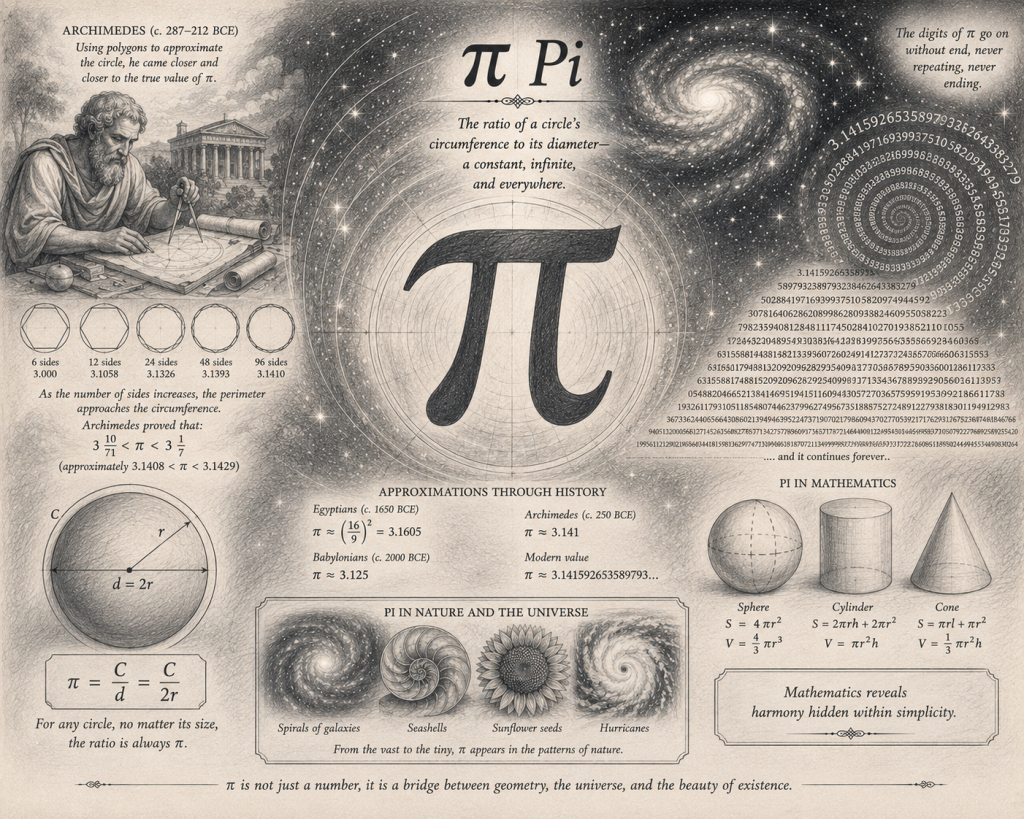
Represented by the Greek letter π, pi is the ratio of a circle’s circumference to its diameter. No matter how large or small a circle may be, this ratio is always the same.
Its value begins as:
3.1415926535…
and continues forever without repeating.
People have known about pi for thousands of years. Ancient Egyptians and Babylonians used approximations, but it was the Greek mathematician Archimedes who made one of the first systematic attempts to calculate its value. By using polygons with increasing numbers of sides, he showed that pi lay between two very close limits.
Today, computers have calculated trillions of digits of pi, yet its decimal expansion never ends.
Pi appears far beyond circles. It is found in geometry, waves, probability, engineering, astronomy, and even quantum physics. It helps describe the motion of planets, the vibrations of sound, and the behavior of light.
Perhaps most remarkably, pi appears throughout nature. From ripples on water to spiral galaxies, from hurricanes to the structure of atoms, this mysterious number is woven into the fabric of the universe.
The existence of pi reminds us that beneath the apparent complexity of nature lies a profound and elegant order.
Mathematics reveals harmony hidden within simplicity.
Pi is not merely a number. It is one of the many ways in which the universe speaks to us.