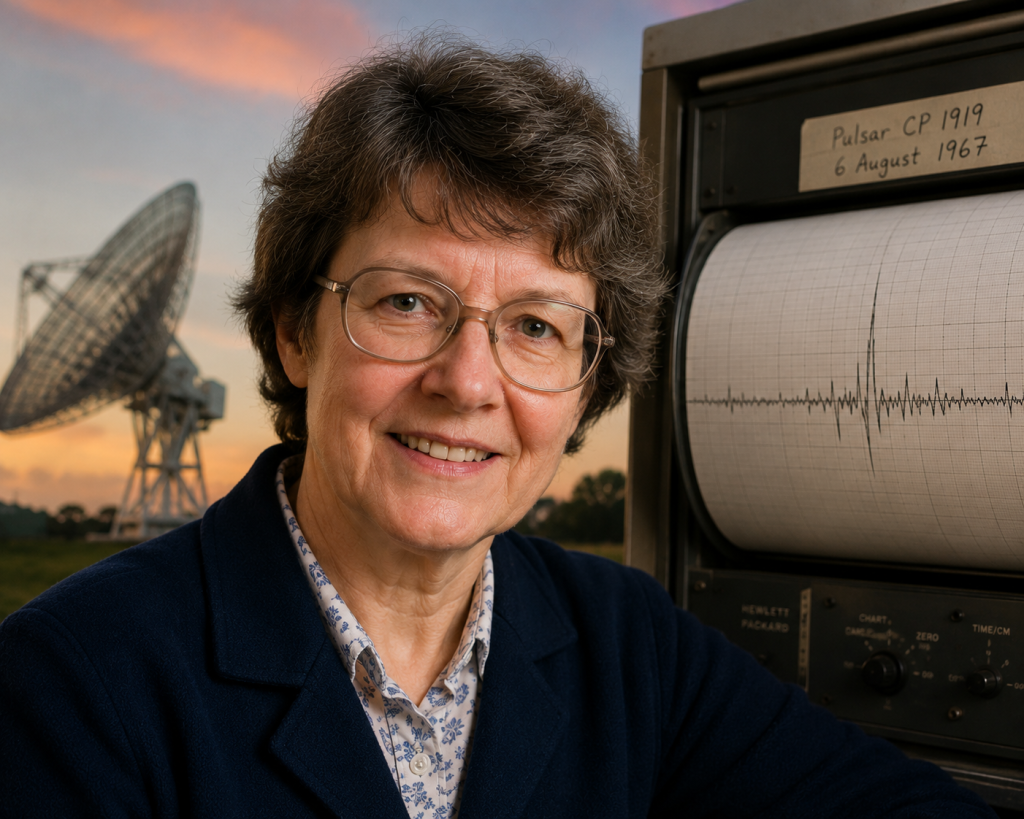
Jocelyn Bell Burnell transformed astronomy by discovering pulsars while still a graduate student. Her careful observations revealed an entirely new class of celestial objects and opened a new window on the Universe. Her story reminds us that great discoveries often begin with someone who notices what everyone else overlooks.
Susan Jocelyn Bell was born in 1943 in Belfast, Northern Ireland. From an early age she was fascinated by science and encouraged by her parents to ask questions and explore the natural world. At a time when relatively few women studied physics, she chose to follow her curiosity wherever it led.
After studying physics at the University of Glasgow, she began doctoral research at the University of Cambridge under the supervision of Antony Hewish. One of her first tasks was to help build a large radio telescope designed to study distant quasars. It was demanding physical work, involving thousands of wooden posts and kilometres of wire spread across several acres.
Once the telescope became operational, Bell Burnell carefully examined the enormous amounts of data it produced. Day after day she studied long rolls of chart paper, searching for anything unusual.
Then she noticed something strange.
A tiny signal appeared at exactly the same position in the sky every day.
It lasted only a fraction of a second.
Most people would probably have dismissed it as interference or an instrumental fault.
Bell Burnell did not.
She continued investigating until she realised that the signal repeated with astonishing regularity every 1.3 seconds.
At first, no one knew what could produce such precise radio pulses. Half jokingly, the research team labelled the source LGM-1—short for “Little Green Men”—because they briefly considered whether it might be an artificial signal.
The real explanation proved even more remarkable.
The signal came from a rapidly rotating neutron star, the collapsed core of a massive star that had exploded as a supernova. As it spins, beams of radio waves sweep across space like the beam from a lighthouse. Each time one of those beams points towards Earth, we detect a pulse.
A new type of object had been discovered.
Today we call these remarkable objects pulsars.
The discovery revolutionised astronomy. Pulsars became powerful laboratories for studying gravity, magnetic fields, neutron stars and even Einstein’s General Theory of Relativity. They remain among the most important objects in modern astrophysics.
In 1974, the Nobel Prize in Physics was awarded to Antony Hewish and Martin Ryle for the discovery of pulsars. Bell Burnell was not included.
Many scientists believed that she should have shared the prize, since it was she who first recognised the unusual signal and insisted that it was real.
Remarkably, Bell Burnell never expressed bitterness. Throughout her career she remained generous, humble and deeply committed to science. She became an inspiring advocate for women and underrepresented groups in physics and has devoted much of her later life to encouraging young scientists.
Her quiet dignity has earned admiration throughout the scientific world.
Legacy
Jocelyn Bell Burnell discovered pulsars, opening an entirely new field of astronomy. Her careful observations transformed our understanding of neutron stars and provided powerful new tests of Einstein’s theory of gravity. Beyond her scientific achievements, she became a role model for integrity, humility and perseverance, inspiring countless young people to pursue careers in science.
What We Can Learn
Great discoveries often begin with careful observation.
Never ignore something simply because it seems unexpected.
Recognition is valuable, but integrity is even more important.
Curiosity, patience and perseverance are essential qualities in science.
Character is remembered as long as discovery.