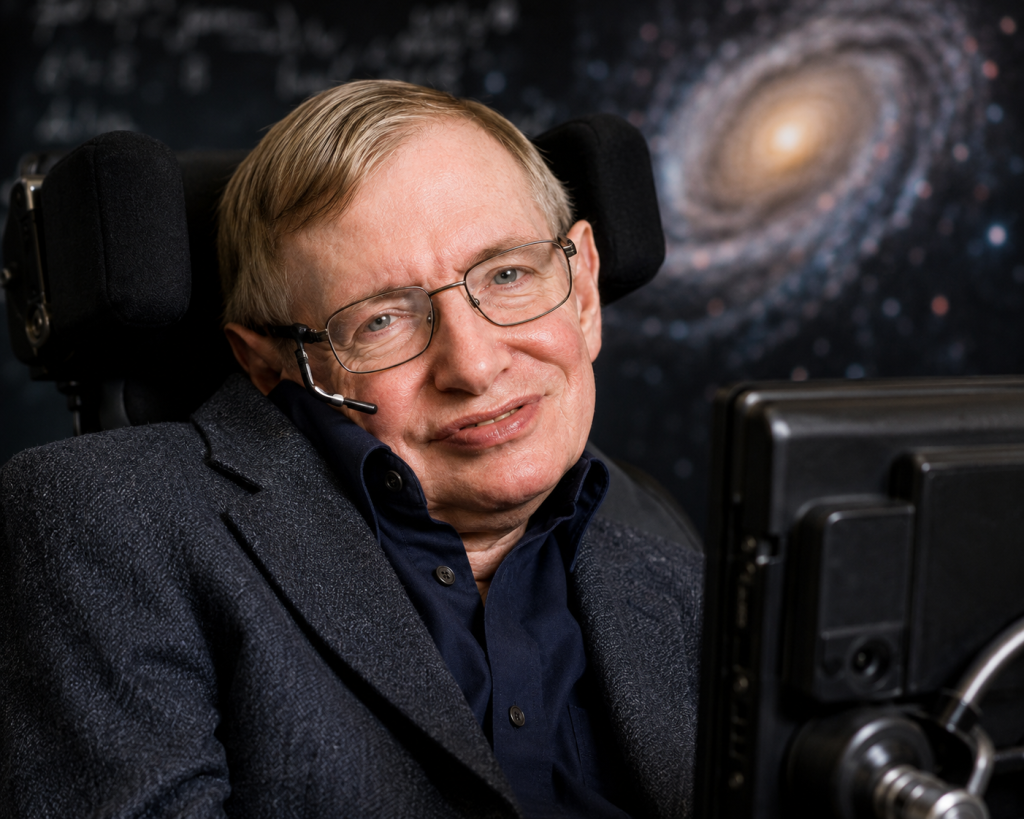
Stephen Hawking transformed our understanding of black holes and the origins of the Universe. With brilliant ideas, extraordinary determination and a unique sense of humour, he showed that even the darkest objects in the cosmos obey the laws of quantum physics. His greatest discovery revealed that black holes are not completely black—they slowly radiate energy.
Stephen William Hawking was born in 1942 in Oxford, England, during the Second World War. From an early age he displayed an exceptional curiosity about how the Universe works. Although not always the top student in school, his classmates recognised his remarkable intelligence and nicknamed him “Einstein.”
Hawking studied physics at the University of Oxford before continuing his research in cosmology at the University of Cambridge. As a young researcher he became fascinated by the biggest questions in science: How did the Universe begin? What happens inside a black hole? Can Einstein’s theory of gravity be united with quantum mechanics?
At the age of twenty-one, Hawking was diagnosed with amyotrophic lateral sclerosis (ALS), a progressive disease that gradually weakened his muscles. Doctors expected him to live only a few years.
Instead, he lived for more than half a century.
Although his body gradually lost the ability to move and speak, his mind remained as active as ever. Using a computer and a speech synthesiser, Hawking continued his research, wrote books and inspired millions of people around the world.
During the 1970s Hawking made one of the most astonishing discoveries in theoretical physics.
According to Einstein’s General Theory of Relativity, nothing can escape from a black hole—not even light.
But Hawking realised that when quantum mechanics is taken into account, the picture changes.
Tiny particles are constantly appearing and disappearing in empty space. Near the event horizon of a black hole, one of these particles can fall into the black hole while the other escapes into space.
To a distant observer, the black hole appears to emit radiation.
This became known as Hawking Radiation.
Because the escaping particles carry away energy, a black hole slowly loses mass. Over unimaginable periods of time, it may eventually disappear completely.
The discovery changed our understanding of black holes forever and became one of the first important links between Einstein’s theory of gravity and quantum mechanics.
Hawking also made important contributions to cosmology. Together with Roger Penrose, he showed that Einstein’s equations imply that the Universe must have begun from an extremely dense state—a singularity. Later, he proposed the no-boundary hypothesis, suggesting that the Universe may have no edge in time, just as the Earth has no edge on its surface.
In 1988 Hawking published A Brief History of Time. The book became an international bestseller, introducing millions of readers to black holes, the Big Bang and the nature of time. It demonstrated that even the most profound scientific ideas could be explained in language that ordinary people could understand.
Despite worldwide fame, Hawking never lost his sense of humour. He often joked about his condition and encouraged people never to stop asking questions.
Stephen Hawking died in 2018, leaving behind a scientific legacy that continues to inspire researchers and the general public alike.
Legacy
Stephen Hawking transformed our understanding of black holes by showing that they slowly emit radiation and are not completely black. His work brought together quantum mechanics, gravity and cosmology in ways that continue to influence modern theoretical physics. Beyond his scientific discoveries, he inspired millions through his books, lectures and remarkable determination, proving that the power of the human mind can overcome extraordinary challenges.
What We Can Learn
The mind can remain free even when the body is limited.
Never stop asking the biggest questions.
Science advances when we dare to challenge accepted ideas.
Courage, perseverance and curiosity can overcome enormous obstacles.
The greatest limitations are often those we place on ourselves.