1201–1274
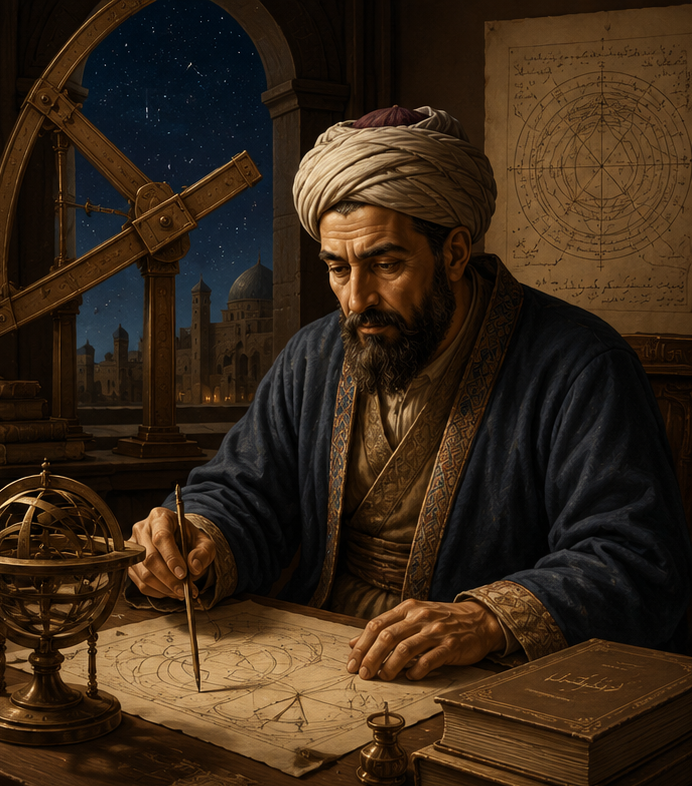
Note: No authentic portrait of Nasir al-Din al-Tusi exists. The illustration above is an artist’s interpretation based on historical descriptions and the period in which he lived.
Nasir al-Din al-Tusi was one of the greatest astronomers, mathematicians and philosophers of the medieval world. Living during the Islamic Golden Age, he helped preserve and expand scientific knowledge at a time when astronomy was becoming increasingly precise and mathematical.
His greatest achievement was the establishment of the Maragheh Observatory in present-day Iran, one of the most advanced scientific institutions of the thirteenth century. Equipped with impressive astronomical instruments and supported by a community of scholars, the observatory became a centre for careful observation and scientific research.
Al-Tusi believed that understanding the heavens required both accurate observations and rigorous mathematics. His work greatly improved astronomical models and laid important foundations for future generations of astronomers.
Among his most famous contributions is the Tusi Couple, an ingenious geometric construction that transforms combinations of circular motion into straight-line motion. Although elegant in its mathematical simplicity, this idea solved important problems in planetary astronomy and later influenced astronomical models developed in Europe.
Al-Tusi also made significant contributions to trigonometry, helping establish it as an independent branch of mathematics rather than simply a tool of astronomy. His books were studied for centuries and became important references for scholars throughout the Islamic world and beyond.
Many historians believe that ideas developed at the Maragheh Observatory eventually found their way into European astronomy and influenced later scientists, including Nicolaus Copernicus. While historians continue to study exactly how this knowledge travelled, there is little doubt that Al-Tusi formed an important link in the long chain of scientific discovery.
Nasir al-Din al-Tusi reminds us that scientific progress is rarely the work of a single individual or civilization. Knowledge grows as each generation builds upon the discoveries of those who came before, carrying humanity’s understanding a little further.
Today he is remembered as one of the greatest scientific minds of the medieval world, whose work helped bridge the achievements of the ancient astronomers and the scientific revolution that transformed our understanding of the Universe.