The universe began in simplicity.
In the aftermath of the Big Bang, matter consisted almost entirely of hydrogen and helium, with only tiny amounts of lithium. Yet the world around us is rich in complexity. Carbon forms the basis of life. Oxygen fills our atmosphere. Iron flows through our blood, and gold adorns jewelry.
Where did these elements come from?
The answer lies in the lives and deaths of stars.
Throughout most of their lives, stars generate energy by fusing hydrogen into helium. As stars evolve, heavier elements are gradually produced within their interiors. In massive stars, this process continues through a series of stages, creating carbon, oxygen, neon, silicon, and eventually iron.
Iron marks a turning point.
Unlike lighter elements, iron does not release energy when fused. Once a massive star develops an iron core, its source of energy begins to fail. Gravity takes over, causing the core to collapse in a matter of seconds.
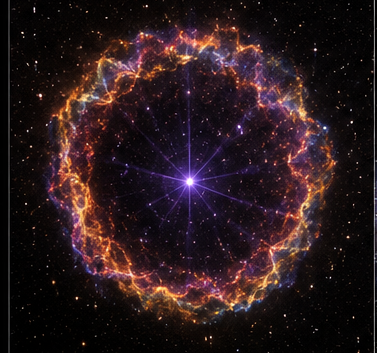
The result is one of the most violent events in the universe—a supernova explosion.
During this brief but spectacular event, enormous amounts of energy are released. Temperatures and pressures become so extreme that many of the heavier elements are created. Gold, silver, uranium, and numerous other elements owe their existence to these cataclysmic explosions and to collisions between neutron stars.
The explosion also scatters these newly formed elements into space.
Over time, the enriched material becomes part of new generations of stars and planets. Around some of these stars, worlds capable of supporting life may emerge.
Our own Solar System formed from such recycled material approximately 4.6 billion years ago.
Every atom of calcium in our bones, every atom of iron in our blood, and much of the oxygen we breathe were forged in ancient stars that lived and died long before the Sun was born.
In this sense, we are connected to the cosmos in a very intimate way.
The atoms that make up our bodies have traveled through space for billions of years. They have been part of stars, nebulae, and interstellar clouds before becoming part of us.
Perhaps that is one of the most remarkable discoveries of modern astronomy.
We are not merely observers of the universe.
We are one of its products.
And when we look up at the stars, we are, in a very real sense, looking toward our own origins.
For we are, quite literally, children of stardust.